


I admit to being a curmudgeon when it comes to inflation. I believe inflation is a monetary phenomenon. While we can debate what constitutes the definition of money, by any measure the Federal Reserve created a lot of it in the past year.
Money growth has slowed dramatically this year. M2 growth has decelerated to a 2.4 percent annualized rate in the three months ended March from an 11.5 percent pace in the three months ended November. I'm not sure why M2 has slowed, but I'm watching it like a hawk for clues about the future.
I've also been watching like a hawk for the pass-through of earlier monetary stimulus into the price indexes. On that score, there was no sign of it in Tuesday's report on consumer prices for March. Despite a 3.8 percent increase in energy prices, the CPI rose a smaller-than-expected 0.3 percent. The core index, which excludes food and energy, rose a tame 0.1 percent, paring the year over year increase to a 20-month low of 2.4 percent.
Is this the long-awaited break in inflation economists have been predicting? On first glance, the CPI report had me baffled.
Going straight to shelter, the largest component accounting for 31.5 percent of the index, the parts didn't seem to add up to the whole. Shelter costs rose 0.1 percent last month, but 90 percent of the shelter index -- owners' equivalent rent and residential rent -- rose 0.3 percent or more. How does this compute?
"It's the lack of precision because of rounding," says Pat Jackman, senior economist at the Bureau of Labor Statistics, which produces the CPI. Jackman agreed with me that it "doesn't make much sense when you look at it." Carried out to several decimal places, the indexes for OER and RR rose 0.25 percent and 0.33 percent respectively, lower than the 0.3 percent and 0.4 percent increases calculated from the rounded indexes in the report.
"Because of the rounding, it appears that the indexes [OER and RR] are higher than they are when they feed into the shelter index," Jackman says.
Both OER and RR are still rising at a 4 percent three-month annualized rate. That's well above the overall inflation rate but down from cycle peaks. It may well be that the softness in the residential rental market in major metropolitan areas such as New York, Boston and San Francisco is starting to show up in the CPI.
(Both OER and RR are derived from a survey of rental units.) Not everyone is convinced.
"I'm having a hard time with the core CPI," says Joe Carson, an economist at Alliance Capital Management.
Carson added up the major components of the core CPI -- OER, RR, home insurance, apparel, new and used vehicles, medical care, education, recreation, communications, and personal care -- and found that 85 percent of the core CPI went up faster, albeit barely, in March than in February. "Yet the [monthly increase in the] core CPI went from 0.3 percent to 0.1 percent. It means that there's a lot of noise in the remaining 20 percent of the core index."
Some of that noise emanated from tobacco prices, which fell 3.5 percent in March following a 3.8 percent increase in February -- a 7 percent swing in 1 percent of the index.
"I don't see any change in the trend," Carson says, citing the Cleveland Fed's median CPI, which rose 0.3 percent in March. "Key drivers of the CPI are rents, education and medical care, and those components are still rising at a 3.5 to 4 percent annual rate."
What was a distinct break from the trend was the 0.1 percent increase in services prices, both with and without energy, in March. It was the smallest increase in core services since June 1999.
Prices of labor-intensive services tend to be "sticky," and there isn't a whole lot of slack in the labor market. If the March increase is the start of a deceleration in core services, it will be a change in the trend.
One would have thought the unexpectedly good inflation news would be perceived as giving the Fed some breathing room. Yet the implied yield on the fed funds futures and eurodollar futures rose on the day.
Clearly the strength in industrial production, along with a broad stock market rally, unnerved the Treasury market, which is always looking for someone or something to tell it what to do.
For those like myself who think the Fed will be forced to tighten more, not less, and who don't expect core inflation to decelerate, Tuesday's CPI report was sobering. (Color me impressed but doubtful.) No doubt Fed chief Alan Greenspan will seize on it when he testifies to the Joint Economic Committee of Congress and presumably forecasts clear sailing ahead.

National Taiwan University (NTU) yesterday said it disqualified a person from an entrance examination for using AI smart glasses to cheat, along with two others for making untruthful statements in their curriculum vitae. The three applicants were given null scores, Taiwan’s highest-ranked university said, calling on prospective students to be honest in the admissions process. NTU registrar Lee Hung-sen (李宏森) said that the cheating applicant wore a hat and thick-rimmed glasses to the second written exam for medical school, claiming that they felt cold. Suspicions were aroused when the applicant stared oddly at the test for long stretches while steadily bringing the paper
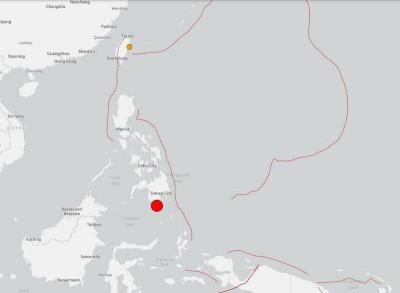
A magnitude 7.8 earthquake struck off the southern coast of Mindanao in the Philippines at 7:38am today, prompting the US Tsunami Warning System to issue an alert for neighboring countries, including Taiwan. The system issued a purple alert indicating a "tsunami threat." The potential threat zone includes Taiwan, the Philippines, Papua New Guinea, Yap and Palau. Philippine authorities were assessing the damage from the quake, with the office of civil defense seeking to verifying initial reports that 15 people had been killed and 129 injured in the region, mostly from falling debris. Arlene Hollero, disaster chief of Maasim town in the Philippines' Sarangani Province,

‘GRAY ZONE’ PRESSURE: Beijing’s activities are intended to create the deceitful impression that China has jurisdiction over the area around Taiwan, the CGA said Taiwan’s rights over its territorial waters and exclusive economic zone must not be violated by any country, the Mainland Affairs Council said yesterday, adding that it will not accept any unprovoked actions. The council issued the remarks in response to the China Coast Guard conducting maritime enforcement drills near eastern Taiwan and claiming to fully exercise China’s maritime administrative law enforcement authority. The Coast Guard Administration (CGA) has been closely monitoring the situation and is taking concrete steps to defend the nation’s sovereignty and secure its waters, the council said. China has no sovereign rights over the waters off eastern
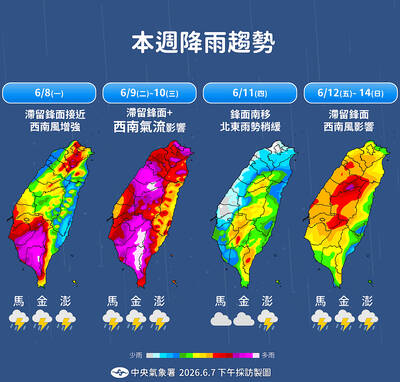
Heavy rain is expected to affect parts of Taiwan this week, the Central Weather Administration (CWA) said yesterday as a meteorologist said the active part of the annual plum rain season has started. A stationary plum rain front and southwesterly winds would bring unstable weather and abundant moisture to Taiwan from today for about a week, with the heaviest rainfall forecast for tomorrow and Wednesday, the CWA said. The agency said western and northeastern Taiwan, and mountainous areas in the east and southeast, could expect showers or thunderstorms on those two days, with localized heavy rain possible. Other parts of


 RSS
RSS