


Antitrust sanctions against Microsoft Corp should seek to repair the damage the company's illegal conduct did to competition and consumers in addition to preventing a repetition of its misdeeds, an economics expert told a federal judge Thursday.
Carl Shapiro, an economist who served as the expert witness for nine states seeking broader regulations of Microsoft's business practices, spelled out for the first time in the ongoing hearing the economic rationale behind several of the states' proposals.
"We simply cannot replicate the powerful combination of factors that threatened Microsoft's Windows monopoly six years ago," Shapiro said. "The clear implication: A broader remedy is required to truly restore competition."
But Shapiro conspicuously withheld his support from the states' proposal that Microsoft be forced to let computer makers remove various Microsoft programs from the Windows operating system, a remedy that the states have promoted perhaps more aggressively than any other.
"You don't believe the unbinding remedy proposed by the states will help competition?" asked Microsoft's lawyer, Michael Lacovara.
"It's a difficult call; I don't know the answer," replied Shapiro, an economics professor at the University of California at Berkeley who served as the deputy assistant attorney general for economics during the Clinton administration.
Stifling opposition
The hearing follows an appeals court ruling last June that Microsoft illegally stifled nascent threats to its personal computer operating system monopoly posed by the Netscape Web browser and the Java programming language from Sun Microsystems.
US District Judge Colleen Kollar-Kotelly must decide whether to approve a settlement endorsed earlier by Microsoft, the Justice Department and nine other states, or adopt more restrictive proposals at the behest of the coalition of state attorneys general still pursuing the four-year-old antitrust case.
Shapiro said the court should impose rules that would lower the barrier to competition in the PC operating system market by approximately the same amount that Microsoft's illegal acts had raised it.
To that end, he said he supports requiring Microsoft to release the source code to its Internet Explorer browser and to license its popular word processing and spreadsheet programs to run on other operating systems like Linux.
He also advocated a "parity principle" that would require Microsoft to publish information about Windows that would ensure that rivals in new technologies can develop software that works as well with Microsoft's operating system as the company's own programs.
The virtue of such a regime, Shapiro said, is that consumers would benefit from the pressure on Microsoft to innovate, whether or not competition was restored.
But Lacovara accused Shapiro of advocating a form of "rough justice."
Counter-argument
The appeals court had found that the Netscape browser and Java were only potential threats to the operating system, Lacovara said, and since it was impossible to measure how much damage Microsoft had done to competition, there was no rationale for a broad remedy.
"There is no direct evidence in this case on which you have relied that any of the unlawful conduct taken by Microsoft had an effect on its monopoly power," Lacovara said.
In his written testimony, Shapiro characterized that position as "extreme," arguing that to assume that Microsoft's current monopoly position was unaffected by its illegal acts disregarded the findings of the appeals court that Netscape and Java showed potential as threats to the operating system.
On Thursday, Shapiro acknowledged that there was no way to know what would have happened had Microsoft not acted illegally. But he noted that Netscape and Java had momentum before they were stifled: "The nature of these markets is that when these things take off they can really go and when they get knocked off, they can really crash," Shapiro said. "I think something significant is needed and I don't think the Microsoft remedy gets us anywhere near there."
When hearings resume Monday, Microsoft will continue to question Shapiro before calling its own witnesses. Bill Gates, chairman of Microsoft, is expected to testify before the hearings end next month.

National Taiwan University (NTU) yesterday said it disqualified a person from an entrance examination for using AI smart glasses to cheat, along with two others for making untruthful statements in their curriculum vitae. The three applicants were given null scores, Taiwan’s highest-ranked university said, calling on prospective students to be honest in the admissions process. NTU registrar Lee Hung-sen (李宏森) said that the cheating applicant wore a hat and thick-rimmed glasses to the second written exam for medical school, claiming that they felt cold. Suspicions were aroused when the applicant stared oddly at the test for long stretches while steadily bringing the paper
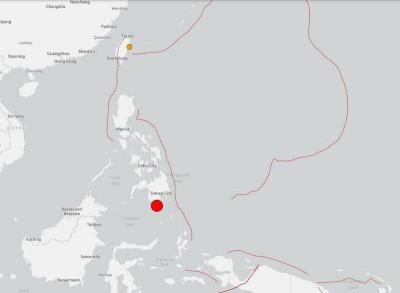
A magnitude 7.8 earthquake struck off the southern coast of Mindanao in the Philippines at 7:38am today, prompting the US Tsunami Warning System to issue an alert for neighboring countries, including Taiwan. The system issued a purple alert indicating a "tsunami threat." The potential threat zone includes Taiwan, the Philippines, Papua New Guinea, Yap and Palau. Philippine authorities were assessing the damage from the quake, with the office of civil defense seeking to verifying initial reports that 15 people had been killed and 129 injured in the region, mostly from falling debris. Arlene Hollero, disaster chief of Maasim town in the Philippines' Sarangani Province,

‘GRAY ZONE’ PRESSURE: Beijing’s activities are intended to create the deceitful impression that China has jurisdiction over the area around Taiwan, the CGA said Taiwan’s rights over its territorial waters and exclusive economic zone must not be violated by any country, the Mainland Affairs Council said yesterday, adding that it will not accept any unprovoked actions. The council issued the remarks in response to the China Coast Guard conducting maritime enforcement drills near eastern Taiwan and claiming to fully exercise China’s maritime administrative law enforcement authority. The Coast Guard Administration (CGA) has been closely monitoring the situation and is taking concrete steps to defend the nation’s sovereignty and secure its waters, the council said. China has no sovereign rights over the waters off eastern
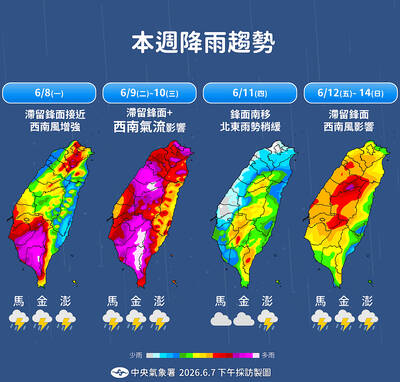
Heavy rain is expected to affect parts of Taiwan this week, the Central Weather Administration (CWA) said yesterday as a meteorologist said the active part of the annual plum rain season has started. A stationary plum rain front and southwesterly winds would bring unstable weather and abundant moisture to Taiwan from today for about a week, with the heaviest rainfall forecast for tomorrow and Wednesday, the CWA said. The agency said western and northeastern Taiwan, and mountainous areas in the east and southeast, could expect showers or thunderstorms on those two days, with localized heavy rain possible. Other parts of


 RSS
RSS