


You've got to pity Paul Krugman. The Princeton University economics professor and New York Times columnist just can't get over the fact that his candidate -- Al Gore -- lost the 2000 presidential election. George Bush is president. Most Americans -- 79 percent in fact -- approve of the job he is doing. Post Sept. 11 many Democrats admitted publicly that they were glad Bush, not Gore, was president.
Yet twice weekly, with a repetitiveness that is an embarrassment even to liberals, Krugman bashes the Bush tax cut, the Bush plan to privatize Social Security, the Bush energy plan.
He had the audacity to accuse the administration of using the Sept. 11 tragedy to promote its plan to drill in the Arctic National Wildlife Refuge when the only one guilty of political opportunism was Krugman himself.
Krugman would have preferred that the US economy never recover. That way he could hope that the next Democratic administration might throw him a bone, bestowing some appointment on him following the 2004 election.
Deprived of his scapegoat -- the Bush tax cut as an economy killer -- Krugman has seized on the Middle East crisis to darken his, and hopefully our, economic outlook.
In his Tuesday New York Times column, "The third oil crisis?" (see page 13 in today's edition of the Taipei Times), Krugman begins with a false statement that "oil prices have risen about US$10 per barrel since the situation in the Middle East began deteriorating." While the determination of when the situation began deteriorating is subjective in nature -- was it 19 months ago when the second intifada began, or was it the suicide bombing in a Netanya hotel on the first night of Passover on March 28? -- Krugman's numbers are inaccurate. But hey, what's a 100 percent error among political sympathizers? As it happens, oil prices are lower now than they were either in September 2000 or on March 28 of this year. Crude oil prices began rising in January, coincident with the improvement in industrial output. At best, the rise from about US$23 in early March to US$28 last week can be tied to concern about a disruption in the oil supply from the Middle East.
Krugman's point, once he dispenses with his standard chiding of the US for its lack of energy conservation, is that a third oil embargo could put a drag on US purchasing power. For those of us of a lesser intelligence than the professor, Krugman fails to explain why the 1979 oil crisis was inflationary and today's would not be.
On Tuesday Saudi Arabia said that it would increase output to offset Iraq's decision to halt oil exports for 30 days. So any theorizing about an oil shock may be an academic exercise -- one that academics like Krugman should get right. After quantifying the US$10 rise in crude oil prices as a US$70 billion tax increase on consumers (maybe the government should cut taxes by an equivalent amount), Krugman demonstrates a total lack of understanding of basic microeconomics, which won't necessarily disqualify him from an appointment to the Federal Reserve Board since policy makers share his view.
"The Fed can't respond with another big round of interest rate cuts: since it has already reduced rates from 6.5 to 1.75 percent, it doesn't have much ammunition left," Krugman wrote.
Are interest-rate cuts the appropriate policy response? The lesson of the two 1970s oil shocks was that the Federal Reserve can't offset the decrease in oil supply with an increase in the money supply. In fact, for the Fed to cut rates in the face of a rise in oil prices resulting from reduced supply would be a perfect recipe for stagflation.
"If the Fed holds the funds rate constant or reduces it, demand will not be curtailed, supply will be because of the lack of oil, and stagflation will result," says Paul Kasriel, director of economic research at the Northern Trust Corp in Chicago. "Fed-created money is not a substitute for Persian Gulf-produced oil."
Krugman has become so blinded by his disbelief that the nation could elect a bumbler like George W. Bush instead of the tree-hugging Vincent van Gogh look-alike Al Gore that he can't differentiate between supply and demand.
According to Princeton University, Krugman is currently teaching international trade theory and policy, so perhaps his micro is a little rusty.
While Krugman has the same right to express his views in his column as I do in mine, he has turned his valuable real estate -- his op-ed colleague, Tom Friedman, just snagged one of the Times' record seven Pulitzer Prizes -- into a toxic waste dump.
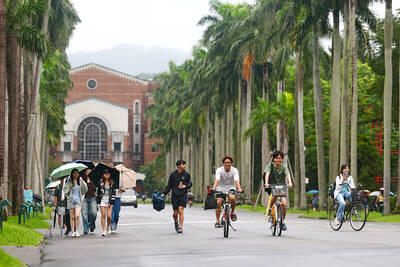
National Taiwan University (NTU) yesterday said it disqualified a person from an entrance examination for using AI smart glasses to cheat, along with two others for making untruthful statements in their curriculum vitae. The three applicants were given null scores, Taiwan’s highest-ranked university said, calling on prospective students to be honest in the admissions process. NTU registrar Lee Hung-sen (李宏森) said that the cheating applicant wore a hat and thick-rimmed glasses to the second written exam for medical school, claiming that they felt cold. Suspicions were aroused when the applicant stared oddly at the test for long stretches while steadily bringing the paper
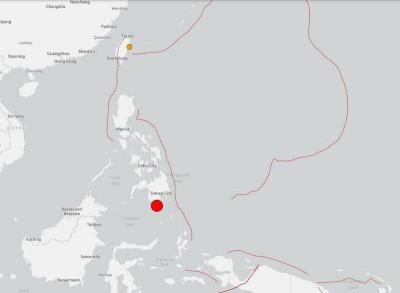
A magnitude 7.8 earthquake struck off the southern coast of Mindanao in the Philippines at 7:38am today, prompting the US Tsunami Warning System to issue an alert for neighboring countries, including Taiwan. The system issued a purple alert indicating a "tsunami threat." The potential threat zone includes Taiwan, the Philippines, Papua New Guinea, Yap and Palau. Philippine authorities were assessing the damage from the quake, with the office of civil defense seeking to verifying initial reports that 15 people had been killed and 129 injured in the region, mostly from falling debris. Arlene Hollero, disaster chief of Maasim town in the Philippines' Sarangani Province,
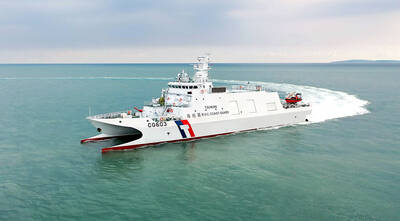
‘GRAY ZONE’ PRESSURE: Beijing’s activities are intended to create the deceitful impression that China has jurisdiction over the area around Taiwan, the CGA said Taiwan’s rights over its territorial waters and exclusive economic zone must not be violated by any country, the Mainland Affairs Council said yesterday, adding that it will not accept any unprovoked actions. The council issued the remarks in response to the China Coast Guard conducting maritime enforcement drills near eastern Taiwan and claiming to fully exercise China’s maritime administrative law enforcement authority. The Coast Guard Administration (CGA) has been closely monitoring the situation and is taking concrete steps to defend the nation’s sovereignty and secure its waters, the council said. China has no sovereign rights over the waters off eastern
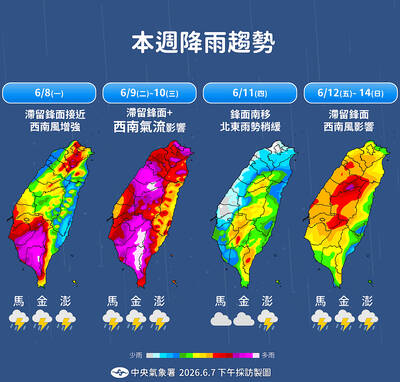
Heavy rain is expected to affect parts of Taiwan this week, the Central Weather Administration (CWA) said yesterday as a meteorologist said the active part of the annual plum rain season has started. A stationary plum rain front and southwesterly winds would bring unstable weather and abundant moisture to Taiwan from today for about a week, with the heaviest rainfall forecast for tomorrow and Wednesday, the CWA said. The agency said western and northeastern Taiwan, and mountainous areas in the east and southeast, could expect showers or thunderstorms on those two days, with localized heavy rain possible. Other parts of


 RSS
RSS