


We are living through one of those times when it is more fun than it should be to work at the Securities and Exchange Commission.
An accounting scandal that began with Enron Corp's collapse and bankruptcy has touched all sorts of unlikely suspects. There isn't a company in America that cannot plausibly be investigated, and there isn't an investigation unworthy of public attention.
Never mind that there is a CEO-loving Republican in the White House. Never mind that Harvey Pitt, the new chairman of the SEC, claimed at first that his job was to make the agency less, not more, intrusive in American business life. The boom went bust, the economy went south, a giant, fashionable company was exposed as a lie, and scandal is now everywhere available. The SEC has almost tripled its accounting-fraud investigations this year, and it's not hard to see why.
PHOTO: BLOOMBERG
One of the features that distinguishes American financial life from American street life is how long it takes the police to turn up after a crime has been committed.
Most of the financial scandal now making its debut in the business press refers to activity that dates back years. Most of the bad things that companies are accused of doing they were doing right through the boom -- when, of course, the SEC had little to say about any of it.
Back when it was actually going on, for instance, the Enron book-rigging was helped along by the SEC, which exempted the company from financial disclosure requirements for utilities. Only now, well after the evil deeds are done and the villains are gone, do the money cops rush in, sirens wailing.
This pattern in the financial markets -- boom followed by bust followed by police action -- is now so common that no one thinks twice about it. But I can think of several reasons why we should.
The first is that bad timing renders financial regulation superfluous. The money cops are more energized than they have been in many years, but their efforts are less necessary than they have been in many years.
At this dark moment, when every major company, from General Electric Co to Microsoft Corp, is treated by investors as guilty until proven innocent, the market has the greatest capacity for self-reform. Last month a word from Pimco money manager Bill Gross that he was suspicious of General Electric's disclosures and its reliance on short-term debt sent the stock down 6 percent in two days. You think any chief executive officer of a public company failed to hear that message? Across America companies are scrambling to comply not with the law but with investors' need for trust. Wall Street analysts are falling over themselves to downgrade companies. CEOs are pulling all-nighters to make sure every last number makes it into their financial statements. Everyone inside the money culture is probably behaving more honestly now than he has in years. Who needs cops? Our newly energized police force isn't merely unnecessary; it's harmful. A few years ago, in the heat of a bull market, it would have been useful, if unpopular, for SEC investigators to ask lots of loud, unpleasant questions about corporate accounting, the relations between Wall Street analysts and the companies they covered, and so on.
When the market itself has little appetite for distrust is exactly when some outside voice should dish it out. When the bull is strong -- when stocks are rising and villains are celebrated by Fortune and Forbes -- is when the bull needs to be confronted. But that's not what SEC people do.
Instead, like second-rate matadors, they wait until the bull has been poked and prodded to the brink of death before they enter the ring, whereupon they wave their cape over the carcass and wait for the bouquets to land. The effect of their crowd-pleasing is to exacerbate the market's natural manic-depressive tendencies. They raise the cost of doing business at exactly the moment when doing business is most costly.
The usual ethical complaint made against people who work at the SEC is that they wind up taking jobs with the companies they are meant to police. All over Wall Street, former SEC employees are paid great sums of money to monitor their firm's relations with the SEC.
But that is a small problem compared with this other systemic one. The SEC cannot behave like an honest, well-run police force because it does not have the incentives of an honest, well-run police force.
It isn't really paid to fight financial crime. It is paid to create the illusion that it fights financial crime -- and at the same time not offend important politicians who give it funding.
That is, the people who work for the SEC must at once police the markets and play politics.
They know that good public relations translates into bigger budgets. They also know that if they create a stink when the market is flying and investors are happy, they will invite not just derision but punishment, in the form of lower budget allocations from Capitol Hill. Only in bad times, when their activity is pointless, do they find it rewarding to leap into action.
Michael Lewis, whose books include Next: The Future Just Happened and Liar's Poker, is a columnist for Bloomberg News. The opinions expressed are his own.

National Taiwan University (NTU) yesterday said it disqualified a person from an entrance examination for using AI smart glasses to cheat, along with two others for making untruthful statements in their curriculum vitae. The three applicants were given null scores, Taiwan’s highest-ranked university said, calling on prospective students to be honest in the admissions process. NTU registrar Lee Hung-sen (李宏森) said that the cheating applicant wore a hat and thick-rimmed glasses to the second written exam for medical school, claiming that they felt cold. Suspicions were aroused when the applicant stared oddly at the test for long stretches while steadily bringing the paper
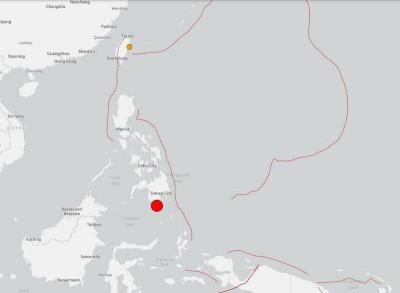
A magnitude 7.8 earthquake struck off the southern coast of Mindanao in the Philippines at 7:38am today, prompting the US Tsunami Warning System to issue an alert for neighboring countries, including Taiwan. The system issued a purple alert indicating a "tsunami threat." The potential threat zone includes Taiwan, the Philippines, Papua New Guinea, Yap and Palau. Philippine authorities were assessing the damage from the quake, with the office of civil defense seeking to verifying initial reports that 15 people had been killed and 129 injured in the region, mostly from falling debris. Arlene Hollero, disaster chief of Maasim town in the Philippines' Sarangani Province,

‘GRAY ZONE’ PRESSURE: Beijing’s activities are intended to create the deceitful impression that China has jurisdiction over the area around Taiwan, the CGA said Taiwan’s rights over its territorial waters and exclusive economic zone must not be violated by any country, the Mainland Affairs Council said yesterday, adding that it will not accept any unprovoked actions. The council issued the remarks in response to the China Coast Guard conducting maritime enforcement drills near eastern Taiwan and claiming to fully exercise China’s maritime administrative law enforcement authority. The Coast Guard Administration (CGA) has been closely monitoring the situation and is taking concrete steps to defend the nation’s sovereignty and secure its waters, the council said. China has no sovereign rights over the waters off eastern
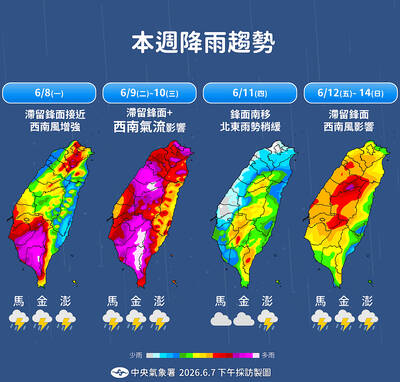
Heavy rain is expected to affect parts of Taiwan this week, the Central Weather Administration (CWA) said yesterday as a meteorologist said the active part of the annual plum rain season has started. A stationary plum rain front and southwesterly winds would bring unstable weather and abundant moisture to Taiwan from today for about a week, with the heaviest rainfall forecast for tomorrow and Wednesday, the CWA said. The agency said western and northeastern Taiwan, and mountainous areas in the east and southeast, could expect showers or thunderstorms on those two days, with localized heavy rain possible. Other parts of


 RSS
RSS