


The Federal Reserve pleasantly surprised the bond market Tuesday by indicating it was in no rush to raise short-term interest rates.
In a statement released following the policy-setting committee's meeting, the Fed acknowledged the strength in economic activity -- largely the result of the swing in inventories, officials believe -- and said the outlook for final demand was uncertain and risks to the economy balanced between weaker economic growth and higher inflation. The Fed elected to leave the federal funds rate unchanged at 1.75 percent.
There was something awkward about the construction of the sentence containing the balance-of-risks statement.
"In these circumstances, although the stance of monetary policy is currently accommodative ... the risks are balanced with respect to the prospects for" long-run price stability and sustainable economic growth, the statement said.
I had to read this sentence several times before I figured out what was wrong with it. The idea in the dependent clause -- "although the stance of monetary policy is currently accommodative" -- sets up an expectation: Although policy is accommodative, we aren't worried about over-stimulating the economy and producing higher inflation. It was as if the Fed didn't want to follow the thought through to its logical conclusion.
"It sounds as if they wanted to put a favorable cast on their accommodative stance," says Jim Glassman, senior US economist at J.P. Morgan Chase.
Evidently the Fed didn't want to talk about the elephant in the room. Why mention the unspoken when the markets are already skittish about the path for short-term rates? Having cut the overnight federal funds rate to a microscopic 1.75 percent, Federal Reserve Chairman Alan Greenspan is now faced with the unenviable task of having to raise rates to a level appropriate to an expanding economy.
He wants neither to abort the recovery nor upend the stock market. He doesn't want long-term rates to rise, fearing it would snuff out the strongest sector of the economy, housing.
Single-family housing starts rose to their highest level since 1978 in February. The strength in housing was evident in Thursday's consumer price index for February as well. Shelter costs, which make up 31.5 percent of the CPI and 40 percent of the core CPI, rose 0.5 percent. The three-month annualized increase of 5 percent is the biggest in 11 years.
Within the shelter component, "0.4 percent monthly increases in owners' equivalent rent and residential rent are now the trend," says Henry Willmore, senior US economist at Barclays Capital Group.
A big surprise last month was the 1.7 percent increase in lodging away from home. That component was up an annualized 6.6 percent in the last three months, supporting anecdotal press reports that consumers are traveling again, which has allowed hotels and motels to unwind aggressive post-9/11 discounts.
The overall CPI rose 0.2 percent last month, leaving the year- over-year increase at a 15-year low of 1.1 percent for the second consecutive month.
The core CPI, which excludes food and energy, rose a larger- than-expected 0.3 percent. The villains were apparel, tobacco and shelter, according to the Bureau of Labor Statistics. The 3.8 percent increase in tobacco and smoking products was the result of a federal excise tax increase in January, which didn't show up because it was offset by price discounts, Willmore says. "When they took off the price discounts [in February], the excise tax showed up." As far as apparel is concerned, huge declines in November, December and January (0.6 percent, 0.6 percent and 0.7 percent, respectively) never seem to count. It's only when prices increase that it's dismissed as a timing issue related to the introduction of the new seasonal line.
The tendency to ex-out everything that goes up reached a new low Thursday, as reflected in this passage from Market News International: Had tobacco been flat, the core rate would have been 0.2 percent, senior BLS analyst Patrick Jackman told Market News International as the CPI report was being made public.
Without the accompanying large increase in shelter costs, up 0.5 percent, the core would have been near motionless, since shelter costs make up about 40 percent of the core rate.
Without shelter? Without the biggest single component? My friend Jim Bianco, president of Bianco Research in Barrington, Illinois, has aptly coined the phrase, "pro forma" CPI, to deal with this nonsense.
"I've never heard anyone say, if you exclude the things going down the CPI would have been worse," Bianco says.
New car prices declined 0.9 percent in February, the biggest drop in 15 years. Given the strength in auto sales, are declines of that magnitude likely to be repeated? What about energy prices, which fell 0.8 percent in February and almost 16 percent in the last 12 months? The average price of a gallon of unleaded gasoline rose 15 percent from US$1.12 in the last week of February to US$1.29 in the third week of March. The price of crude oil, from which gasoline is distilled, is up 14 percent this month.
Most economists expect core inflation, up 2.6 percent in the last year, to fall this year. The TIPS market suggests just the opposite. The difference between the yield on the 10-year Treasury inflation protection security and the nominal 10-year note has moved out by 50 basis points in the last two months to 202 basis points.

National Taiwan University (NTU) yesterday said it disqualified a person from an entrance examination for using AI smart glasses to cheat, along with two others for making untruthful statements in their curriculum vitae. The three applicants were given null scores, Taiwan’s highest-ranked university said, calling on prospective students to be honest in the admissions process. NTU registrar Lee Hung-sen (李宏森) said that the cheating applicant wore a hat and thick-rimmed glasses to the second written exam for medical school, claiming that they felt cold. Suspicions were aroused when the applicant stared oddly at the test for long stretches while steadily bringing the paper
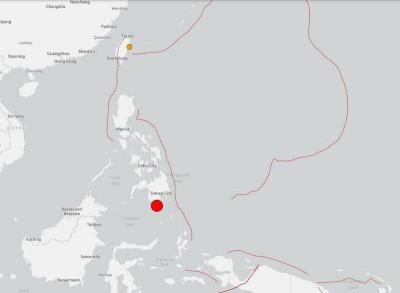
A magnitude 7.8 earthquake struck off the southern coast of Mindanao in the Philippines at 7:38am today, prompting the US Tsunami Warning System to issue an alert for neighboring countries, including Taiwan. The system issued a purple alert indicating a "tsunami threat." The potential threat zone includes Taiwan, the Philippines, Papua New Guinea, Yap and Palau. Philippine authorities were assessing the damage from the quake, with the office of civil defense seeking to verifying initial reports that 15 people had been killed and 129 injured in the region, mostly from falling debris. Arlene Hollero, disaster chief of Maasim town in the Philippines' Sarangani Province,

‘GRAY ZONE’ PRESSURE: Beijing’s activities are intended to create the deceitful impression that China has jurisdiction over the area around Taiwan, the CGA said Taiwan’s rights over its territorial waters and exclusive economic zone must not be violated by any country, the Mainland Affairs Council said yesterday, adding that it will not accept any unprovoked actions. The council issued the remarks in response to the China Coast Guard conducting maritime enforcement drills near eastern Taiwan and claiming to fully exercise China’s maritime administrative law enforcement authority. The Coast Guard Administration (CGA) has been closely monitoring the situation and is taking concrete steps to defend the nation’s sovereignty and secure its waters, the council said. China has no sovereign rights over the waters off eastern
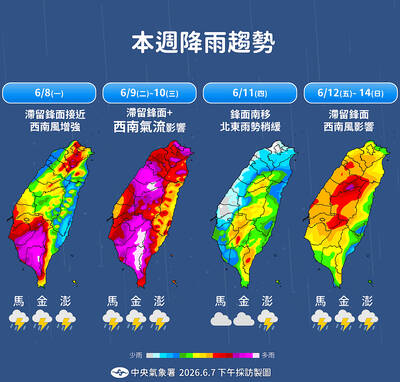
Heavy rain is expected to affect parts of Taiwan this week, the Central Weather Administration (CWA) said yesterday as a meteorologist said the active part of the annual plum rain season has started. A stationary plum rain front and southwesterly winds would bring unstable weather and abundant moisture to Taiwan from today for about a week, with the heaviest rainfall forecast for tomorrow and Wednesday, the CWA said. The agency said western and northeastern Taiwan, and mountainous areas in the east and southeast, could expect showers or thunderstorms on those two days, with localized heavy rain possible. Other parts of


 RSS
RSS