


A self-balancing scooter billed as heralding a revolution in the way people travel could run into an obstacle in Japan, where a robotics professor wants recognition for inventing a nearly identical machine 15 years ago.
The claim comes a little more than a month after US inventor Dean Kamen unveiled the "Segway Human Transporter" and Segway LLC, the company founded to make and sell it, ending a year of speculation and secrecy over the invention that kept the high-tech world in thrall.
"I'm not saying that they took the idea but I want people to know that it existed before the Segway was developed," Kazuo Yamafuji, Professor Emiritus at Tokyo's University of Electro-Communications, told Reuters.
"I made this machine 15 years ago."
More importantly, Yamafuji applied for a patent for his machine in 1987, which was granted in 1996.
Legal experts say that while it may be difficult for Yamafuji or anyone else to challenge Dean Kamen's US patent, the award-winning US inventor could run into trouble if Segway decides to sell the scooter in Japan.
With its densely packed cities and enthusiasm for high-tech gadgets, Japan could be an ideal market for Segway's machine.
Transforming urban landscapes
The motorized scooter, which went under the code names "Ginger" or "It" before it was revealed to the public, is a device that Kamen believes has the potential to transform urban landscapes, allowing people to zip over short distances instead of driving their cars.
Users stand on a small platform between two wheels and hold on to a handle similar to that on a bicycle. Leaning forward moves the scooter forward, leaning back reverses course and turns are made by twisting the handle.
While Professor Yamafuji admits he never took his invention beyond the research phase and into commercial development, he insists that the basic ideas incorporated in the Segway scooter are the same: a computer processor to detect minute shifts in balance to keep the machine upright on two parallel wheels.
"I call it a `parallel bicycle,'" said Yamafuji, a robotics scientist for more than 30 years and now in semi-retirement.
"The Segway is essentially a motorized parallel bicycle, with wheels side by side instead of front to back. If they claim that they did it first, it wouldn't be fair to me or my university. We did the research."
But when asked if he was considering legal action, Yamafuji said: "I will not fight this."
Obstacle course
A 45-cm high parallel bicycle made by Yamafuji and his research team 15 years ago has the same two-wheel arrangement as the Segway scooter, but is too small for a rider and lacks a platform.
The upper section is a hollow rectangular box set at an slightly tilted angle to hold motors, processors and a pendulum that helps maintain balance.
A small rod attached to one of the wheels rests against the ground to sense the tilt of the machine, a contrast to the Segway, which uses gyroscopes to mimic the human ear's sense of balance.
The similarities may be enough, said Joseph A. Calvaruso, a litigation partner at intellectual property law firm Morgan & Finnegan LLP in New York, to make it difficult for Segway to sell the machine in Japan.
"Kamen could have a problem in Japan if the Japanese patent challenges any one of the claims on his patent," Calvaruso said.
Segway said it is still is still evaluating plans for specific countries and has no details on strategy outside of the US, according to Senior Vice President Gary Bridge.
Within the United States, Calvaruso said it would be very difficult -- but not impossible -- for Yamafuji or anyone else to invalidate Kamen's US patent.
That's because Kamen's 1999 patent has a reference to Yamafuji's Japan patent application -- meaning Kamen's machine was nonetheless deemed worthy of a patent by the United States Patent and Trademark Office.
"We're aware of Professor Yamafuji's work," Bridge said, but added that "it is important to note that the technology underlying the Segway Human Transporter is a significant advance over prior technologies."
In a further twist, Yamafuji was granted a second patent in 1998 for a four-wheeled version of his machine which expands on his original invention.
Cat twist
The later version has a counterweight that would allow users use a switch to move forwards and backwards without having to lean.
"With this version a person can stand on the unit and push a button to move," Yamafuji said.
Another prototype climbs stairs.
The ideal form for the machine's wheels, Yamafuji says, is to have a sphere with built-in mechanics that can go in any direction from a standing start.
While none of his prototypes were built with space for a human operator, Yamafuji said that his former students went on to develop usable versions for research at the corporate level.
A working human-operated scooter was built by one of Yamafuji's students for Sony Corp, which has already made a name for itself in home robotics with the AIBO "pet" robot, while another built a scooter on a sphere that balanced itself like a unicycle for Honda Motor Co Ltd.
Yamafuji has created other machines, including a robot that replicates the quick twist that helps falling cats land on their feet.
"The US Air Force was interested in our cat-twist robot," he said.
Yamafuji admitted that he was eager to meet Kamen and share ideas. "It is a matter of pride for me, not money."
"I would hand over my patent for one dollar if Mr. Kamen admitted that we were first."
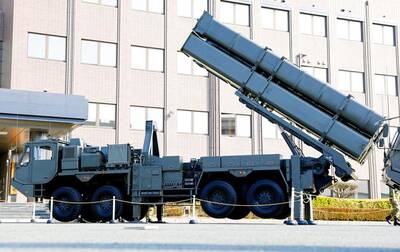
Japan has deployed long-range missiles in a southwestern region near China, the Japanese defense minister said yesterday, at a time when ties with Beijing are at their lowest in recent years. The missiles were installed in Kumamoto in the southern region of Kyushu, as Japan is attempting to shore up its military capacity as China steps up naval activity in the East China Sea. “Standoff defense capabilities enable us to counter the threat of enemy forces attempting to invade our country ... while ensuring the safety of our personnel,” Japanese Minister of Defense Shinjiro Koizumi said. “This is an extremely important initiative for

Chinese Nationalist Party (KMT) Chairwoman Cheng Li-wun (鄭麗文) today accepted an invitation from Chinese President Xi Jinping (習近平) to lead a delegation to China next month, saying she hopes to promote the peaceful development of cross-strait relations and bring stability to the Taiwan Strait. “I am grateful and happy to accept this invitation,” Cheng said in a statement from the KMT chairperson’s office. Cheng said she hopes both sides can work together to promote the peaceful development of cross-strait relations, enhance exchange and cooperation, bring stability to the Taiwan Strait and improve people’s livelihoods. At today's news conference, Cheng said any efforts to

MORE POPULAR: Taiwan Pass sales increased by 59 percent during the first quarter compared with the same period last year, the Tourism Administration said The Tourism Administration yesterday said that it has streamlined the Taiwan Pass, with two versions available for purchase beginning today. The tourism agency has made the pass available to international tourists since 2024, allowing them to access the high-speed rail, Taiwan Railway Corp services, four MRT systems and four Taiwan Tourist Shuttles. Previously, five types of Taiwan Pass were available, but some tourists have said that the offerings were too complicated. The agency said only two types of Taiwan Pass would be available, starting from a three-day pass with the high-speed rail and a three-day pass with Taiwan Railway Corp. The former costs NT$2,800

The nation’s fastest supercomputer, Nano 4 (晶創26), is scheduled to be launched in the third quarter, and would be used to train large language models in finance and national defense sectors, the National Center for High-Performance Computing (NCHC) said. The supercomputer, which would operate at about 86.05 petaflops, is being tested at a new cloud computing center in the Southern Taiwan Science Park in Tainan. The exterior of the server cabinet features chip circuitry patterns overlaid with a map of Taiwan, highlighting the nation’s central position in the semiconductor industry. The center also houses Taiwania 2, Taiwania 3, Forerunner 1 and


 RSS
RSS