


Only three months ago, Critical Path appeared close to collapse. With its reputation in ruin after an accounting scandal, its shares trading as low as US$0.24 and a debt of US$300 million, the once highflying provider of corporate e-mail systems appeared ready to join the many remains of failed companies strewn along the Internet's trail of busted dreams.
But Critical Path may be on the comeback path. Under a new management team, the company has quietly settled more than 50 shareholder lawsuits, brought in well-respected financiers and nursed its balance sheet closer to health.
The leaders of the revival are David Hayden, the founder and executive chairman, and William McGlashan, a venture capitalist and turnaround specialist who accepted an interim executive role shortly after the scandal broke in February last year. McGlashan was to shed the term ``interim'' from his title yesterday, when the company announces that it has named him full-time chief executive.
"We made it through the valley of the shadow of death," McGlashan, 38, said in a recent interview at the company's headquarters in the South of Market neighborhood of San Francisco, which was once filled with dotcom companies.
Critical Path's quarters, a four-story converted warehouse with exposed brick walls and wood beams, will soon be part of the company's dark history. The company leased the building -- for US$47 a square foot -- only a month before the accounting irregularities became known. Now, as part of its efforts to reduce operating costs to less than US$30 million a quarter, half the rate of last spring, Critical Path will soon move to the sixth floor of a more staid corporate building nearby -- for US$35 a square foot, reducing its rent by US$1.6 million a year.
The move is just one of many ways the company's executives have tried to correct the management mistakes of the past two years. Since March, Critical Path has shed half its work force as it has withdrawn from weak businesses, most of which the company entered through a dozen acquisitions that pulled it further and further from its original vision: running e-mail systems and large data directories for corporations.
"What 2001 was about was re-establishing the company's financial credibility and balance sheet," said William Ford, a new member of the Critical Path board. "This coming year is going to be about growth and market leadership."
But before that happens, Critical Path must continue to convince customers and investors that its business model is strong. More important, it must win back the trust it so badly damaged.
Once a Wall Street darling, with its stock soaring as high as US$119.50 in March 2000, Critical Path screeched to a halt last January when it widely missed its earnings projections. Instead of the profit long promised by the company's management, Critical Path posted a loss of US$0.16 a share.
But the bombshell hit two weeks later. On Feb. 2, the company suspended two top executives and started an internal investigation into its financial practices after questions arose about the way executives reported revenue from several sales contracts. The Securities and Exchange Commission began an investigation, the stock plunged, and Wall Street analysts and investors began accusing Critical Path of deliberately cooking its books under heavy pressure to turn a profit.
Critical Path was eventually forced to restate its financial results from the third and fourth quarters of 2000, lowering its annual revenue 13 percent and widening its loss more than a third. The board forced out the chief executive, the president and the vice president for worldwide sales, then dismissed eight members of the sales team.
Citing the SEC investigation, the company would not describe the questionable transactions. But McGlashan said they were limited to three deals. Referring to the previous management, he said: "For three deals, you went through this as a company? You cheated for three lousy deals?"
The accounting debacle struck as the economy worsened, leaving Critical Path scrambling to reassure existing and potential customers that it would survive. Hayden -- who said he was on a yearlong sabbatical from the company when the scandal occurred -- and McGlashan spent much of last summer visiting customers in the US, Europe and Asia. During the tour they offered confidential information about the company's prospects for financing in exchange for agreements not to trade Critical Path's stock on the insider information.
Some companies balked at the sales pitch, unwilling to become involved with a company sitting under a black cloud. But others, including Morgan Stanley, DuPont and the national postal services of Italy and Germany, signed on.
DuPont uses Lotus Notes for its corporate Web-based e-mail, but hired Critical Path to operate a less sophisticated, and less expensive system for 7,000 workers in some factories and remote offices. "Obviously, one of the concerns we had was, `Will they still be here tomorrow?'" said Irvin Lipp, a spokesman for DuPont. "They answered that question, which is why we went with them."
While software sales for the first nine months of last year fell 40 percent, to about US$22 million, from the year before, Critical Path alleviated some doubts about its survival in November. First it announced that it would pay US$17.5 million and issue warrants on 850,000 shares to settle shareholder lawsuits. The next day, the company said that investors led by General Atlantic Partners, a venture capital firm, had retired US$65 million in Critical Path's debt and invested US$30 million for a 26 percent stake, bringing the debt down to US$38 million.
Ford, a partner with General Atlantic, and Raul Fernandez, chief executive of Dimension Data North America, joined the Critical Path board, restoring more credibility to the turnaround efforts. The stock price has increased moderately with the company's fortunes, closing up US$0.20 cents to US$3.80 on Friday.
Critical Path has "done a remarkable pullback from the abyss," said Matt Cain, an analyst with the Meta Group, a research firm. "It's not necessarily out of danger, but it has been, overall, a remarkable comeback."
But the sting of betrayal will not go away easily for many investors. All 17 Wall Street analysts who followed the company early last year have dropped their coverage. One mutual fund manager who was burned by the falling stock price said he had no confidence in the company; he plans to sell his shares as soon as they rebound enough to offset some of his losses.
"In the end, everything they said about what they had appeared to be false," said the manager, who spoke on the condition that his name not be used. "Every once in a while you get skunked in a fraud, and we got skunked."

National Taiwan University (NTU) yesterday said it disqualified a person from an entrance examination for using AI smart glasses to cheat, along with two others for making untruthful statements in their curriculum vitae. The three applicants were given null scores, Taiwan’s highest-ranked university said, calling on prospective students to be honest in the admissions process. NTU registrar Lee Hung-sen (李宏森) said that the cheating applicant wore a hat and thick-rimmed glasses to the second written exam for medical school, claiming that they felt cold. Suspicions were aroused when the applicant stared oddly at the test for long stretches while steadily bringing the paper
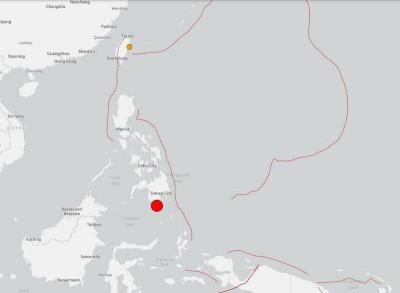
A magnitude 7.8 earthquake struck off the southern coast of Mindanao in the Philippines at 7:38am today, prompting the US Tsunami Warning System to issue an alert for neighboring countries, including Taiwan. The system issued a purple alert indicating a "tsunami threat." The potential threat zone includes Taiwan, the Philippines, Papua New Guinea, Yap and Palau. Philippine authorities were assessing the damage from the quake, with the office of civil defense seeking to verifying initial reports that 15 people had been killed and 129 injured in the region, mostly from falling debris. Arlene Hollero, disaster chief of Maasim town in the Philippines' Sarangani Province,

‘GRAY ZONE’ PRESSURE: Beijing’s activities are intended to create the deceitful impression that China has jurisdiction over the area around Taiwan, the CGA said Taiwan’s rights over its territorial waters and exclusive economic zone must not be violated by any country, the Mainland Affairs Council said yesterday, adding that it will not accept any unprovoked actions. The council issued the remarks in response to the China Coast Guard conducting maritime enforcement drills near eastern Taiwan and claiming to fully exercise China’s maritime administrative law enforcement authority. The Coast Guard Administration (CGA) has been closely monitoring the situation and is taking concrete steps to defend the nation’s sovereignty and secure its waters, the council said. China has no sovereign rights over the waters off eastern
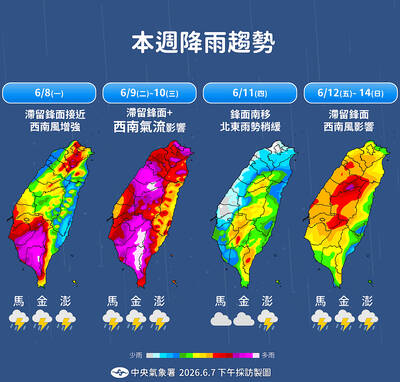
Heavy rain is expected to affect parts of Taiwan this week, the Central Weather Administration (CWA) said yesterday as a meteorologist said the active part of the annual plum rain season has started. A stationary plum rain front and southwesterly winds would bring unstable weather and abundant moisture to Taiwan from today for about a week, with the heaviest rainfall forecast for tomorrow and Wednesday, the CWA said. The agency said western and northeastern Taiwan, and mountainous areas in the east and southeast, could expect showers or thunderstorms on those two days, with localized heavy rain possible. Other parts of


 RSS
RSS