


Four years ago South Korea was the Argentina of today. It lurched from one currency crisis to the next, its biggest companies burdened by towering debts and its political system in gridlock. Economists wrote Korea off as a basket case -- in a worse state even than its sickly neighbor Japan.
However, Korea has confounded the pessimists this year -- and the tiny number of British investors who believed in the possibility of a rapid recovery have been rewarded with the best returns achieved anywhere in the world.
The top performing unit trust this year -- of the 1,969 on offer to private investors -- was the JP Morgan Fleming Korea fund which, according to figures from Standard & Poor's, rose 45 percent during the year. Korean funds took three out of the top four places, with trusts from Barings and Schroders also recording strong gains.
Propping up the bottom of the table is a roll-call of technology funds from some of the biggest asset management companies -- Aberdeen, Gartmore, M&G and Edinburgh all managed to lose more than 50 percent of their investors' money this year.
Korea has restructured its economy more successfully than any other Asian country, accepting the painful medicine of corporate collapses such as Daewoo far more readily than Japan, which has allowed its industrial behemoths to stagger onwards. While Japan, Taiwan and Hong Kong all fell into recession this year, Korea's GDP rose 2.7 percent.
The Seoul stock market jumped 35 percent in 2001, outstripping every other with the exception of Russia. Korean companies claimed eight spots on the list of top-performing global stocks this year.
Retailers led the way, with Hyundai department stores posting a 239 percent gain on its share price.
The surprise for investors is how far Korea has surged ahead since Sept. 11. Exports account for 46 per cent of Korea's GDP, and the expectation was that Korea, along with other Asian economies would suffer as its biggest market, the US, went into recession.
Sure enough, the Kospi index fell more than 15 percent in the days after Sept. 11. But since then recovery has been dramatic, with the market up more than 40 percent.
Barings says: "The outlook for global demand has now begun to improve. Fiscal and monetary easing under way in the US and elsewhere is expected to lead to a recovery in the second half of next year. These factors help to explain the substantial recovery of the Korean market since Sept. 11."
But there is more to Korea than the international perspective; like Britain, consumer spending is sustaining the economy while its neighbors struggle. One of the biggest holdings is Kookmin Bank which, unlike the state-controlled banks, has avoided pouring money into ailing industrials. Instead it focuses on credit cards, personal loans and mortgages, which are fuelling the Korean consumer boom.
Will the Korean boom continue? Financial advisers generally recommend that small investors steer clear of single-country funds, which are highly volatile. David Choi, who runs the JPMF Korea fund, is also cautious about a repeat of thsi year's gains in 2002. He points to the recent rescue of the near-bankrupt Hynix semiconductor company as a sign that old-style state interference is still strong.
"Hynix's bail-out is not good for long-term market reforms or overcapacity in the semiconductor industry." he said.
But those who think it's all over for Korea should examine research issued by HSBC Securities last week. It found that countries that have hosted the World Cup since 1966 have seen their stock markets outperform global indices by 9 percent on average in the six months before the tournament. It expects the World Cup to help Korea to a 4.7 percent economic growth rate next year.
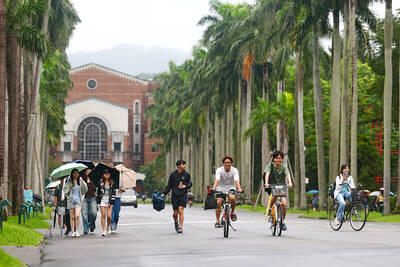
National Taiwan University (NTU) yesterday said it disqualified a person from an entrance examination for using AI smart glasses to cheat, along with two others for making untruthful statements in their curriculum vitae. The three applicants were given null scores, Taiwan’s highest-ranked university said, calling on prospective students to be honest in the admissions process. NTU registrar Lee Hung-sen (李宏森) said that the cheating applicant wore a hat and thick-rimmed glasses to the second written exam for medical school, claiming that they felt cold. Suspicions were aroused when the applicant stared oddly at the test for long stretches while steadily bringing the paper
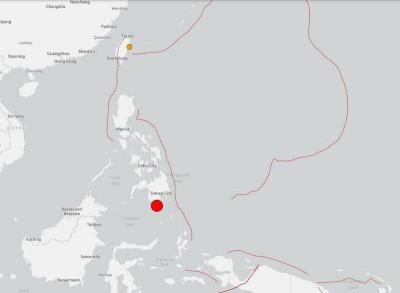
A magnitude 7.8 earthquake struck off the southern coast of Mindanao in the Philippines at 7:38am today, prompting the US Tsunami Warning System to issue an alert for neighboring countries, including Taiwan. The system issued a purple alert indicating a "tsunami threat." The potential threat zone includes Taiwan, the Philippines, Papua New Guinea, Yap and Palau. Philippine authorities were assessing the damage from the quake, with the office of civil defense seeking to verifying initial reports that 15 people had been killed and 129 injured in the region, mostly from falling debris. Arlene Hollero, disaster chief of Maasim town in the Philippines' Sarangani Province,

‘GRAY ZONE’ PRESSURE: Beijing’s activities are intended to create the deceitful impression that China has jurisdiction over the area around Taiwan, the CGA said Taiwan’s rights over its territorial waters and exclusive economic zone must not be violated by any country, the Mainland Affairs Council said yesterday, adding that it will not accept any unprovoked actions. The council issued the remarks in response to the China Coast Guard conducting maritime enforcement drills near eastern Taiwan and claiming to fully exercise China’s maritime administrative law enforcement authority. The Coast Guard Administration (CGA) has been closely monitoring the situation and is taking concrete steps to defend the nation’s sovereignty and secure its waters, the council said. China has no sovereign rights over the waters off eastern
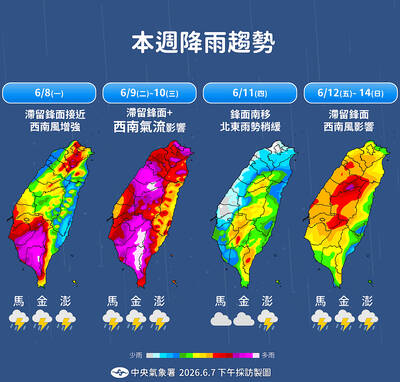
Heavy rain is expected to affect parts of Taiwan this week, the Central Weather Administration (CWA) said yesterday as a meteorologist said the active part of the annual plum rain season has started. A stationary plum rain front and southwesterly winds would bring unstable weather and abundant moisture to Taiwan from today for about a week, with the heaviest rainfall forecast for tomorrow and Wednesday, the CWA said. The agency said western and northeastern Taiwan, and mountainous areas in the east and southeast, could expect showers or thunderstorms on those two days, with localized heavy rain possible. Other parts of


 RSS
RSS