


Germany's strongly expanding wind power industry is now about to take the next step in the bid to establish wind-generated electricity on an industrial scale -- going out to sea.
In a development which promises even greater potential for the alternative source of electricity generation, the Prokon company in Leer, in the North Frisian region of northwestern Germany has become the first to receive approval for an offshore windpark.
Initially it will be a modest facility: only 12 wind generators about 45km offshore from the North Sea island of Borkum.
But if the first phase is successful, Prokon Nord already has the blueprints made for a windpark of 200 generators -- producing the electricity equivalent to two coal-burning plants -- in what would be a DM250 million (US$115 million) project.
It's a move which analysts say is the next logical step in the wind power industry. After a decade of strong expansion with land- based wind generators, German operators and windpark contractors have started to run out of space on the mainland.
At the moment, 23 potential offshore German projects are under study. The sea -- with its more constant breezes promising greater efficiency in terms of generation-hours per year -- has become the next frontier for the industry.
The development of windparks out at sea also promises to make stock analysts sit up and take even more serious note of this tiny segment of the German power generation industry.
Analysts at HSBC Trinkaus & Burkhardt point out that there are currently four major players among the German wind park developers: Energiekontor of Bremen, P&T Technology in Hamburg, Umweltkontor in Erkelenz and Plambeck in Cuxhhaven.
HSBC has given the Energiekontor company good ratings for its land-based operations, while noting that there is a "high saturation of the German wind market" but that the company has positioned itself for "attractive markets outside of Germany."
Another report, by the Hamburgische Landesbank, sees the offshore project by Prokon as giving a boost to the German wind power industry, especially in the bid to make the electricity production more price-competitive.
"In the meantime, wind energy can be produced at a similarly low price as with the use of conventional energy," said Hamburgische Landesbank analyst Claudia Erdmann.
Last summer, prospects for sea-based windparks got a further boost when the German government said it planned to provide fast-track approval for at least 15 new offshore windparks in the Baltic and North Sea to replace nuclear power stations which are to be closed.
This came as good news for the industry, with P&T Technology investor relations executive Oliver Eggert saying that bureaucracy had been the biggest obstacle.
He said that the question as to where sea-based windparks could be located and the process for seeking a licence for a project had been complicated by the fact that there were so many competing economic and environmental protection interest groups and ministries involved.
"Our company has stayed away from this area because of the legal uncertainties," Eggert said. "The areas explicitly set aside as nature preserves were not legally binding."
As HSBC analysts note, with land space for windparks becoming increasingly scarce in Germany, wind power developers also must start looking abroad if they are to continue the pace of expansion that has occurred in Germany over the past decade.
For example, P&T Technology has gained permission for windparks in Greece and Poland, while Energiekontor is pursuing small-scale projects in Greece, Wales and Portugal, the HSBC analysts note.
At the moment, according to statistics by the International Economic Forum for Regenerative Energy (IWR) in Duesseldorf, Germany now has more than 10,000 wind generators in operation, with an installed capacity of 7,500 megawatts.
For this year, the IWR is projecting German wind-power electrical output of 13 billion kilowatt-hours, up 42 percent from 9.1 billion last year. In reviewing the forthcoming wind energy technology fair -- Windtech -- set for November 27 and 28 in Grevenbroich, IWR said German now gets 3 percent of its electricty from wind generators.
Hamburgische Landesbank figures show that Germany, the world leader in wind energy production, accounts for nearly half of the total wind-generated electrical output in Europe.
By the end of this year, the installed capacity in Germany will reach some 8,840 megawatts, out of a projected European-wide total of some 18,500. Spain -- where German wind technology companies are now the most involved -- is a distant second at around 4,440 megawatts.
Under European promotion of wind-generated electrical power production, by 2010 Europe is to have 77,000 megawatts of installed capacity, whereby Germany's share would be down to less than one-third at 25,000 megawatts. Spain would be next at 15,000 megawatts, followed by France at 10,000 megawatts and Britain at 5,000 megawatts.

National Taiwan University (NTU) yesterday said it disqualified a person from an entrance examination for using AI smart glasses to cheat, along with two others for making untruthful statements in their curriculum vitae. The three applicants were given null scores, Taiwan’s highest-ranked university said, calling on prospective students to be honest in the admissions process. NTU registrar Lee Hung-sen (李宏森) said that the cheating applicant wore a hat and thick-rimmed glasses to the second written exam for medical school, claiming that they felt cold. Suspicions were aroused when the applicant stared oddly at the test for long stretches while steadily bringing the paper
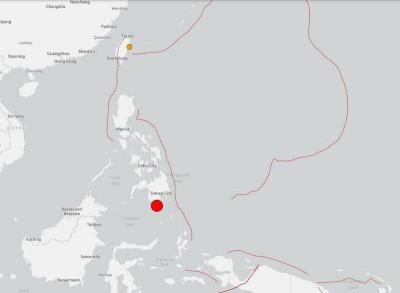
A magnitude 7.8 earthquake struck off the southern coast of Mindanao in the Philippines at 7:38am today, prompting the US Tsunami Warning System to issue an alert for neighboring countries, including Taiwan. The system issued a purple alert indicating a "tsunami threat." The potential threat zone includes Taiwan, the Philippines, Papua New Guinea, Yap and Palau. Philippine authorities were assessing the damage from the quake, with the office of civil defense seeking to verifying initial reports that 15 people had been killed and 129 injured in the region, mostly from falling debris. Arlene Hollero, disaster chief of Maasim town in the Philippines' Sarangani Province,
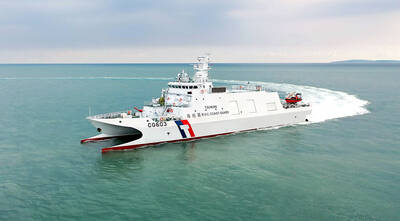
‘GRAY ZONE’ PRESSURE: Beijing’s activities are intended to create the deceitful impression that China has jurisdiction over the area around Taiwan, the CGA said Taiwan’s rights over its territorial waters and exclusive economic zone must not be violated by any country, the Mainland Affairs Council said yesterday, adding that it will not accept any unprovoked actions. The council issued the remarks in response to the China Coast Guard conducting maritime enforcement drills near eastern Taiwan and claiming to fully exercise China’s maritime administrative law enforcement authority. The Coast Guard Administration (CGA) has been closely monitoring the situation and is taking concrete steps to defend the nation’s sovereignty and secure its waters, the council said. China has no sovereign rights over the waters off eastern
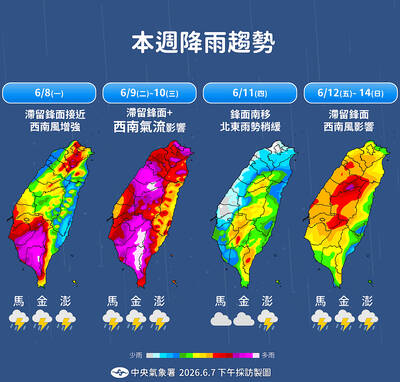
Heavy rain is expected to affect parts of Taiwan this week, the Central Weather Administration (CWA) said yesterday as a meteorologist said the active part of the annual plum rain season has started. A stationary plum rain front and southwesterly winds would bring unstable weather and abundant moisture to Taiwan from today for about a week, with the heaviest rainfall forecast for tomorrow and Wednesday, the CWA said. The agency said western and northeastern Taiwan, and mountainous areas in the east and southeast, could expect showers or thunderstorms on those two days, with localized heavy rain possible. Other parts of


 RSS
RSS