


The White House and both houses of Congress struggled Tuesday to agree on legislation that would tighten aviation security, as divisions remained over whether the federal government would run the whole security effort or just supervise it.
The legislation under negotiation would upgrade equipment, install bulletproof cockpit doors and employ well-trained, well-paid airport security screeners. The Senate version would make the screeners federal employees. But the House version would not, and companies that now screen passengers are lobbying to keep the work in their hands.
The plan also calls for expanding the number of air marshals and gradually increasing their presence on flights.
Like the legislation, airline industry recommendations, made on Monday by an aviation task force appointed by the transportation secretary soon after the hijackings of Sept. 11, called for better cockpit doors. But they also raised new security questions, including whether the people who have been searching empty jetliners for weapons daily since Sept. 11 are qualified to do so.
The task force laid out some quick remedies, among them the use of passwords to get through the cockpit door. It suggested that in any attempted takeover of an aircraft, flight attendants be left on their own, with no help from the pilots. The flight attendants would have access to "nonlethal" weapons, though.
Congressional Democrats have led the push for full federal assumption of the security effort. House Republicans say federal employees should oversee the work but not do it. Other open questions are how much the security effort will cost and how much passengers will be charged to pay for it.
Officials said the White House appeared to be moving toward those advocating a greater degree of federal involvement.
Senators Ernest Hollings, a Democrat, and John McCain, a Republican, said there was broad consensus in the Senate to nationalize security at all major airports, and argued that anything short of that would simply maintain the status quo. Hollings initially wanted to see security at all airports put under federal control but now says he is amenable to federalizing it only at the largest ones, a number somewhere between 140 and 200.
Smaller airports would have to comply with whatever stricter standards emerged from the new legislation but, with the help of federal financing, might be able to use local law enforcement agencies rather than federal workers to carry out the functions.
"The current situation is not acceptable," McCain said. "Let's see at least partial federalization."
But the executives of companies that now do the work came to Washington to argue that even if their past performance was poor, no one was ready to replace them. "We are going to be the trainers anyway," said Lior Zouker, chief executive of International Consultants on Targeted Security. "Let us train the right people."

National Taiwan University (NTU) yesterday said it disqualified a person from an entrance examination for using AI smart glasses to cheat, along with two others for making untruthful statements in their curriculum vitae. The three applicants were given null scores, Taiwan’s highest-ranked university said, calling on prospective students to be honest in the admissions process. NTU registrar Lee Hung-sen (李宏森) said that the cheating applicant wore a hat and thick-rimmed glasses to the second written exam for medical school, claiming that they felt cold. Suspicions were aroused when the applicant stared oddly at the test for long stretches while steadily bringing the paper
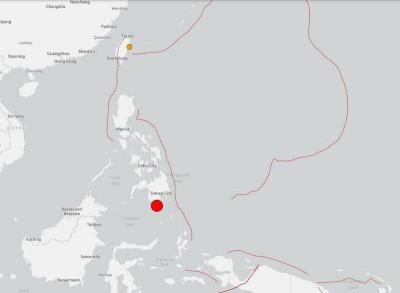
A magnitude 7.8 earthquake struck off the southern coast of Mindanao in the Philippines at 7:38am today, prompting the US Tsunami Warning System to issue an alert for neighboring countries, including Taiwan. The system issued a purple alert indicating a "tsunami threat." The potential threat zone includes Taiwan, the Philippines, Papua New Guinea, Yap and Palau. Philippine authorities were assessing the damage from the quake, with the office of civil defense seeking to verifying initial reports that 15 people had been killed and 129 injured in the region, mostly from falling debris. Arlene Hollero, disaster chief of Maasim town in the Philippines' Sarangani Province,

‘GRAY ZONE’ PRESSURE: Beijing’s activities are intended to create the deceitful impression that China has jurisdiction over the area around Taiwan, the CGA said Taiwan’s rights over its territorial waters and exclusive economic zone must not be violated by any country, the Mainland Affairs Council said yesterday, adding that it will not accept any unprovoked actions. The council issued the remarks in response to the China Coast Guard conducting maritime enforcement drills near eastern Taiwan and claiming to fully exercise China’s maritime administrative law enforcement authority. The Coast Guard Administration (CGA) has been closely monitoring the situation and is taking concrete steps to defend the nation’s sovereignty and secure its waters, the council said. China has no sovereign rights over the waters off eastern
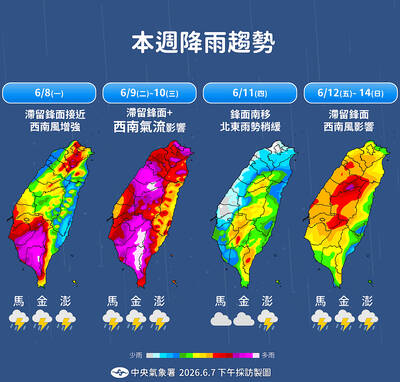
Heavy rain is expected to affect parts of Taiwan this week, the Central Weather Administration (CWA) said yesterday as a meteorologist said the active part of the annual plum rain season has started. A stationary plum rain front and southwesterly winds would bring unstable weather and abundant moisture to Taiwan from today for about a week, with the heaviest rainfall forecast for tomorrow and Wednesday, the CWA said. The agency said western and northeastern Taiwan, and mountainous areas in the east and southeast, could expect showers or thunderstorms on those two days, with localized heavy rain possible. Other parts of


 RSS
RSS