


Ten years ago, Indian software professional Gitali Pawar dreaded her occasional trips to the drab local post office.
"It was hot and dusty, and the serpentine queues made an ordeal of a simple task like buying stamps," the 28-year old said.
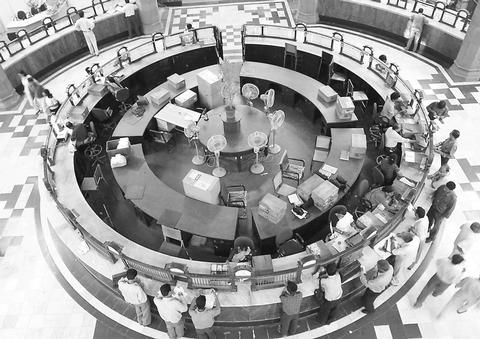
PHOTO: REUTERS
Today, it's a very different story.
The post office in central Bombay, India's financial capital, is brightly lit and air-conditioned. Posters plaster its walls, offering a range of services undreamt of a decade ago.
Pawar can now choose among services such as speed post, telefax and Internet kiosks at the post office, where cranky clerks formerly sold mainly just stamps and letters. She can also buy mutual fund units, bonds and receive money from overseas.
And very soon, she will be able to borrow money against a postal savings instrument, access an automated teller machine and change money.
Once seen as an example of public sector sloth, India Post is converting itself with a vengeance into a one-stop shop for financial services.
"Distribution of new financial services outside of eight to 10 major cities is still very low," said A.P. Singh, a director in India's department of posts.
"India Post can change this scenario and help mobilize business from hitherto untapped markets."
So, threatened also by mushrooming local courier businesses that offer an efficient alternative to its lengthy delays, India Post is grabbing opportunities created by 10 years of economic reform that have transformed India's banking sector.
Its makeover could transform the way financial services are delivered in the world's second-most populous nation, a country of more than one billion, by potentially deepening the market.
"It could well provide a useful developmental example of what could be done in other countries to help broaden financial markets," Simon Bell, a senior economist with the World Bank in Washington, said in an e-mail statement.
"The World Bank's interest in the project is the capacity to use a physical infrastructure such as the post office to deliver goods and services down to a very decentralized village level," he said.
India Post's far-flung network of 154,000 branches reaches virtually every corner of a sprawling nation which individual players would find it expensive to access.
By comparison, the country's 2,200 banks have 67,000 branches.
Besides its unparalleled reach, India Post has vast experience in mobilizing public resources. Its Post Office Savings Bank (POSB) had deposits of 1.82 trillion rupees (US$$38.5 billion), or around a fifth of national savings, at the end of the the last financial year.
And its brand name could carry it a long way as Indian investors become increasingly suspicious after a series of scandals hit the country's largest mutual fund -- a state-run outfit -- and banks.
"The Post Office Savings Bank is set to emerge as a financial services supermarket and the largest retail distributor of financial products and services," said Gautam Bhardwaj, chief of Invest India Economic Foundation (IIEF), a leading independent agency involved in financial training and education.
India Post started with a pilot project in January, and more than 200 branches in cities and towns now sell mutual fund units, bonds and offer international money transfers.
Residents of small towns such as Udipi in the southern state of Karnataka, or distant Port Blair in the Andaman and Nicobar islands in the Indian Ocean, can now buy into mutual fund schemes from neighborhood post offices.
In three years, India Post plans to sell an array of products at 3,000 branches in India's rural districts, where more than two-thirds of the population lives.
Private banks and mutual funds, which would otherwise find it too expensive to access smaller towns and villages, are watching keenly.
"With the post office -- in even a small center -- functioning as a one-stop shop for investment needs, the benefits would be far more than just greater reach," says Sanjay Sachdev, head of IDBI-Principal, the first private mutual fund to tie up with India Post.
"It gives us an opportunity to educate the common man on investments and help cultivate a healthy investment habit."
ROLLER-COASTER RIDE: More than five earthquakes ranging from magnitude 4.4 to 5.5 on the Richter scale shook eastern Taiwan in rapid succession yesterday afternoon Back-to-back weather fronts are forecast to hit Taiwan this week, resulting in rain across the nation in the coming days, the Central Weather Administration said yesterday, as it also warned residents in mountainous regions to be wary of landslides and rockfalls. As the first front approached, sporadic rainfall began in central and northern parts of Taiwan yesterday, the agency said, adding that rain is forecast to intensify in those regions today, while brief showers would also affect other parts of the nation. A second weather system is forecast to arrive on Thursday, bringing additional rain to the whole nation until Sunday, it

LANDSLIDES POSSIBLE: The agency advised the public to avoid visiting mountainous regions due to more expected aftershocks and rainfall from a series of weather fronts A series of earthquakes over the past few days were likely aftershocks of the April 3 earthquake in Hualien County, with further aftershocks to be expected for up to a year, the Central Weather Administration (CWA) said yesterday. Based on the nation’s experience after the quake on Sept. 21, 1999, more aftershocks are possible over the next six months to a year, the agency said. A total of 103 earthquakes of magnitude 4 on the local magnitude scale or higher hit Hualien County from 5:08pm on Monday to 10:27am yesterday, with 27 of them exceeding magnitude 5. They included two, of magnitude

CONDITIONAL: The PRC imposes secret requirements that the funding it provides cannot be spent in states with diplomatic relations with Taiwan, Emma Reilly said China has been bribing UN officials to obtain “special benefits” and to block funding from countries that have diplomatic ties with Taiwan, a former UN employee told the British House of Commons on Tuesday. At a House of Commons Foreign Affairs Committee hearing into “international relations within the multilateral system,” former Office of the UN High Commissioner for Human Rights (OHCHR) employee Emma Reilly said in a written statement that “Beijing paid bribes to the two successive Presidents of the [UN] General Assembly” during the two-year negotiation of the Sustainable Development Goals. Another way China exercises influence within the UN Secretariat is

Taiwan’s first drag queen to compete on the internationally acclaimed RuPaul’s Drag Race, Nymphia Wind (妮妃雅), was on Friday crowned the “Next Drag Superstar.” Dressed in a sparkling banana dress, Nymphia Wind swept onto the stage for the final, and stole the show. “Taiwan this is for you,” she said right after show host RuPaul announced her as the winner. “To those who feel like they don’t belong, just remember to live fearlessly and to live their truth,” she said on stage. One of the frontrunners for the past 15 episodes, the 28-year-old breezed through to the final after weeks of showcasing her unique


 RSS
RSS