


ASE Technology Holding Co (日月光投控), the world’s largest chip packaging and testing service provider, yesterday said it is expanding capacity at a factory in Penang, Malaysia, as the company is bullish about longer-term semiconductor demand driven by artificial intelligence (AI) and people-to-machine and machine-to-people applications.
The company expects the first building of the Malaysian factory to start operations in July next year, with construction of a second building to begin in 2025, ASE chief operating officer Tien Wu (吳田玉) told reporters on the sideline of a news conference for the Semicon Taiwan trade show in Taipei.
The Penang factory is expected to generate US$750 million in revenue in two to three years, doubling from its current US$350 million, the company said.
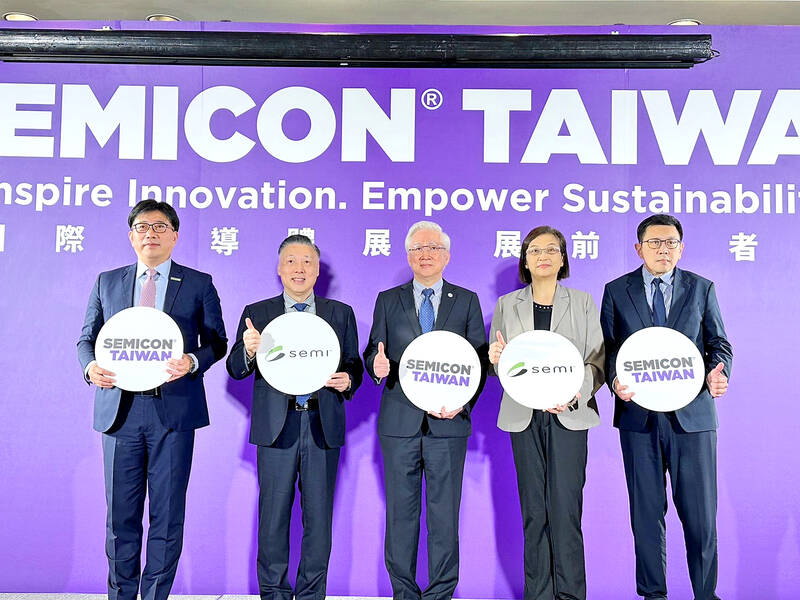
Photo: Grace Hung, Taipei Times
Wu said that ASE is also expanding capacity in California through its US subsidiary, ISE Labs Inc, in response to customer requests.
ISE Labs plans to acquire a building in San Jose for US$24 million, ASE said last week.
In Taiwan, ASE is boosting capacity at factories in Kaohsiung, Taoyuan and Taichung, Wu said.
Although the industry is undergoing an inventory correction, the demand outlook remains strong in the long term, with global semiconductor revenue likely to reach US$1 trillion in 2030, fueled by demand for chips to power AI, robots, electric vehicles, advanced driver-assistance systems and Internet of Things devices, he said.
GlobalWafers Co (環球晶圓), the world’s No. 3 silicon wafer supplier, yesterday said that the second half of this year would be tough as most customers are still digesting inventories.
However, most customers are reporting a rebound in revenue this quarter, GlobalWafers chairwoman Doris Hsu (徐秀蘭) said, adding that customers are steadily leveling off inventories.
“We have high hopes for a recovery in the first half of next year. From the second quarter next year, we expect to see a more significant pickup,” Hsu said.
However, semiconductor companies are facing pressure to diversify production locations to address geopolitical tensions and a push to reduce carbon emissions, she said.
To boost supply chain resilience, GlobalWafers and some Taiwanese companies have been asked to build capacity beyond Taiwan, which fragments capacity and raises manufacturing costs, Hsu said.
GlobalWafers faces milder pressure compared with its peers as it has diversified to 10 countries through mergers and acquisitions over the past 20 years, Hsu said.
The company also plans to spend NT$100 billion to expand capacity at its fabs for three years beginning this year, and is building a new fab in Texas, she added.

Cairo’s new monorail slices across the city skyline, running above the familiar chaos of blaring horns and aging buses’ exhaust fumes that mark rush hour below. The US$4.5 billion monorail, opened this month, is among Egypt’s most prominent new transport projects, part of a debt-funded infrastructure drive criticized for sapping state finances while bringing limited benefits to most of the country’s 109 million people. “It feels like you’re in a different country,” said Ramy Sayed, a restaurant manager, aboard a driverless Innovia 300 train. “No noise, no traffic, we’re not used to this.” The eastern line runs 56km from the bustling middle-class
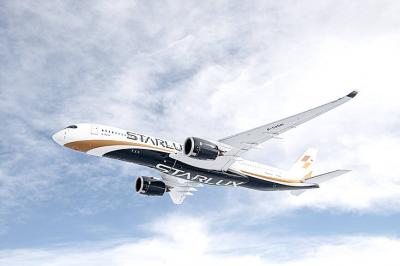
Starlux Airlines Co (星宇航空) today unveiled a long-haul network expansion plan at a shareholders’ meeting in Taipei, including direct flights to Barcelona, Spain, and Zurich, Switzerland, as well as a service connecting Taipei, Sydney and New Zealand. Starlux is to become the first Taiwanese carrier to offer non-stop services to the two European cities, while the inaugural oceanic route is expected to expand transit opportunities within the Australia-New Zealand market, Starlux said. Flight services to Chicago, Dallas, Washington and New York are under evaluation, the airline added. Prior to the shareholders’ meeting, the airline earlier this year announced that it would be

Taiwanese firms have increased investment in the Philippines in recent years as Manila’s ties with Washington deepen and global supply chains continue to shift away from China, an expert at the Chung-Hua Institution for Economic Research (CIER, 中華經濟研究院) said yesterday. The Philippines had not been among Taiwanese investors’ top choices in Southeast Asia, CIER Taiwan ASEAN Studies Center director Kristy Hsu (徐遵慈) said at a seminar in Taipei. However, Taiwan’s investment in the country has grown significantly since the COVID-19 pandemic, reaching US $257 million last year, a high in recent years, she said. Although Taiwan’s total investment in the Philippines still lags
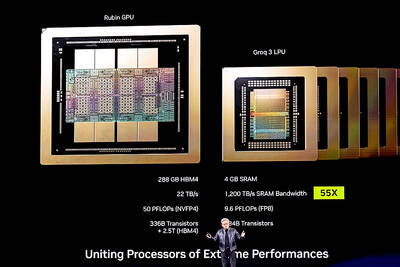
Taiwanese prosecutors suspect that three people successfully smuggled at least one shipment of Nvidia Corp artificial intelligence (AI) chips to China after first exporting them to Japan, people familiar with the matter said. The trio was detained last week by the Keelung District Prosecutors’ Office for allegedly falsifying documents related to exports of Super Micro Computer Inc servers containing advanced Nvidia chips, which the US has barred from sale to China without a license from Washington. The move marked Taiwan’s first public crackdown on AI chip diversion after years of pressure from the US to take a more active role in curtailing


 RSS
RSS