


Bank of Japan (BOJ) Governor Haruhiko Kuroda yesterday said that the COVID-19 outbreak could inflict big damage on the economy, stressing the central bank’s readiness to take “appropriate action” to underpin a fragile recovery.
Japan’s economy had been expected to recover in the current quarter, but the outbreak has hurt exports and consumption through a decline in Chinese tourists, Kuroda told parliament.
“If the epidemic is prolonged, it could also affect production,” he said.
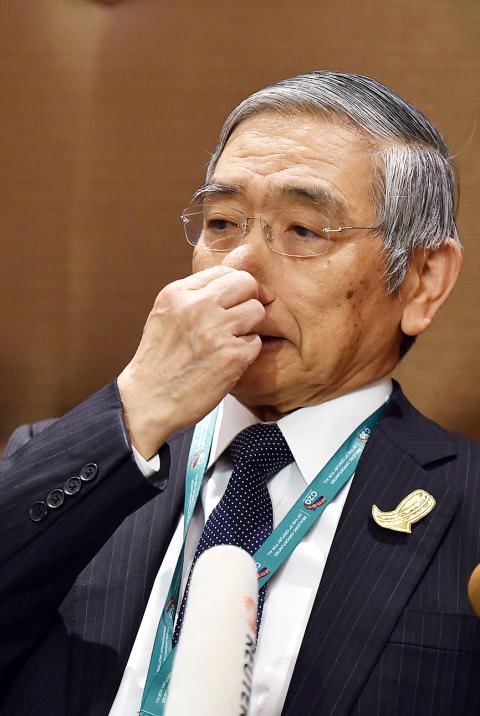
Photo: AFP
“We need to be mindful that the impact from the outbreak could be big,” Kuroda said, adding that consumer sentiment is already being hurt from the health crisis.
The remarks underscore a growing concern among BOJ policymakers over the widening fallout from the outbreak, which is hurting an economy already reeling from last year’s sales tax hike and natural disasters that disrupted production.
Heightening fears of a recession are piling pressure on the BOJ to follow in the footsteps of other central banks and ramp up stimulus as early as this month’s rate review.
The BOJ’s policy rate has stood at minus-0.1 percent for several years and the central bank has been purchasing tens of billions of yen (millions of US dollars) of government bonds and other assets to help keep credit cheap and stave off deflation as the population in the world’s No. 3 economy ages and shrinks.
While robust capital expenditure and government spending continue to underpin growth, the fate of Japan’s recovery depends largely on how long it takes to contain the outbreak, Kuroda said.
“We will carefully watch economic and market developments, and take appropriate action as needed,” he said.
More than 60 percent of Japanese firms said that their earnings were being hurt by the outbreak, a survey showed yesterday, adding to market fears that it could tip the world’s third-largest economy into recession.
However, the central bank’s policy decision could be a close call as some at the BOJ feel monetary policy can do little to eradicate fears about the outbreak that are keeping people at home, they said.
Japanese Prime Minister Shinzo Abe told a parliament committee that the government would take steps to protect jobs and mitigate the hit to the economy from the outbreak.
“We’ll closely watch global economic developments, and take sufficient and necessary economic and fiscal policies” to address risks, Abe said.
Shares of contract chipmaker Taiwan Semiconductor Manufacturing Co (TSMC, 台積電) came under pressure yesterday after a report that Apple Inc is looking to shift some orders from the Taiwanese company to Intel Corp. TSMC shares fell NT$55, or 2.4 percent, to close at NT$2,235 on the local main board, Taiwan Stock Exchange data showed. Despite the losses, TSMC is expected to continue to benefit from sound fundamentals, as it maintains a lead over its peers in high-end process development, analysts said. “The selling was a knee-jerk reaction to an Intel-Apple report over the weekend,” Mega International Investment Services Corp (兆豐國際投顧) analyst Alex Huang
Taiwan Semiconductor Manufacturing Co (TSMC, 台積電) is expected to remain Apple Inc’s primary chip manufacturing partner despite reports that Apple could shift some orders to Intel Corp, industry experts said yesterday. The comments came after The Wall Street Journal reported on Friday that Apple and Intel had reached a preliminary agreement following more than a year of negotiations for Intel to manufacture some chips for Apple devices. Taiwan Institute of Economic Research (台灣經濟研究院) economist Arisa Liu (劉佩真) said TSMC’s advanced packaging technologies, including integrated fan-out and chip-on-wafer-on-substrate, remain critical to the performance of Apple’s A-series and M-series chips. She said Intel and Samsung
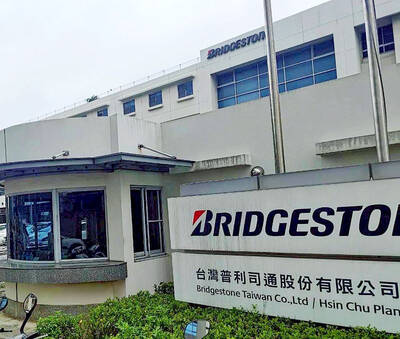
TRANSITION: With the closure, the company would reorganize its Taiwanese unit to a sales and service-focused model, Bridgestone said Bridgestone Corp yesterday announced it would cease manufacturing operations at its tire plant in Hsinchu County’s Hukou Township (湖口), affecting more than 500 workers. Bridgestone Taiwan Co (台灣普利司通) said in a statement that the decision was based on the Tokyo-based tire maker’s adjustments to its global operational strategy and long-term market development considerations. The Taiwanese unit would be reorganized as part of the closure, effective yesterday, and all related production activities would be concluded, the statement said. Under the plan, Bridgestone would continue to deepen its presence in the Taiwanese market, while transitioning to a sales and service-focused business model, it added. The Hsinchu
Taiwan Semiconductor Manufacturing Co (TSMC, 台積電) has approved a capital budget of US$31.28 billion for production expansion to meet long-term development needs during the artificial intelligence (AI) boom. The company’s board meeting yesterday approved the capital appropriation plan for purposes such as the installation of advanced technology capacity and fab construction, the world’s largest contract chipmaker said in a statement. At an earnings conference last month, TSMC forecast that its capital expenditure for this year would be at the higher end of the US$52 billion to US$56 billion range it forecast in January in response to robust demand for 5G, AI and


 RSS
RSS