


Hon Hai Precision Industry Co (鴻海精密) cut its revenue outlook for this year after deciding to impose strict quarantines at its main base for making iPhones, a measure to guard against the 2019 novel coronavirus outbreak that might hurt Apple Inc.
Hon Hai, which makes the vast majority of the world’s iPhones in Zhengzhou, China, officially resumes production on Monday next week after an extended Lunar New Year holiday.
However, workers returning from outside Henan Province — the site of its main factory — would be quarantined for 14 days, the company said in a statement, adding that any staff reporting to work who reside within the province would be isolated for seven days.

Photo: David Chang, EPA-EFE
The lost production prompted Hon Hai to slash its revenue growth forecast for this year.
The company is projecting a revenue increase of 1 to 3 percent this year, chairman Young Liu (劉揚偉) told Bloomberg News in a text message.
That is down from a Jan. 22 forecast of 3 to 5 percent growth — before the outbreak spread beyond China — and lags behind the 5.4 percent average of analysts’ projections.
“Given current market conditions, we are lowering to between 1 percent and 3 percent,” Liu said, when asked whether Hon Hai would cut its sales growth forecast for this year.
On Tuesday, Hon Hai said that it still expects to restart facilities throughout China on schedule next week, but it could take one to two weeks from then to resume full production due to the outbreak, a person with direct knowledge of the matter said.
The company has filed requests to reopen factories with Chinese authorities, the source said.
A full resumption is not possible until late this month because of various travel restrictions imposed to curb the virus, the source added.
“Roads are closed in some parts of the country. Nobody knows for sure if some workers could get back in time,” said the source, who described a “chaotic” situation in the company’s top management as it scrambles to meet different requirements for the resumption of operations set by various local governments across China.
“A full resumption will take at least one to two weeks from Feb. 10,” the person said.
The factory halt is set to hit Hon Hai’s profit for this year, but it was still evaluating the likely impact, the person said.
“Profit is definitely going to be hit, but as to how big the impact will be, we’re still calculating,” the person added.
Hon Hai, the world’s largest contract electronics manufacturer, is making plans to ensure the health and safety of its hundreds of thousands of workers, including scanning a QR code on employees’ mobile phones for health screening.
The company expects to use local workers as much as possible, while allowing time off for those who cannot travel long distances to get back to work, an internal document showed.
Hon Hai’s factories are dependent to a great extent on migrant workers from poorer regions.
“We will be very glad if the return rate could hit 30 percent [on Monday],” the source said.
Additional reporting by Reuters


The domestic unit of the Chinese-owned, Dutch-headquartered chipmaker Nexperia BV will soon be able to produce semiconductors locally within China, according to two company sources. Nexperia is at the center of a global tug-of-war over critical semiconductor technology, with a Dutch court in February ordering a probe into alleged mismanagement at the company. The geopolitical tussle has disrupted supply chains, with some carmakers reportedly forced to cut production due to chip shortages. Local production would allow Nexperia’s domestic arm, Nexperia Semiconductors (China) Ltd (安世半導體中國), to bypass restrictions in place since October on the supply of silicon wafers — etched with tiny components to

Taiwan is open to joining a global liquefied natural gas (LNG) program if one is created, but on the condition that countries provide delivery even in a scenario where there is a conflict with China, an energy department official said yesterday. While Taiwan’s priority is to have enough LNG at home, the nation is open to exploring potential strategic reserves in other countries such as Japan or South Korea, Energy Administration Deputy Director-General Chen Chung-hsien (陳崇憲) said. While the LNG market does not have a global reserve for emergencies like that of oil, the concept has been raised a few times —

Taiwan Semiconductor Manufacturing Co (TSMC, 台積電) yesterday received government approval to deploy its advanced 3-nanometer (3nm) process at its second fab currently under construction in Japan, the Ministry of Economic Affairs said in a news release. The ministry green-lit the plan for the facility in Kumamoto, which is scheduled to start installing equipment and come online in 2028 with a monthly production capacity of 15,000 12-inch wafers, the ministry said. The Department of Investment Review in June 2024 authorized a US$5.26 billion investment for the facility, slated to manufacture 6- to 12nm chips, significantly less advanced than 3nm process. At a meeting with
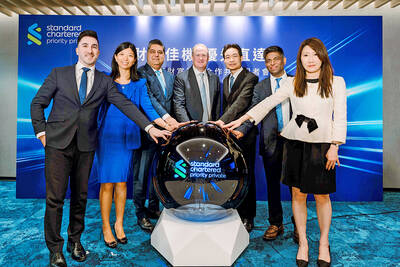
Standard Chartered Taiwan on March 26 announced that it has partnered with international fintech firm FinIQ to build an “Automated Structured Products Pricing Platform.” The bank is also introducing products from global issuers including Goldman Sachs Group Inc, Barclays PLC and BNP Paribas SA. The new platform enables an end-to-end process whereby it finds the most competitive pricing across multiple issuers in a matter of minutes, followed by automated documentation and transaction execution, which significantly shortens time-to-market and delivers a superior wealth management experience. Standard Chartered Bank Taiwan CEO Anthony Yu (游天立) said: “Standard Chartered is increasingly leveraging its wealth management


 RSS
RSS