


Japan’s goal of attracting 40 million visitors this year may already be in danger, following China’s decision to ban tour groups going overseas to help contain the impact of the rapidly spreading novel coronavirus.
Chinese tourists made up almost a third of all arrivals to Japan last year, in a year that saw visitor growth impacted by a diplomatic spat with South Korea and a series of extreme weather events.
Once considered a tourism backwater with a reputation for expensive prices and a lack of foreign language skills, Japan’s inbound boom has been one of the few unambiguous economic success stories under Japanese Prime Minister Shinzo Abe. Aided by government steps to relax visa approvals, visitors to Japan have surged almost four-fold to 31.9 million since 2012, buoying sectors from cosmetics to consumer goods and hospitality.
The government’s original goal of attracting 20 million visitors this year, when it is to host the Olympic games, was met with five years to spare and swiftly doubled. That goal could now be in doubt, with the tour restriction the latest brake on growth.
The pneumonia-like illness has led China to take unprecedented moves to lock down travel as the number of infections in the country surged to almost 2,000. Chinese President Xi Jinping (習近平) has ordered a faster response to the virus, with the ban on all outgoing overseas group tours to take effect today. Domestic group tours were suspended on Friday.
The restrictions come in the middle of Lunar New Year, a peak time for travel by Chinese to Japan. Almost a third of visitors from China came as part of tour groups in 2018, the most recent year for which information was available from the Japan National Tourism Organization.
Chinese spending has been a highlight for Japan’s tourism industry last year. Visitors from China are the largest from any country, and their spending rose 15 percent to ¥1.77 trillion (US$16.2 billion), making up almost 37 percent of the total.
That helped alleviate a plunge in arrivals from South Korea, which fell by more than 60 percent in December from the year earlier amid an escalating feud that has spread from historical grievances to trade, investment and military ties.
A series of typhoons making landfall in metropolitan areas in 2018 and last year also hurt tourism and dented the country’s reputation for smooth public transport, after the storms wreaked havoc on airports and infrastructure in Tokyo and Osaka.
In Tokyo’s tourist hubs over the weekend, a visible impact from the virus was not yet apparent. Overseas shoppers were seen buying face masks in bulk in the tourist hotspot of Asakusa, while at the Mitsukoshi department store in upscale Ginza, favored by Chinese visitors, fewer shoppers were seen buying cosmetics than usual.
The impact to Japan’s economy from the virus could exceed that of the SARS outbreak in 2003, due to the growth in inbound tourists in the interim, Mitsubishi UFJ Morgan Stanley Securities economists Shuji Tonouchi and Lee Chiwoong wrote in a note before the tour group ban was announced.
“If the new China virus spreads further to reach a scale similar to 2003, we would expect the negative impact of a drop-off in foreign tourists coming to Japan to exceed that seen in 2003,” they wrote. “In that case, we would anticipate an overall negative impact on Japan’s GDP, even after reflecting any boosts from fewer Japanese traveling abroad.”


The domestic unit of the Chinese-owned, Dutch-headquartered chipmaker Nexperia BV will soon be able to produce semiconductors locally within China, according to two company sources. Nexperia is at the center of a global tug-of-war over critical semiconductor technology, with a Dutch court in February ordering a probe into alleged mismanagement at the company. The geopolitical tussle has disrupted supply chains, with some carmakers reportedly forced to cut production due to chip shortages. Local production would allow Nexperia’s domestic arm, Nexperia Semiconductors (China) Ltd (安世半導體中國), to bypass restrictions in place since October on the supply of silicon wafers — etched with tiny components to
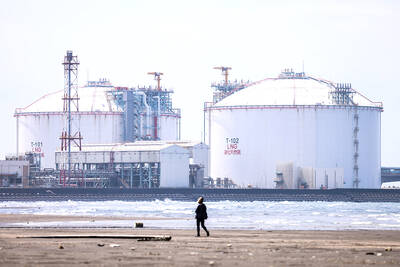
Taiwan is open to joining a global liquefied natural gas (LNG) program if one is created, but on the condition that countries provide delivery even in a scenario where there is a conflict with China, an energy department official said yesterday. While Taiwan’s priority is to have enough LNG at home, the nation is open to exploring potential strategic reserves in other countries such as Japan or South Korea, Energy Administration Deputy Director-General Chen Chung-hsien (陳崇憲) said. While the LNG market does not have a global reserve for emergencies like that of oil, the concept has been raised a few times —

Taiwan Semiconductor Manufacturing Co (TSMC, 台積電) yesterday received government approval to deploy its advanced 3-nanometer (3nm) process at its second fab currently under construction in Japan, the Ministry of Economic Affairs said in a news release. The ministry green-lit the plan for the facility in Kumamoto, which is scheduled to start installing equipment and come online in 2028 with a monthly production capacity of 15,000 12-inch wafers, the ministry said. The Department of Investment Review in June 2024 authorized a US$5.26 billion investment for the facility, slated to manufacture 6- to 12nm chips, significantly less advanced than 3nm process. At a meeting with

Standard Chartered Taiwan on March 26 announced that it has partnered with international fintech firm FinIQ to build an “Automated Structured Products Pricing Platform.” The bank is also introducing products from global issuers including Goldman Sachs Group Inc, Barclays PLC and BNP Paribas SA. The new platform enables an end-to-end process whereby it finds the most competitive pricing across multiple issuers in a matter of minutes, followed by automated documentation and transaction execution, which significantly shortens time-to-market and delivers a superior wealth management experience. Standard Chartered Bank Taiwan CEO Anthony Yu (游天立) said: “Standard Chartered is increasingly leveraging its wealth management


 RSS
RSS