


If the official figures are any guide, the good times in the Republic of the Congo should be returning.
Five years after going into a tailspin, oil — the country’s lifeblood — is flowing at a record 350,000 barrels per day after a new field, Moho Nord, went on tap.
The IMF projected that the central African state would record growth of 4 percent for last year, after 1.6 percent in 2018 and contraction in 2016 and 2017.
However, in Pointe-Noire, a port city that is home to about one-fifth of the country’s 4.5 million people, many say that any upturn has yet to reach them.
Deschagrains Ebeh, 37, is head of De-Network, one of many companies that did well out of servicing the country’s rush for black gold.
Today, Ebeh’s business card lists a dozen activities — including computing, video surveillance, training, auditing and consulting, Web site design and even a call center. He had to diversify to survive and pitch his business to individuals rather than well-heeled corporations.
To save money, he trimmed his payroll to 10 people, works as both managing director and technical director, and opened up part of his office space for coworking to ease the burden of his US$1,120 monthly rent.
With the oil crash, “we lost 50 percent of our clients and 60 percent of our customers,” Ebeh said.
In the halcyon year of 2014-2015, his company had a turnover of 500 million CFA francs (US$851,789 at the current exchange rate).
“We haven’t made any profits for four years,” he said.
Pointe-Noire Chamber of Commerce, Industry, Agriculture and Crafts president Sylvestre Didier Mavouenzela said that the oil contraction had ricocheted down the job market.
“When the crisis hit, Total [SA], the biggest company in Pointe-Noire, renegotiated lower contracts with its subcontractors,” he said.
“Fifty thousand jobs went between 2014 and 2017,” he said.
Many expatriate posts were cut — which had a knock-on effect for those working as gardeners, child caregivers or drivers.
There has been little sign of any new oil wealth trickling down — state receipts are being used to scale down public debt, in line with an agreement with the IMF, which in July last year approved a US$448 million bailout.
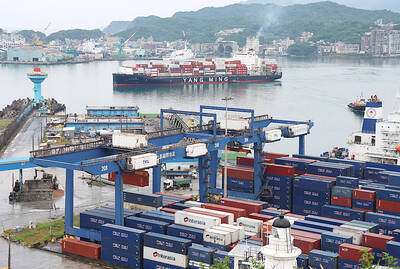
Pointe-Noire’s port has recorded a big upturn in container traffic: 900,000 units last year after 800,000 in 2018.
Yet, most of the containers are in transit, rather than destined for the local economy.
They head to other ports in the region — Matadi in the neighboring Democratic Republic of the Congo and Libreville, the capital of Gabon.
“We are going through the third round of job cuts in two years,” said Christophe Pujalte, regional director of the French group Bollore Transport & Logistics, one of the port’s operators.
“In 2015, we had 1,100 people. By the end of year, it will be less than 700,” Pujalte said.
Other figures in the local economy have plenty of complaints about governance.
They include corruption, “harassment” by tax and customs authorities and the cost of using a highway linking the city to the capital, Brazzaville — the toll is the equivalent of more than US$330 per truck for the 500km journey.
Political uncertainty is also a concern.
The last poll, in 2016, saw the re-election of Congolese President Denis Sassou Nguesso, 76, triggering unrest in Brazzaville and armed conflict in the fertile region of Pool that cut the vital rail line between the capital and Pointe-Noire.
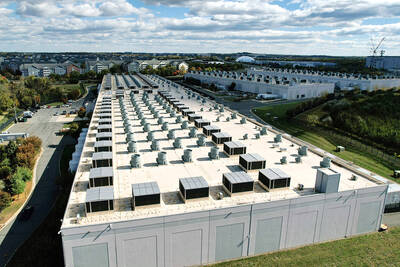
The demise of the coal industry left the US’ Appalachian region in tatters, with lost jobs, spoiled water and countless kilometers of abandoned underground mines. Now entrepreneurs are eyeing the rural region with ambitious visions to rebuild its economy by converting old mines into solar power systems and data centers that could help fuel the increasing power demands of the artificial intelligence (AI) boom. One such project is underway by a non-profit team calling itself Energy DELTA (Discovery, Education, Learning and Technology Accelerator) Lab, which is looking to develop energy sources on about 26,305 hectares of old coal land in
Taiwan’s exports soared 56 percent year-on-year to an all-time high of US$64.05 billion last month, propelled by surging global demand for artificial intelligence (AI), high-performance computing and cloud service infrastructure, the Ministry of Finance said yesterday. Department of Statistics Director-General Beatrice Tsai (蔡美娜) called the figure an unexpected upside surprise, citing a wave of technology orders from overseas customers alongside the usual year-end shopping season for technology products. Growth is likely to remain strong this month, she said, projecting a 40 percent to 45 percent expansion on an annual basis. The outperformance could prompt the Directorate-General of Budget, Accounting and

Netflix on Friday faced fierce criticism over its blockbuster deal to acquire Warner Bros Discovery. The streaming giant is already viewed as a pariah in some Hollywood circles, largely due to its reluctance to release content in theaters and its disruption of traditional industry practices. As Netflix emerged as the likely winning bidder for Warner Bros — the studio behind Casablanca, the Harry Potter movies and Friends — Hollywood’s elite launched an aggressive campaign against the acquisition. Titanic director James Cameron called the buyout a “disaster,” while a group of prominent producers are lobbying US Congress to oppose the deal,

Two Chinese chipmakers are attracting strong retail investor demand, buoyed by industry peer Moore Threads Technology Co’s (摩爾線程) stellar debut. The retail portion of MetaX Integrated Circuits (Shanghai) Co’s (上海沐曦) upcoming initial public offering (IPO) was 2,986 times oversubscribed on Friday, according to a filing. Meanwhile, Beijing Onmicro Electronics Co (北京昂瑞微), which makes radio frequency chips, was 2,899 times oversubscribed on Friday, its filing showed. The bids coincided with Moore Threads’ trading debut, which surged 425 percent on Friday after raising 8 billion yuan (US$1.13 billion) on bets that the company could emerge as a viable local competitor to Nvidia


 RSS
RSS