


The nondescript building on an industrial site near Kyoto gave little hint to the productivity inside: 30,000 heads of lettuce grow inside daily, under artificial light and with barely any human intervention.
This “vegetable factory,” using the latest vertical farming techniques, is part of a trend born out of necessity in Japan, where traditional farming faces a double threat from the aging population and migration toward cities.
With the average age of a farmer in Japan at 67 and few candidates to replace those dying out, the country has been forced to become a pioneer in so-called vertical farming.
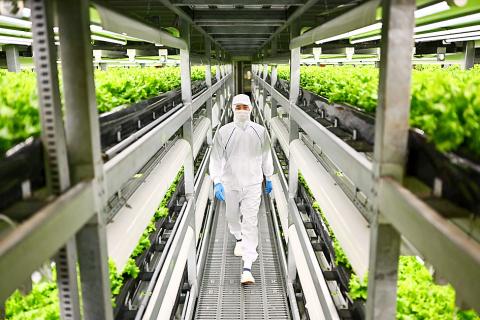
Photo: AFP
Globally renowned firms such as Panasonic Corp, Toshiba Corp and Fujitsu Ltd have tried their hand — converting old semiconductor production lines with varying levels of success.
One of the few companies to turn a quick profit, Spread Co Ltd produces 11 million heads of lettuce annually from its latest factory in Kyoto, a vast sterile area where the vegetables are stacked on shelves several meters high.
Machines shift the lettuces around the factory to areas where the light, temperature and humidity are ideal for that stage of growth. The process works without soil or pesticides, and only a dozen or so humans are employed to collect the lettuce at the end.
Other countries have employed vertical farming techniques — notably Denmark and the US — but Japan’s population crisis means that farmers are dying out, with question marks over how the world’s third-biggest economy will feed itself.
“Given the lack of manpower and decline in agricultural production, I felt a new system was needed,” Spread CEO Shinji Inada told reporters.
Spread has taken some time to make the process nearly fully automated: An older factory in Kyoto still employs several dozen humans to move the lettuce — a “difficult task,” one staff member said.
However, the advantages are clear.
“We can produce in large quantities and at a stable rate all year round, without being affected by temperature changes,” Inada said.
“The other benefit is that we have few losses, because our products are preserved for longer,” the vegetable tycoon added.
The firm initially experienced some difficulty in selling the lettuce, Inada said, but added that it has now grown a good brand by producing consistent quality at a consistent price — in a country where prices vary considerably depending on the season.
Spread’s lettuce is found on supermarket shelves in Kyoto and the capital, Tokyo, and Inada has grand expansion visions to move production closer to where the vegetables are consumed.
The firm is building a factory in Narita near Tokyo and is eyeing further afield to countries where the climate is not suited for such agriculture.
“We can easily export our production system to very warm or very cold climates to grow lettuce,” Inada said.
However, is this system environmentally friendly?
Inada said that he hesitated before launching the concept over this very question, but finally reasoned the pros outweighed the cons.
“It’s true that we use more energy compared to production using the sun, but on the other hand our productivity is higher over a similar surface area,” he said.
The system allows the firm to produce eight crops of lettuce per year, irrespective of the season. Spread also uses significantly less water than traditional agricultural methods.
“I believe we are contributing to a sustainable agriculture for our society,” Inada said.
Japan already has about 200 lettuce factories using artificial light, the majority of which are small-scale, but specialist consultancy group Innoplex LLC said that such factories would double in number by 2025.
Other companies are jumping on the smart agriculture bandwagon, with Mitsubishi Gas Chemical Co Inc building a factory in northeastern Fukushima that is to produce 32,000 heads of lettuce daily.
Nor is it just lettuce: tomatoes and strawberries grown by computer under artificial light are on their way to a table near you.

The domestic unit of the Chinese-owned, Dutch-headquartered chipmaker Nexperia BV will soon be able to produce semiconductors locally within China, according to two company sources. Nexperia is at the center of a global tug-of-war over critical semiconductor technology, with a Dutch court in February ordering a probe into alleged mismanagement at the company. The geopolitical tussle has disrupted supply chains, with some carmakers reportedly forced to cut production due to chip shortages. Local production would allow Nexperia’s domestic arm, Nexperia Semiconductors (China) Ltd (安世半導體中國), to bypass restrictions in place since October on the supply of silicon wafers — etched with tiny components to

Singapore-based ride-hailing and delivery giant Grab Holdings Ltd has applied for regulatory approval to acquire the Taiwan operations of Germany-based Delivery Hero SE's Foodpanda in a deal valued at about US$600 million. Grab submitted the filing to the Fair Trade Commission on Friday last week, with the transaction subject to regulatory review and approval, the company said in a statement yesterday. Its independent governance structure would help foster a healthy and competitive market in Taiwan if the deal is approved, Grab said. Grab, which is listed on the NASDAQ, said in the filing that US-based Uber Technologies Inc holds about 13 percent of
Taiwan is open to joining a global liquefied natural gas (LNG) program if one is created, but on the condition that countries provide delivery even in a scenario where there is a conflict with China, an energy department official said yesterday. While Taiwan’s priority is to have enough LNG at home, the nation is open to exploring potential strategic reserves in other countries such as Japan or South Korea, Energy Administration Deputy Director-General Chen Chung-hsien (陳崇憲) said. While the LNG market does not have a global reserve for emergencies like that of oil, the concept has been raised a few times —

Taiwan Semiconductor Manufacturing Co (TSMC, 台積電) yesterday received government approval to deploy its advanced 3-nanometer (3nm) process at its second fab currently under construction in Japan, the Ministry of Economic Affairs said in a news release. The ministry green-lit the plan for the facility in Kumamoto, which is scheduled to start installing equipment and come online in 2028 with a monthly production capacity of 15,000 12-inch wafers, the ministry said. The Department of Investment Review in June 2024 authorized a US$5.26 billion investment for the facility, slated to manufacture 6- to 12nm chips, significantly less advanced than 3nm process. At a meeting with


 RSS
RSS