


The official manufacturing purchasing managers’ index (PMI) last month climbed to 56.2, the fastest expansion in 19 months, as local companies benefited from 5G deployment and inventory demand for electronics ahead of the Lunar New Year holiday, the Chung-Hua Institution for Economic Research (CIER, 中華經濟研究院) said yesterday.
Companies turned upbeat about their prospects for the first time since July last year, with the possibility of a US-China phase one deal on Jan. 15 contributing to the optimism, the Taipei-based think tank said.
The PMI value — the result of a monthly survey intended to gauge the health of the nation’s manufacturing sectors — indicated an upturn in operating conditions for a third consecutive month.
Scores higher than 50 indicate an expansion, while those below the threshold suggest a contraction.
“An increase in demand for semiconductor equipment fueled the pickup and inventory demand ahead of the Lunar New Year holiday also contributed,” CIER president Chen Shi-kuan (陳思寬) told a media briefing in Taipei.
Chinese technology brands are rolling out 5G smartphones in an effort to increase sales over the Lunar New Year holiday this month.
All sectors reported business improvement with the exception of companies that supply electrical and machinery equipment, the monthly survey showed, meaning that companies selling chemical, plastic and basic materials also emerged from a protracted slowdown.
The sub-index on overall new business orders added 0.5 points to 61.5, while new export orders posted a concrete gain of 5.5 points to 55.8, CIER said, adding that the reading on industrial production reached an impressive 59.9, although easing from 60.4 a month earlier.
Manufacturers kept high headcounts last month, with the employment sub-index at 55, down from 55.6 in November, the survey showed.
Most companies have a positive business outlook moving forward, with the six-month outlook adding 8.4 points to 57.4 — pushing above 50 for the first time since July last year, CIER said.
Chen said that he attributed the rise in sentiment to reports that Washington and Beijing aim to sign a trade deal on Jan. 15 and organize further negotiations afterward.
Steve Lai (賴樹鑫), executive director at Supply Management Institute in Taiwan (中華採購與供應管理協會), said that 5G deployment would bring new consumer experiences and lend support to companies that are tapping related businesses.
The non-manufacturing index (NMI) was 54.1 from 55 in November, reflecting vibrant operating conditions for service-oriented firms for the 10th month in a row.
All sectors had an increase in business except for restaurants and hotels, the NMI report said.

Taichung reported the steepest fall in completed home prices among the six special municipalities in the first quarter of this year, data compiled by Taiwan Realty Co (台灣房屋) showed yesterday. From January through last month, the average transaction price for completed homes in Taichung fell 8 percent from a year earlier to NT$299,000 (US$9,483) per ping (3.3m²), said Taiwan Realty, which compiled the data based on the government’s price registration platform. The decline could be attributed to many home buyers choosing relatively affordable used homes to live in themselves, instead of newly built homes in the city’s prime property market, Taiwan Realty
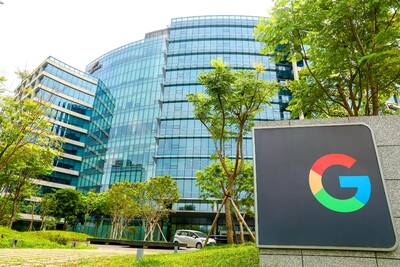
The government yesterday approved applications by Alphabet Inc’s Google to invest NT$27.08 billion (US$859.98 million) in Taiwan, the Ministry of Economic Affairs said in a statement. The Department of Investment Review approved two investments proposed by Google, with much of the funds to be used for data processing and electronic information supply services, as well as inventory procurement businesses in the semiconductor field, the ministry said. It marks the second consecutive year that Google has applied to increase its investment in Taiwan. Google plans to infuse NT$25.34 billion into Charter Investments Ltd (特許投資顧問) through its Singapore-based subsidiary Fructan Holdings Singapore Pte Ltd, and

JET JUICE: The war on Iran’s secondary effects have seen fuel prices skyrocket, knocking flight schedules down to earth in return as airlines struggle with costs Airline passengers should brace for more irritation in the next few months as carriers worldwide cancel flights and ground planes to cope with stratospheric increases in jet-fuel prices. Dutch flag carrier KLM is the latest company to cut its schedule, saying on Thursday that it would scrap 80 return flights at Amsterdam’s Schiphol Airport in the coming month. That puts it in the same league as United Airlines Holdings Inc, Deutsche Lufthansa AG and Cathay Pacific Airways Ltd, which have all pruned itineraries to mitigate costs. Global capacity for next month has been reduced by about 3 percentage points, with all
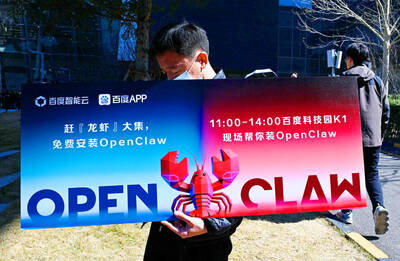
FORESEEABLE CONSEQUENCES: New technology always comes with new innovations by the iniquitous in exploiting users for financial gain or more nefarious ends Artificial intelligence (AI) “agents” say they can save users time and energy by automating tasks, but the growing power of systems such as OpenClaw is putting cybersecurity experts on edge. Powered by a wave of hype, OpenClaw today says it has more than three million users worldwide. The system allows users to create so-called agents, tools based on a large language model (LLM) such as OpenAI’s ChatGPT or Anthropic PBC’s Claude, that can carry out online tasks. “We’ve moved from an AI you could talk with via a chatbot to an agentic AI, which can take action... the threat and the risks are


 RSS
RSS