


Saudi Arabia put a preliminary valuation on its state-owned oil giant Saudi Arabian Oil Co (Aramco) of between US$1.6 trillion and US$1.71 trillion, short of the US$2 trillion target set by Saudi Crown Prince Mohammad bin Salman in 2016.
Aramco is seeking as much as US$25.6 billion by selling a 1.5 percent stake. The company would raise US$24 billion if the deal prices at the lower end — just shy of the US$25 billion raised by Alibaba Group Holding Ltd (阿里巴巴), currently the world’s largest initial public offering (IPO).
With one-third of the deal reserved for Saudi retail investors, Aramco is to rely heavily on the local market.
The shares are to be offered at a price range of 30 riyals to 32 riyals per share, and Aramco would publish the final price and valuation on Dec. 5.
Saudi Arabia has been pulling out all the stops to ensure the IPO — key to the crown prince’s plans to diversify the economy — is a success. It has cut the tax rate for Aramco and is promising a hefty dividend.
The kingdom has also negotiated commitments from its wealthiest families to invest in the offering, as many international money managers seem ready to pass.
“We expect a decent cover in the range of 2x-3x oversubscription for this size,” wrote Aarthi Chandrasekaran, a portfolio manager in Abu Dhabi at Shuaa Capital.
“From a retail perspective, assured bonus shares and fixed dividend will support the stock price in the secondary market, not to forget the passive funds flow that follows in few weeks after the listing,” Chandrasekaran said.
Still, valuation has been a sticking point ever since the crown prince first floated the idea in 2016. Aramco has faced a delicate balance by pushing the valuation as close as possible to US$2 trillion — a figure that has been met with skepticism from many investors — while making sure it is attractive to potential Saudi buyers.
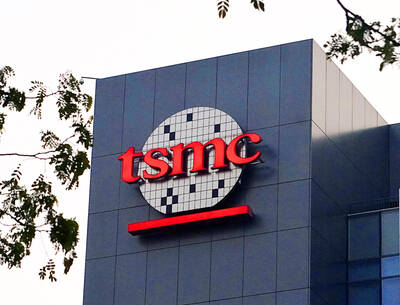
Taiwan’s long-term economic competitiveness will hinge not only on national champions like Taiwan Semiconductor Manufacturing Co. (TSMC, 台積電) but also on the widespread adoption of artificial intelligence (AI) and other emerging technologies, a US-based scholar has said. At a lecture in Taipei on Tuesday, Jeffrey Ding, assistant professor of political science at the George Washington University and author of "Technology and the Rise of Great Powers," argued that historical experience shows that general-purpose technologies (GPTs) — such as electricity, computers and now AI — shape long-term economic advantages through their diffusion across the broader economy. "What really matters is not who pioneers

In a high-security Shenzhen laboratory, Chinese scientists have built what Washington has spent years trying to prevent: a prototype of a machine capable of producing the cutting-edge semiconductor chips that power artificial intelligence (AI), smartphones and weapons central to Western military dominance, Reuters has learned. Completed early this year and undergoing testing, the prototype fills nearly an entire factory floor. It was built by a team of former engineers from Dutch semiconductor giant ASML who reverse-engineered the company’s extreme ultraviolet lithography (EUV) machines, according to two people with knowledge of the project. EUV machines sit at the heart of a technological Cold
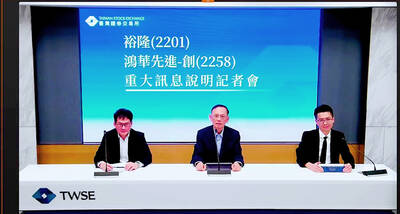
TAIWAN VALUE CHAIN: Foxtron is to fully own Luxgen following the transaction and it plans to launch a new electric model, the Foxtron Bria, in Taiwan next year Yulon Motor Co (裕隆汽車) yesterday said that its board of directors approved the disposal of its electric vehicle (EV) unit, Luxgen Motor Co (納智捷汽車), to Foxtron Vehicle Technologies Co (鴻華先進) for NT$787.6 million (US$24.98 million). Foxtron, a half-half joint venture between Yulon affiliate Hua-Chuang Automobile Information Technical Center Co (華創車電) and Hon Hai Precision Industry Co (鴻海精密), expects to wrap up the deal in the first quarter of next year. Foxtron would fully own Luxgen following the transaction, including five car distributing companies, outlets and all employees. The deal is subject to the approval of the Fair Trade Commission, Foxtron said. “Foxtron will be
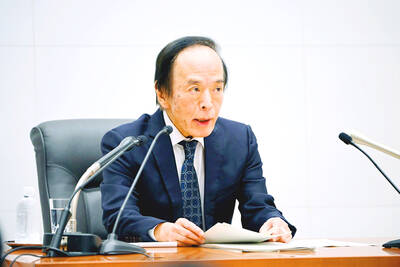
INFLATION CONSIDERATION: The BOJ governor said that it would ‘keep making appropriate decisions’ and would adjust depending on the economy and prices The Bank of Japan (BOJ) yesterday raised its benchmark interest rate to the highest in 30 years and said more increases are in the pipeline if conditions allow, in a sign of growing conviction that it can attain the stable inflation target it has pursued for more than a decade. Bank of Japan Governor Kazuo Ueda’s policy board increased the rate by 0.2 percentage points to 0.75 percent, in a unanimous decision, the bank said in a statement. The central bank cited the rising likelihood of its economic outlook being realized. The rate change was expected by all 50 economists surveyed by Bloomberg. The


 RSS
RSS