


Chinese shoppers snapped up food supplements, facial masks and baby milk powder at the world’s largest shopping festival, with brands such as L’Oreal and Nestle among the biggest winners, Alibaba Group Holding Ltd (阿里巴巴) data showed.
The Chinese e-commerce giant’s annual Singles’ Day shopping blitz on Monday brought in a record 268.4 billion yuan (US$38.38 billion) in sales, more than six times the amount of online sales made in the US on Black Friday last year.
Alibaba yesterday said that 299 brands surpassed 100 million yuan in gross merchandise value, among them smartphone makers Huawei Technologies Co (華為) and Apple Inc, LVMH Moet Hennessy Louis Vuitton SE’s Givenchy, home appliance makers Dyson Ltd and Royal Philips NV and sportswear makers Nike Inc and Under Armour Inc.
Food supplements were the most popular import product, while sales of makeup, diapers and face wash were also strong.
Sales growth for the annual shopping festival this year eased to 26 percent, the weakest since the event started in 2009, in a reflection of how e-commerce sales in China have been slowing.
However, analysts said the growth rate had slightly beaten their expectations, saying that more aggressive promotions, a focus on attracting more customers from rural cities, and even the overall slowing economy might have helped, as people sought to buy goods at discounted prices.
Citic Securities Co (中信證券) had predicted a 20 to 25 percent expansion, while Daiwa Capital Markets Inc had an estimate of 23 percent.
“What’s happened is that you’ve had a lot of consumers this year being a little bit more careful about their purchasing, because the economy’s slowing down,” said Ben Cavender, managing director of consultancy China Market Research Group.
“I think this year especially, people were kind of waiting for Singles’ Day and kind of waiting to make some of those medium-sized purchases that they didn’t want to pay full price for,” he said.
Liu Xingliang (劉興亮), Internet analyst at DCCI Data Center, who was among guests invited to Alibaba’s headquarters on the day of the event, said the firm’s efforts to reach smaller, lower-tier cities with real bargains played a significant role.
“I saw them selling electronic toothbrushes at 9.9 yuan, and 65-inch TV sets at 1,800 yuan. People in lower-tier cities and towns can afford these products and in fact, they like big TVs more than city people, because they usually have larger houses,” Liu said.
CHIP RACE: Three years of overbroad export controls drove foreign competitors to pursue their own AI chips, and ‘cost US taxpayers billions of dollars,’ Nvidia said China has figured out the US strategy for allowing it to buy Nvidia Corp’s H200s and is rejecting the artificial intelligence (AI) chip in favor of domestically developed semiconductors, White House AI adviser David Sacks said, citing news reports. US President Donald Trump on Monday said that he would allow shipments of Nvidia’s H200 chips to China, part of an administration effort backed by Sacks to challenge Chinese tech champions such as Huawei Technologies Co (華為) by bringing US competition to their home market. On Friday, Sacks signaled that he was uncertain about whether that approach would work. “They’re rejecting our chips,” Sacks
NATIONAL SECURITY: Intel’s testing of ACM tools despite US government control ‘highlights egregious gaps in US technology protection policies,’ a former official said Chipmaker Intel Corp has tested chipmaking tools this year from a toolmaker with deep roots in China and two overseas units that were targeted by US sanctions, according to two sources with direct knowledge of the matter. Intel, which fended off calls for its CEO’s resignation from US President Donald Trump in August over his alleged ties to China, got the tools from ACM Research Inc, a Fremont, California-based producer of chipmaking equipment. Two of ACM’s units, based in Shanghai and South Korea, were among a number of firms barred last year from receiving US technology over claims they have
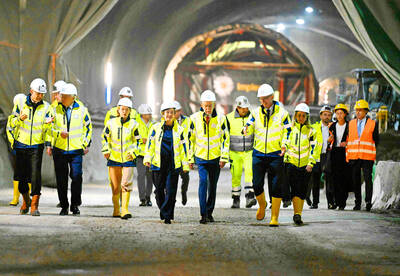
It is challenging to build infrastructure in much of Europe. Constrained budgets and polarized politics tend to undermine long-term projects, forcing officials to react to emergencies rather than plan for the future. Not in Austria. Today, the country is to officially open its Koralmbahn tunnel, the 5.9 billion euro (US$6.9 billion) centerpiece of a groundbreaking new railway that will eventually run from Poland’s Baltic coast to the Adriatic Sea, transforming travel within Austria and positioning the Alpine nation at the forefront of logistics in Europe. “It is Austria’s biggest socio-economic experiment in over a century,” said Eric Kirschner, an economist at Graz-based Joanneum

BUBBLE? Only a handful of companies are seeing rapid revenue growth and higher valuations, and it is not enough to call the AI trend a transformation, an analyst said Artificial intelligence (AI) is entering a more challenging phase next year as companies move beyond experimentation and begin demanding clear financial returns from a technology that has delivered big gains to only a small group of early adopters, PricewaterhouseCoopers (PwC) Taiwan said yesterday. Most organizations have been able to justify AI investments through cost recovery or modest efficiency gains, but few have achieved meaningful revenue growth or long-term competitive advantage, the consultancy said in its 2026 AI Business Predictions report. This growing performance gap is forcing executives to reconsider how AI is deployed across their organizations, it said. “Many companies


 RSS
RSS