


It might sound like science fiction, but in a few short years the family dinner table could be laden with steak from a printer and other proteins produced from air, methane or volcanic microbes.
With the explosive success of vegan beef and burger substitutes developed by Beyond Meat Inc and Impossible Foods Inc, the alternative protein sector just keeps growing.
Alternative meat sales could reach US$140 billion — or 10 percent of the global meat industry — within a decade, or a 10-fold increase from current levels, Barclays PLC said.
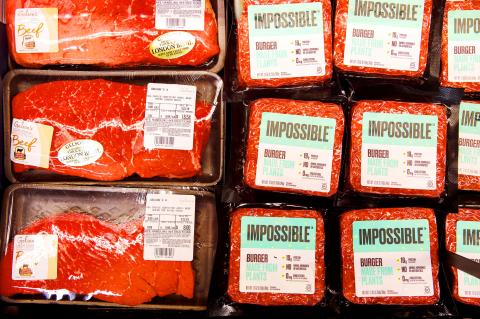
Photo: Bloomberg
A new generation of products in the works melds cutting-edge technology with age-old fermentation processes to turn otherwise harmful or everyday elements into essential food ingredients, with the aim of reducing agriculture’s massive carbon footprint.
Agriculture, forestry and other land use activities accounted for 23 percent of total net greenhouse gas emissions of human origin from 2007 to 2016, soaring to 37 percent when pre and post-production activity were factored in, UN data showed.
Meanwhile, livestock are responsible for about 14.5 percent of global greenhouse gas emissions, the UN Food and Agriculture Organization said.
Enter Solar Foods Ltd, a Finnish company working on an edible protein powder called Solein, which uses water, air and renewable electricity as a way to separate food production from agriculture.
“You avoid land use impacts like clearing forests for agriculture, use of pesticides and use of fertilizers that release greenhouse gases and so on,” Solar Foods cofounder and CEO Pasi Vainikka said.
Solein is made by putting microbes into a liquid and feeding them small bubbles of hydrogen and carbon dioxide, a process similar to making beer or wine, apart from the lack of grapes or grains, he said.
As the liquid thickens, it is dried into a very fine powder that is about 65 percent protein and tastes much like wheat flour.
In September, Solar Foods struck an agreement with Nordic food company Fazer Group to develop products using Solein, which can be used in existing plant-based offerings or future products such as lab-grown meat.
Solein is to cost about 5 euro (US$5.51) per kilogram to produce and would hit the market by 2021, Vainikka said.
“There’s a lot of climate anxiety,” Vainikka said. “And people are looking for hope and solutions, and they’re happy to see companies like ours, so that’s encouraging.”
Another company tackling agriculture’s emissions through fermentation, Bengaluru, India-based String Bio Pvt Ltd, is working to convert methane, a greenhouse gas more potent than carbon dioxide as it traps 28 times more heat, from waste and natural sources into protein powder — initially for animals.
“We said this is probably the best impact we humans can have in this world, where we take something that we don’t need for the environment and convert it into something we do need,” said Vinod Kumar, who founded the company with his wife, Ezhil Subbian.
Such environmental considerations, along with concerns over animal welfare and human health, have driven both demand and supply of alternative proteins, investment firm Unovis Partners managing partner Dan Altschuler Malek said.
He said that just 10 years ago retailers saw alternative proteins as a risky bet, but “today they realize there is a huge demand for all these products.”
Unovis manages New Crop Capital, a fund that invests exclusively in start-ups developing meat, seafood and dairy replacements, including Beyond Meat.
New Crop has also invested in NovaMeat, a Spanish company that uses a special 3D printer to produce steak that can mimic the taste and texture of meat.
The printers produce 3D vegan steaks using cartridge-style syringes that extrude plant-based proteins.
Some have criticized plant-based alternatives flooding store shelves as highly processed and high in sodium, and Harvard University scientists have questioned their role in a healthy diet.
Others, such as the Center for Consumer Freedom, which is backed by the food and beverage industry, have launched campaigns decrying so-called “fake meat” as loaded with chemicals.
Proponents counter that burgers have always been laden with fat and sodium and were never exactly considered health food.
The new generation of proteins is also less processed, said Thomas Jonas, CEO of Sustainable Bioproducts Inc, whose protein is based on microbes found in volcanic hot springs at the US’ Yellowstone National Park.
In that barren, otherworldly and dangerous landscape, researchers “discovered a bunch of life-forms that across millennia evolved to survive in this environment,” he said.
Having raised US$33 million in February, the company plans to produce “a hamburger equivalent” next year through a “novel fermentation” of the microbes.
At full capacity, its 3,250m2 plant in Chicago could produce burgers equivalent to those made from cows grazing on 6,100 hectares of land, Jonas said.
For investors like Altschuler Malek, alternative proteins are all about options for consumers, with three essential caveats.
“It needs to taste great, it needs to meet certain price points and it needs to be able to be manufactured in large volume,” Malek said.
“There are amazing chefs all over the world that are doing plant-based products, but if you cannot convert that into mass manufacturing, it’s really hard to see how that can actually make a change in the world,” he said.
It is also an opportunity for a radical shift in agriculture, which, despite incremental improvements, has remained much the same for centuries, Jonas said.
“Fundamentally, we are surviving on this planet based on an agricultural system that has barely changed in the past 11,000 years ... when we domesticated a handful of plants and animals,” Jonas said.
“New technologies are really giving us tools for a second domestication — things that we didn’t even know were there,” he added.

SECOND-RATE: Models distilled from US products do not perform the same as the original and undo measures that ensure the systems are neutral, the US’ cable said The US Department of State has ordered a global push to bring attention to what it said are widespread efforts by Chinese companies, including artificial intelligence (AI) start-up DeepSeek (深度求索), to steal intellectual property from US AI labs, according to a diplomatic cable. The cable, dated Friday and sent to diplomatic and consular posts around the world, instructs diplomatic staff to speak to their foreign counterparts about “concerns over adversaries’ extraction and distillation of US AI models.” Distillation is the process of training smaller AI models using output from larger, more expensive ones to lower the costs of training a powerful new

Singapore-based ride-hailing and delivery giant Grab Holdings’ planned acquisition of Foodpanda’s Taiwan operations has yet to enter the formal review stage, as regulators await supplementary documents, the Fair Trade Commission (FTC) said yesterday. Acting FTC Chairman Chen Chih-min (陳志民) told the legislature’s Economics Committee that although Grab submitted its application on March 27, the case has not been officially accepted because required materials remain incomplete. Once the filing is finalized, the FTC would launch a formal probe into the deal, focusing on issues such as cross-shareholding and potential restrictions on market competition, Chen told lawmakers. Grab last month announced that it would acquire
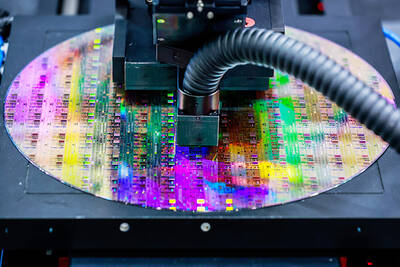
The artificial intelligence (AI) boom has triggered a seismic reshuffling of global equity markets, with Taiwan and South Korea muscling past European nations one by one. With its stock market now valued at nearly US$4.3 trillion, Taiwan surpassed the UK, Europe’s biggest market, earlier this month, data compiled by Bloomberg showed. South Korea is about US$140 billion away from doing the same. The tech-heavy Asian markets have shot past Germany and France in the past seven months. The shift is largely down to massive gains in shares of three companies that provide essential hardware for AI: Taiwan Semiconductor Manufacturing Co (TSMC, 台積電),

Shares of Taiwan Semiconductor Manufacturing Co (TSMC, 台積電) have repeatedly hit new highs, but an equity analyst said the stock’s valuation remains within a reasonable range and any pullback would likely be technical. The contract chipmaker’s historical price-to-earnings (P/E) ratio has ranged between 20 and 30, Cathay Futures Consultant Co (國泰證期) analyst Tsai Ming-han (蔡明翰) told Central News Agency. With market consensus projecting that TSMC would post earnings per share of about NT$100 (US$3.17) this year, supported by strong global demand for artificial intelligence (AI) applications, and the stock currently trading at a P/E ratio of below 25, Tsai said the valuation


 RSS
RSS