


Oil rose the most in six weeks on Friday on upbeat US jobs data and Chinese manufacturing figures, but persistent trade dispute concerns kept prices down on the week.
Futures in New York rose 3.7 percent on Friday, the biggest jump since the attacks on Saudi oil infrastructure in September. US hiring proved unexpectedly resilient last month and new Chinese manufacturing orders rose at the quickest pace in more than six years.
Still, prices for the week were dragged down by concerns of a slowing global economy, abundant US crude stockpiles and trade talks.
“The main thing here is the good economic news — Chinese data suggested it was time to buy back in,” said Michael Lynch, president of Strategic Energy & Economic Research in Winchester, Massachusetts. “But we’re still in a situation where there’s too much oil out there and the economic news generally looks like we are going for a downturn in the next six months and that’s got people concerned.”
Prices fell this week as Chinese officials cast doubt on the potential to reach a comprehensive long-term trade deal with the US even as the two sides get close to signing an initial accord.
The protracted dispute, together with ample oil supplies, is putting pressure on OPEC and its allies to reduce output further to prop up prices.
“Looking ahead, any price recovery faces an uphill struggle given the backdrop of rising supply and cooling demand,” PVM Oil Associates analyst Stephen Brennock wrote in a report.
West Texas Intermediate (WTI) for December delivery rose US$2.02 to settle at US$56.20 a barrel on the New York Mercantile Exchange, down 0.8 percent for the week.
Brent for January delivery advanced US$2.07 to close at US$61.69 a barrel on the London-based ICE Futures Europe Exchange, little changed from last week’s US$61.73 a barrel. The global benchmark crude traded at a premium of US$5.42 to WTI for the same month.
China reached a consensus in principle with the US on the first phase of a potential trade deal, according to the Chinese Ministry of Commerce.
However, Chinese officials remain skeptical, saying that would require the US to withdraw tariffs on about US$360 billion of imports from China — something many do not see US President Donald Trump being ready to do.
“The trade issue has been overhanging on the market for quite some time,” said Gene McGillian, senior analyst and broker at Tradition Energy Group in Stamford, Connecticut. “Right now the market is eyeing signs of whether trade negotiations are going to bear fruit.”

Taiwan Semiconductor Manufacturing Co (TSMC, 台積電) last week recorded an increase in the number of shareholders to the highest in almost eight months, despite its share price falling 3.38 percent from the previous week, Taiwan Stock Exchange data released on Saturday showed. As of Friday, TSMC had 1.88 million shareholders, the most since the week of April 25 and an increase of 31,870 from the previous week, the data showed. The number of shareholders jumped despite a drop of NT$50 (US$1.59), or 3.38 percent, in TSMC’s share price from a week earlier to NT$1,430, as investors took profits from their earlier gains

AI TALENT: No financial details were released about the deal, in which top Groq executives, including its CEO, would join Nvidia to help advance the technology Nvidia Corp has agreed to a licensing deal with artificial intelligence (AI) start-up Groq, furthering its investments in companies connected to the AI boom and gaining the right to add a new type of technology to its products. The world’s largest publicly traded company has paid for the right to use Groq’s technology and is to integrate its chip design into future products. Some of the start-up’s executives are leaving to join Nvidia to help with that effort, the companies said. Groq would continue as an independent company with a new chief executive, it said on Wednesday in a post on its Web

CHINA RIVAL: The chips are positioned to compete with Nvidia’s Hopper and Blackwell products and would enable clusters connecting more than 100,000 chips Moore Threads Technology Co (摩爾線程) introduced a new generation of chips aimed at reducing artificial intelligence (AI) developers’ dependence on Nvidia Corp’s hardware, just weeks after pulling off one of the most successful Chinese initial public offerings (IPOs) in years. “These products will significantly enhance world-class computing speed and capabilities that all developers aspire to,” Moore Threads CEO Zhang Jianzhong (張建中), a former Nvidia executive, said on Saturday at a company event in Beijing. “We hope they can meet the needs of more developers in China so that you no longer need to wait for advanced foreign products.” Chinese chipmakers are in
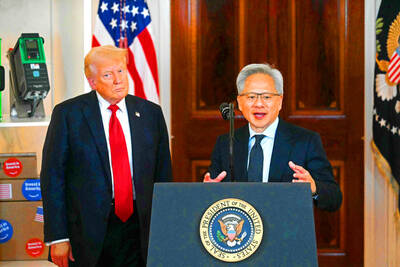
POLICY REVERSAL: The decision to allow sales of Nvidia’s H200 chips to China came after years of tightening controls and has drawn objections among some Republicans US House Republicans are calling for arms-sale-style congressional oversight of artificial intelligence (AI) chip exports as US President Donald Trump’s administration moves to approve licenses for Nvidia Corp to ship its H200 processor to China. US Representative Brian Mast, the Republican chairman of the US House Committee on Foreign Affairs, which oversees export controls, on Friday introduced a bill dubbed the AI Overwatch Act that would require the US Congress to be notified of AI chips sales to adversaries. Any processors equal to or higher in capabilities than Nvidia’s H20 would be subject to oversight, the draft bill says. Lawmakers would have


 RSS
RSS