


Even as Walt Disney Co, HBO Inc and Apple Inc lavish billions on content to gatecrash TV streaming wars, social networks like Facebook, YouTube and Snapchat are creating their own original shows to get their piece of the advertising pie.
Historically, these three social networks are better known for hosting user-generated content. However, in the past few years, each has invested in scripted programming that is free to view — unlike the streaming giants, which charge subscriptions.
At one stage, Google’s YouTube planned to charge for shows such as Karate Kid spinoff Cobra Kai and Generation Z comedy Liza on Demand using its premium service. However, it backtracked this year.

Photo: AP
Free access “gives advertisers more opportunities to engage with a broader audience ... and align with top Hollywood talent and YouTube creators,” the company said in May.
For YouTube, which has at times been condemned for the questionable content posted by users, offering high-quality series with production values matching conventional TV also burnishes its reputation.
Mark Beal, a Rutgers professor who wrote a book, Decoding Gen Z, on the generation born since the mid-1990s, said young people “do not respond to traditional advertising.”
However, they might be more receptive to branding tied to original content on platforms such as YouTube, he said.
Still, after its ambitious burst of content, YouTube has slowed down its original production, scrapping multiple new and existing programs to focus on a few successful shows.
Quality, not quantity also appears to be Facebook Inc’s strategy on scripted shows.
In the middle of last month, it released Limetown, a Web drama starring Jessica Biel based on a popular podcast of the same name. In addition to boosting the social network’s image with prestige content, the show helps drive its Facebook Watch video platform.
Both Limetown and Elizabeth Olsen-starring flagship show Sorry For Your Loss benefit from and drive interaction among Facebook’s nearly 2.5 billion monthly users.
“That, to me, is the most exciting part,” Limetown co-producer Michelle Purple said at the Toronto film festival in September.
“From week to week, audiences can have their water-cooler moment together and talk about what happened, and what they think is going to happen,” she said.
Sorry For Your Loss tackles themes of grief, and moderators are on hand to offer online psychological support for users seeking help.
Both dramas are dark in tone and intended for older audiences, reflecting Facebook’s demographic compared with younger platforms, such as Snapchat and TikTok.
While Snapchat owner Snap Inc also produces fictional programming to increase user interactions and time spent on its platform, it does so in its own distinctive way.
Episodes are typically only a few minutes long, shot at a frantic pace with flashy visual effects, and are filmed vertically to suit smartphone viewing.
Unlike YouTube and Facebook, Snapchat is not skimping on quantity.
In April, it announced six brand-new scripted shows, followed by a further three in September, on top of those already available including sorority hacking comedy Kappa Crypto and supernatural mystery The Dead Girls Detective Agency.
Though a long way from the US$15 million per episode Apple TV+ is throwing at flagship series The Morning Show, Snap is still happy to spend up to US$50,000 per episode, according to media Web site Digiday.
“Mobile is now the dominant medium for telling stories and consuming content,” Snapchat original content head Sean Mills said at a summit in April.
“This transformation is creating massive new opportunities.”

Taiwan Semiconductor Manufacturing Co (TSMC, 台積電) last week recorded an increase in the number of shareholders to the highest in almost eight months, despite its share price falling 3.38 percent from the previous week, Taiwan Stock Exchange data released on Saturday showed. As of Friday, TSMC had 1.88 million shareholders, the most since the week of April 25 and an increase of 31,870 from the previous week, the data showed. The number of shareholders jumped despite a drop of NT$50 (US$1.59), or 3.38 percent, in TSMC’s share price from a week earlier to NT$1,430, as investors took profits from their earlier gains

In a high-security Shenzhen laboratory, Chinese scientists have built what Washington has spent years trying to prevent: a prototype of a machine capable of producing the cutting-edge semiconductor chips that power artificial intelligence (AI), smartphones and weapons central to Western military dominance, Reuters has learned. Completed early this year and undergoing testing, the prototype fills nearly an entire factory floor. It was built by a team of former engineers from Dutch semiconductor giant ASML who reverse-engineered the company’s extreme ultraviolet lithography (EUV) machines, according to two people with knowledge of the project. EUV machines sit at the heart of a technological Cold

TAIWAN VALUE CHAIN: Foxtron is to fully own Luxgen following the transaction and it plans to launch a new electric model, the Foxtron Bria, in Taiwan next year Yulon Motor Co (裕隆汽車) yesterday said that its board of directors approved the disposal of its electric vehicle (EV) unit, Luxgen Motor Co (納智捷汽車), to Foxtron Vehicle Technologies Co (鴻華先進) for NT$787.6 million (US$24.98 million). Foxtron, a half-half joint venture between Yulon affiliate Hua-Chuang Automobile Information Technical Center Co (華創車電) and Hon Hai Precision Industry Co (鴻海精密), expects to wrap up the deal in the first quarter of next year. Foxtron would fully own Luxgen following the transaction, including five car distributing companies, outlets and all employees. The deal is subject to the approval of the Fair Trade Commission, Foxtron said. “Foxtron will be
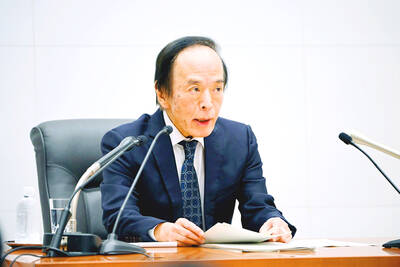
INFLATION CONSIDERATION: The BOJ governor said that it would ‘keep making appropriate decisions’ and would adjust depending on the economy and prices The Bank of Japan (BOJ) yesterday raised its benchmark interest rate to the highest in 30 years and said more increases are in the pipeline if conditions allow, in a sign of growing conviction that it can attain the stable inflation target it has pursued for more than a decade. Bank of Japan Governor Kazuo Ueda’s policy board increased the rate by 0.2 percentage points to 0.75 percent, in a unanimous decision, the bank said in a statement. The central bank cited the rising likelihood of its economic outlook being realized. The rate change was expected by all 50 economists surveyed by Bloomberg. The


 RSS
RSS