


Microsoft Corp on Wednesday reported its latest quarterly report card to Wall Street, buoyed by another round of business customers signing up for its cloud computing services.
The company reported fiscal first-quarter profit of US$10.7 billion, up 21 percent from the same period last year.
The net income of US$1.38 per share beat Wall Street expectations. The average estimate of 13 analysts surveyed by Zacks Investment Research was for earnings of US$1.25 per share.
The software maker posted revenue of US$33.1 billion in the July-to-September period, up 14 percent from last year and also beating forecasts. Ten analysts surveyed by Zacks expected US$32.2 billion.
Microsoft shares have risen 35 percent since the beginning of the year, while the Standard & Poor’s 500 index has risen 20 percent.
In the final minutes of trading on Wednesday, the shares hit US$137.11, an increase of 27 percent in the past 12 months. It has been dueling with Apple Inc this season as the most valuable company in the S&P 500.
Microsoft chief executive officer Satya Nadella has been rewarded for his efforts in steadily lifting the company’s earnings since taking over in 2014.
His compensation was US$42.9 million in the fiscal year that ended in June, a 66 percent increase from the previous year, according to a statement filed last week ahead of the company’s annual shareholders’ meeting in December.
That included a US$1 million base salary increase, which the board said it awarded because of “his significant contributions to Microsoft’s success during his tenure as CEO” and a desire to encourage his “continued strong leadership.”
The strongest sales growth has come from adding new corporate and government clients to Microsoft’s Azure cloud computing platform, Microsoft said.
Azure’s quarterly revenue grew 59 percent from the same time last year, much of that powered by contracts worth at least US$10 million each, it said.
A less profitable part of Microsoft’s business has been its consumer products, such as Xbox, which saw no revenue growth in the quarter, and Surface laptops, which declined 4 percent.
The Surface team, though a small part of Microsoft’s business, launched a new line of devices this fall and expects demand to pick up during the holiday season.

Taiwan Semiconductor Manufacturing Co (TSMC, 台積電) last week recorded an increase in the number of shareholders to the highest in almost eight months, despite its share price falling 3.38 percent from the previous week, Taiwan Stock Exchange data released on Saturday showed. As of Friday, TSMC had 1.88 million shareholders, the most since the week of April 25 and an increase of 31,870 from the previous week, the data showed. The number of shareholders jumped despite a drop of NT$50 (US$1.59), or 3.38 percent, in TSMC’s share price from a week earlier to NT$1,430, as investors took profits from their earlier gains
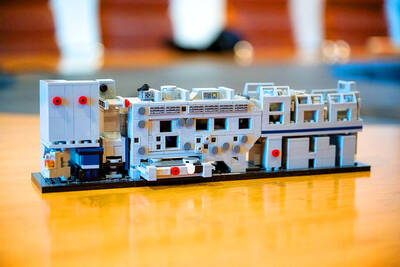
In a high-security Shenzhen laboratory, Chinese scientists have built what Washington has spent years trying to prevent: a prototype of a machine capable of producing the cutting-edge semiconductor chips that power artificial intelligence (AI), smartphones and weapons central to Western military dominance, Reuters has learned. Completed early this year and undergoing testing, the prototype fills nearly an entire factory floor. It was built by a team of former engineers from Dutch semiconductor giant ASML who reverse-engineered the company’s extreme ultraviolet lithography (EUV) machines, according to two people with knowledge of the project. EUV machines sit at the heart of a technological Cold
AI TALENT: No financial details were released about the deal, in which top Groq executives, including its CEO, would join Nvidia to help advance the technology Nvidia Corp has agreed to a licensing deal with artificial intelligence (AI) start-up Groq, furthering its investments in companies connected to the AI boom and gaining the right to add a new type of technology to its products. The world’s largest publicly traded company has paid for the right to use Groq’s technology and is to integrate its chip design into future products. Some of the start-up’s executives are leaving to join Nvidia to help with that effort, the companies said. Groq would continue as an independent company with a new chief executive, it said on Wednesday in a post on its Web

CHINA RIVAL: The chips are positioned to compete with Nvidia’s Hopper and Blackwell products and would enable clusters connecting more than 100,000 chips Moore Threads Technology Co (摩爾線程) introduced a new generation of chips aimed at reducing artificial intelligence (AI) developers’ dependence on Nvidia Corp’s hardware, just weeks after pulling off one of the most successful Chinese initial public offerings (IPOs) in years. “These products will significantly enhance world-class computing speed and capabilities that all developers aspire to,” Moore Threads CEO Zhang Jianzhong (張建中), a former Nvidia executive, said on Saturday at a company event in Beijing. “We hope they can meet the needs of more developers in China so that you no longer need to wait for advanced foreign products.” Chinese chipmakers are in


 RSS
RSS