


Contract electronics manufacturer Inventec Corp (英業達) is to invest NT$4.8 billion (US$156.93 million) to expand local production facilities, the Ministry of Economic Affairs said yesterday as it approved the firm’s application to join a government plan to boost investments in Taiwan.
The news came after Inventec president Maurice Wu (巫永財) told investors last month that the company is planning to shift all of its operations to produce US-bound laptops to Taiwan to avoid US tariffs on Chinese-made goods.
The Taipei-headquartered Inventec is relocating some of its production lines from Chongqing in China’s Sichuan Province to a manufacturing site in Taoyuan’s Dasi District (大溪).
At the same time, Inventec also plans to move some of its server production lines from Shanghai to its Gueishan District (龜山) plant in Taoyuan, the ministry said, adding that the company’s latest investment would create up to 1,526 jobs.
The ministry also approved precision metal ball manufacturer Tan Kong Precision Tech Co’s (天工精密) application to invest NT$1.7 billion in a new plant at the Central Taiwan Science Park (中部科學園區) to expand its production capacity in Taiwan.
Through the investment, Tan Kong aims to develop smart production systems solutions and incorporate ceramic materials into its production process, the ministry said.
Since January, Taiwanese companies returning to Taiwan have pledged a total of NT$622.3 billion in investments, which are expected to create 54,889 jobs, the ministry said.
In related news, the ministry approved three companies’ applications, worth NT$12.2 billion in combined investments, to participate in a separate government program.
Hiwin Mikrosystem Corp (大銀微系統), which makes components and system for linear motion and positioning controls, plans to invest more than NT$4.3 billion to expand its plant at the Fengshan Industrial Park (鳳山工業區) in Hsinchu County and establish a new plant at the Yunlin Technology Industrial Park (雲林科技工業區), the ministry said.
The new facility would produce alternating current servo motors and would be completed next month, Hiwin Mikrosystem executive vice president Yu Kai-sheng (游凱勝) told a news conference last month.
The investment is expected to create 157 jobs, the ministry said.
APEX Dynamics Inc (台灣精銳科技), which specializes in high-precision planetary gearboxes for servo motors, plans to invest NT$3 billion to expand its plant at the Central Taiwan Science Park, the ministry said.
The company exports more than 90 percent of its products, with major brand customers including Apple Inc, Royal Philips NV, Samsung Electronics Co, AU Optronics Corp (友達光電) and Innolux Corp (群創光電).
An unnamed optoelectronics manufacturer plans to invest NT$4.8 billion to set up a production facility at the Central Taiwan Industrial Park, which would create about 300 jobs, the ministry added.

The EU and US are nearing an agreement to coordinate on producing and securing critical minerals, part of a push to break reliance on Chinese supplies. The potential deal would create incentives, such as minimum prices, that could advantage non-Chinese suppliers, according to a draft of an “action plan” seen by Bloomberg. The EU and US would also cooperate on standards, investments and joint projects, as well as coordinate on any supply disruptions by countries like China. The two sides are additionally seeking other “like-minded partners” to join a multicountry accord to help create these new critical mineral supply chains, which feed into

For weeks now, the global tech industry has been waiting for a major artificial intelligence (AI) launch from DeepSeek (深度求索), seen as a benchmark for China’s progress in the fast-moving field. More than a year has passed since the start-up put Chinese AI on the map in early last year with a low-cost chatbot that performed at a similar level to US rivals. However, despite reports and rumors about its imminent release, DeepSeek’s next-generation “V4” model is nowhere in sight. Speculation is also swirling over the geopolitical implications of which computer chips were chosen to train and power the new

Elon Musk’s lieutenants have reached out to chip industry suppliers, including Applied Materials Inc, Tokyo Electron Ltd and Lam Research Corp, for his envisioned Terafab, early steps in an audacious and likely arduous attempt to break into the production of cutting-edge chips. Staff working for the joint venture between Tesla Inc and Space Exploration Technologies Corp (SpaceX) have sought price quotes and delivery times for an array of chipmaking gear, people familiar with the matter said. In past weeks, they’ve contacted makers of photomasks, substrates, etchers, depositors, cleaning devices, testers and other tools, according to the people, who asked not to
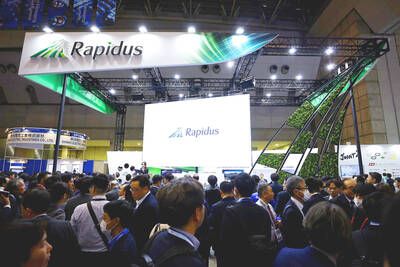
Japan approved ¥631.5 billion (US$3.97 billion) in additional subsidies to hasten Rapidus Corp’s entry into the high-stakes artificial intelligence (AI) chipmaking arena, ramping up support for a project widely regarded as a long shot. The capital is intended to bankroll Rapidus’ work for information technology firm Fujitsu Ltd, one of the initial customers that Tokyo hopes would get the signature endeavor off the ground. The new money raises the fees and investments that the government is injecting into the start-up to ¥2.6 trillion by the end of the current fiscal year to March next year, the Japanese Ministry of Economy, Trade and


 RSS
RSS