


WeWork will narrowly avoid financial ruin and in the process reward its former leader, Adam Neumann, with as much as US$1.2 billion.
The reaction from his former colleagues, who are still facing the prospect of mass job cuts and a corporate crisis: “You’ve got to be kidding me.”
That was one of the comments posted on Tuesday on WeWork’s staff-wide communications system, reflecting a broader mood throughout its headquarters in New York.
Dozens of employees expressed indignation in interviews and messages to colleagues on company Slack channels that were relayed to Bloomberg. They requested anonymity in a bid to protect their jobs, as management weighs the dismissal of thousands of employees.
WeWork’s board on Tuesday agreed to take a bailout from Softbank Group Corp, which would secure an 80 percent stake.
The Japanese conglomerate would provide US$6.5 billion to the business as it is on the verge of running out of money.
It would also buy as much as US$3 billion in stock from shareholders at the lowest price since 2015.
Almost a third of that offer might be allocated to Neumann, in addition to a consulting fee of about US$185 million, a US$500 million credit line and the ability to appoint two board members.
In exchange, Neumann is to step down from his role as chairman.
Most employees who sell their shares to Softbank would do so for less than the paper value of their stakes when they were issued.
Mike Adams, who sold a start-up to WeWork, said the payout to Neumann was an “injustice.”
Representatives for Neumann and WeWork declined to comment.
A spokeswoman for Softbank did not immediately respond to a request for comment.
Neumann, 40, built WeWork into a global real-estate company fueled by relentless optimism and billions of dollars in investment capital and debt.
His sermons about community and mission engendered fierce loyalty among staff and investors for years.
However, his aura vanished over the last couple months when public investors were given a closer look at the business ahead of an initial public offering (IPO).
WeWork’s parent company, We Company, abandoned the IPO, and Softbank helped oust Neumann as chief executive.
In recent weeks, an executive exodus and cost-saving measures had already dampened morale. In satellite offices, many workers had stopped coming into work.
News of Neumann’s “platinum parachute,” as one former employee described it, made things a lot worse this week.
Several workers noted the irony that WeWork could not afford payroll costs associated with the planned job cuts, but that its largest shareholder, Masayoshi Son’s Softbank, agreed to pay a hefty fee to Neumann.
“So we’re too broke to pay employees severance, but Adam gets US$200m?” one post read.
Another employee posted a photo of the orphan from Oliver Twist, with the caption: “Please, Masayoshi Son, can I have some severance?”

Taiwan Semiconductor Manufacturing Co (TSMC, 台積電) last week recorded an increase in the number of shareholders to the highest in almost eight months, despite its share price falling 3.38 percent from the previous week, Taiwan Stock Exchange data released on Saturday showed. As of Friday, TSMC had 1.88 million shareholders, the most since the week of April 25 and an increase of 31,870 from the previous week, the data showed. The number of shareholders jumped despite a drop of NT$50 (US$1.59), or 3.38 percent, in TSMC’s share price from a week earlier to NT$1,430, as investors took profits from their earlier gains
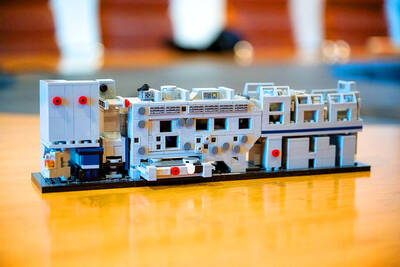
In a high-security Shenzhen laboratory, Chinese scientists have built what Washington has spent years trying to prevent: a prototype of a machine capable of producing the cutting-edge semiconductor chips that power artificial intelligence (AI), smartphones and weapons central to Western military dominance, Reuters has learned. Completed early this year and undergoing testing, the prototype fills nearly an entire factory floor. It was built by a team of former engineers from Dutch semiconductor giant ASML who reverse-engineered the company’s extreme ultraviolet lithography (EUV) machines, according to two people with knowledge of the project. EUV machines sit at the heart of a technological Cold
AI TALENT: No financial details were released about the deal, in which top Groq executives, including its CEO, would join Nvidia to help advance the technology Nvidia Corp has agreed to a licensing deal with artificial intelligence (AI) start-up Groq, furthering its investments in companies connected to the AI boom and gaining the right to add a new type of technology to its products. The world’s largest publicly traded company has paid for the right to use Groq’s technology and is to integrate its chip design into future products. Some of the start-up’s executives are leaving to join Nvidia to help with that effort, the companies said. Groq would continue as an independent company with a new chief executive, it said on Wednesday in a post on its Web

CHINA RIVAL: The chips are positioned to compete with Nvidia’s Hopper and Blackwell products and would enable clusters connecting more than 100,000 chips Moore Threads Technology Co (摩爾線程) introduced a new generation of chips aimed at reducing artificial intelligence (AI) developers’ dependence on Nvidia Corp’s hardware, just weeks after pulling off one of the most successful Chinese initial public offerings (IPOs) in years. “These products will significantly enhance world-class computing speed and capabilities that all developers aspire to,” Moore Threads CEO Zhang Jianzhong (張建中), a former Nvidia executive, said on Saturday at a company event in Beijing. “We hope they can meet the needs of more developers in China so that you no longer need to wait for advanced foreign products.” Chinese chipmakers are in


 RSS
RSS