


The nation’s US Business Day, which matches Taiwanese suppliers with US companies, is expected to increase trade opportunities this year by 10 to 20 percent as more US firms avoid tariffs imposed by Washington on Chinese imports by buying Taiwanese goods, Taiwan External Trade Development Council (TAITRA, 外貿協會) chairman James Huang (黃志芳) said yesterday.
TAITRA declined to provide a total for the amount of business opportunities the annual event might generate, but it said that positive responses from US companies indicated that the amount could be higher than last year’s NT$168.3 million (US$5.42 million).
The amount is estimated to reach NT$185.13 million to NT$201.96 million, based on Huang’s comment.
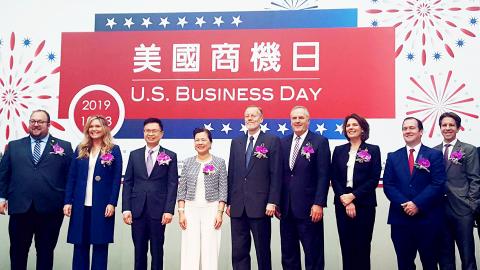
Photo: CNA
The event at the Taipei International Convention Center was attended by dozens of US companies, including server manufacturer Super Micro Computer Inc, retailers Meijer Inc and Staples Inc, organic foods distributor United Natural Foods Inc, and motor and power tool maker WW Grainger Inc, the council said.
The event is a platform for US companies to buy information and communications technology (ICT) products, auto parts, machines, bicycles, textiles and food products from more than 200 Taiwanese firms, the Ministry of Economic Affairs said.
Several US state governments also participated, seeking Taiwanese companies with plans to cooperate with agencies or invest in the US, the ministry said.
“The US is proud to be one of Taiwan’s top trading partners, and we look forward to finding new ways to strengthen and expand our trade relationship,” American Institute in Taiwan Director Brent Christensen told participants.
A report released last month by the Ministry of Finance suggested that orders are being diverted from China to Taiwan, as Taiwanese companies in August shipped 28.4 percent more of the products that in China are hit by US tariffs, compared with last year, while exports of products not on the US tariff list increased only 6.9 percent.
In the first eight months of this year, Taiwan’s exports to the US increased 18 percent year-on-year, with ICT and electronics goods making up the majority, while imports from the US climbed 8 percent, the Ministry of Economic Affairs said.
“The US is well aware that the increase is mainly due to more companies moving their production bases back to Taiwan, instead of re-exportation through Taiwan,” Vice Minister of Economic Affairs Wang Mei-hua (王美花) said, adding that the ministry would be monitoring the nation’s rising trade surplus with the US.
Asked whether Taiwan might sign a free-trade agreement with the US, Wang said that some US lawmakers would like to deepen trade ties with Taiwan, and that this would be a good time to sign an agreement.
However, the US government is busy with other trade issues and support for Taiwan comes mainly from the private sector, she said.
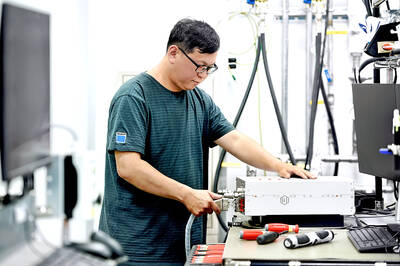
SEMICONDUCTORS: The German laser and plasma generator company will expand its local services as its specialized offerings support Taiwan’s semiconductor industries Trumpf SE + Co KG, a global leader in supplying laser technology and plasma generators used in chip production, is expanding its investments in Taiwan in an effort to deeply integrate into the global semiconductor supply chain in the pursuit of growth. The company, headquartered in Ditzingen, Germany, has invested significantly in a newly inaugurated regional technical center for plasma generators in Taoyuan, its latest expansion in Taiwan after being engaged in various industries for more than 25 years. The center, the first of its kind Trumpf built outside Germany, aims to serve customers from Taiwan, Japan, Southeast Asia and South Korea,

Gasoline and diesel prices at domestic fuel stations are to fall NT$0.2 per liter this week, down for a second consecutive week, CPC Corp, Taiwan (台灣中油) and Formosa Petrochemical Corp (台塑石化) announced yesterday. Effective today, gasoline prices at CPC and Formosa stations are to drop to NT$26.4, NT$27.9 and NT$29.9 per liter for 92, 95 and 98-octane unleaded gasoline respectively, the companies said in separate statements. The price of premium diesel is to fall to NT$24.8 per liter at CPC stations and NT$24.6 at Formosa pumps, they said. The price adjustments came even as international crude oil prices rose last week, as traders
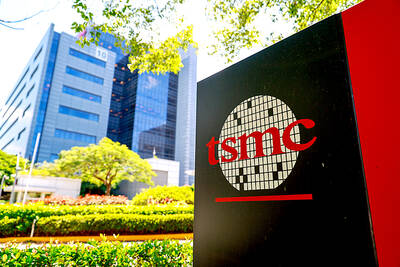
Taiwan Semiconductor Manufacturing Co (TSMC, 台積電), which supplies advanced chips to Nvidia Corp and Apple Inc, yesterday reported NT$1.046 trillion (US$33.1 billion) in revenue for last quarter, driven by constantly strong demand for artificial intelligence (AI) chips, falling in the upper end of its forecast. Based on TSMC’s financial guidance, revenue would expand about 22 percent sequentially to the range from US$32.2 billion to US$33.4 billion during the final quarter of 2024, it told investors in October last year. Last year in total, revenue jumped 31.61 percent to NT$3.81 trillion, compared with NT$2.89 trillion generated in the year before, according to
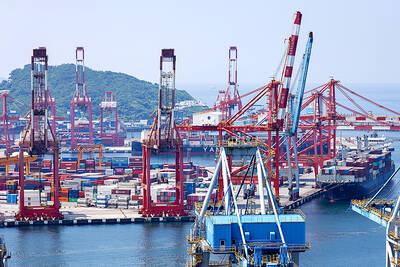
PRECEDENTED TIMES: In news that surely does not shock, AI and tech exports drove a banner for exports last year as Taiwan’s economic growth experienced a flood tide Taiwan’s exports delivered a blockbuster finish to last year with last month’s shipments rising at the second-highest pace on record as demand for artificial intelligence (AI) hardware and advanced computing remained strong, the Ministry of Finance said yesterday. Exports surged 43.4 percent from a year earlier to US$62.48 billion last month, extending growth to 26 consecutive months. Imports climbed 14.9 percent to US$43.04 billion, the second-highest monthly level historically, resulting in a trade surplus of US$19.43 billion — more than double that of the year before. Department of Statistics Director-General Beatrice Tsai (蔡美娜) described the performance as “surprisingly outstanding,” forecasting export growth


 RSS
RSS