


Another research institute yesterday raised its forecast for Taiwan’s economic growth this year, as more companies return home from China amid the US-China trade feud, driving up private investment and cushioning the blow from soft external demand.
Yuanta-Polaris Research Institute (元大寶華綜經院) revised up its GDP growth forecast for this year to 2.3 percent from the 2.1 percent it predicted six months earlier, as China-based companies shift production bases back home at a faster pace and a greater scale.
“The supply chain realignment has made Taiwan less of a victim of the ongoing trade dispute and cut its economic dependence on China, although the link remains strong,” the Taipei-based think tank’s president Liang Kuo-yuan (梁國源) said.
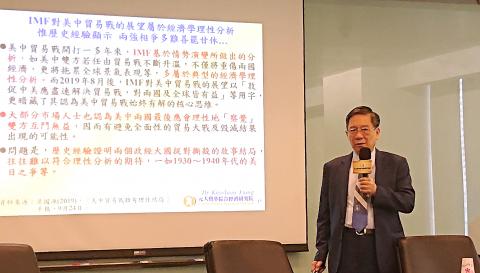
Photo: CNA
A government-backed survey late last year found that 45.8 percent of Taiwanese firms in China said they intend to adjust their investments or relocate, Liang said.
That ratio rose to 49.6 percent in the first half of this year, he added.
Nearly 19 percent would move back to Taiwan, while 22 percent favor Southeast Asia, mainly Vietnam, as a relocation destination, he said, citing government data.
The figure should climb further as the US and China are scheduled to impose additional tariffs, with no sign of a resolution in sight, Liang said.
Against this backdrop, Yuanta-Polaris now expects private investment to expand 5.05 percent, from a previous estimate of 3.67 percent.
Government incentives have helped foster investment at home, and the nation has benefited from Chinese firms cutting reliance on US suppliers and shifting orders to Taiwanese firms, Liang said.
Exports to the US soared to a record 19 percent of outbound shipments in the first eight months of the year, but shipments to China still accounted for the bulk at 40 percent, making Taiwan vulnerable to a slowdown in China, which would become more evident next year, he said.
The Taiwanese economy would remain resilient next year, but with growth easing to 2.2 percent, as similar downside risks linger, Liang said.
Low inflation and interest rates, stemming from protracted monetary easing, have squeezed room for returns and contributed to a stagnant economy, he said.
“Domestic companies are generally cautious about business prospects as several surveys have shown,” Liang said.
A monthly survey released yesterday by the Taiwan Institute of Economic Research (TIER, 台灣經濟研究院) shared similar observations.
The manufacturing industry’s sentiment gauge came in at 96.14 last month, up 1.16 points from one month earlier, although more companies were negative about the business outlook and fewer firms were upbeat, the TIER report showed.
The service sector shed 1.46 points to 91.16, as stock brokers, banks retailers and logistics operators fared weaker, it said.

ENERGY ISSUES: The TSIA urged the government to increase natural gas and helium reserves to reduce the impact of the Middle East war on semiconductor supply stability Chip testing and packaging service provider ASE Technology Holding Co (日月光投控) yesterday said it planned to invest more than NT$100 billion (US$3.15 billion) in building a new advanced chip testing facility in Kaohsiung to keep up with customer demand driven by the artificial intelligence (AI) boom. That would be included in the company’s capital expenditure budget next year, ASE said. There is also room to raise this year’s capital spending budget from a record-high US$7 billion estimated three months ago, it added. ASE would have six factories under construction this year, another record-breaking number, ASE chief operating officer Tien Wu

The EU and US are nearing an agreement to coordinate on producing and securing critical minerals, part of a push to break reliance on Chinese supplies. The potential deal would create incentives, such as minimum prices, that could advantage non-Chinese suppliers, according to a draft of an “action plan” seen by Bloomberg. The EU and US would also cooperate on standards, investments and joint projects, as well as coordinate on any supply disruptions by countries like China. The two sides are additionally seeking other “like-minded partners” to join a multicountry accord to help create these new critical mineral supply chains, which feed into

For weeks now, the global tech industry has been waiting for a major artificial intelligence (AI) launch from DeepSeek (深度求索), seen as a benchmark for China’s progress in the fast-moving field. More than a year has passed since the start-up put Chinese AI on the map in early last year with a low-cost chatbot that performed at a similar level to US rivals. However, despite reports and rumors about its imminent release, DeepSeek’s next-generation “V4” model is nowhere in sight. Speculation is also swirling over the geopolitical implications of which computer chips were chosen to train and power the new
TECH WINNERS: Taiwan and South Korea reported robust trade, which suggests that they have critical advantages in the rapidly expanding AI supply chain, an official said Exports last month surged to a new high, as booming demand tied to artificial intelligence (AI) infrastructure fueled shipments of advanced technology components, underscoring the nation’s pivotal role in the global semiconductor supply chain. Outbound shipments climbed to US$80.18 billion, the highest ever for a single month, rising 61.8 percent from a year earlier and marking the 29th consecutive month of growth, the Ministry of Finance said yesterday. “The surge was driven primarily by global investment in AI infrastructure,” Department of Statistics Director-General Beatrice Tsai (蔡美娜) said. The mass production of next-generation AI computing systems has accelerated procurement across the semiconductor supply


 RSS
RSS