


Trade negotiators from the US and China resumed face-to-face talks in Washington, as the administration of US President Donald Trump said that a Chinese delegation is to visit farms next week.
Talks between a Chinese delegation led by Chinese Vice Minister of Finance Liao Min (廖岷) and US Deputy Trade Representative Jeffrey Gerrish began on Thursday and continued yesterday.
The negotiations are expected to lay the groundwork for top-level negotiations between US Trade Representative Robert Lighthizer, US Secretary of the Treasury Steven Mnuchin and Chinese Vice Premier Liu He (劉鶴) in Washington next month. An exact date for that meeting has not been released.
Stock futures edged higher in Japan, Hong Kong and Australia, while the S&P 500 Index closed little changed, within 1 percent of a record.
The burst of diplomacy follows two months of ratcheting up of the trade dispute after senior officials previously met in Shanghai in late July.
Following that meeting, Trump announced an increase in planned tariffs on an additional batch of US$300 billion of Chinese goods to 15 percent from 10 percent, which he began imposing on Sept. 1. Tariffs on some goods was delayed to Dec. 15.
Trump later announced a two-week delay on increasing existing tariffs on US$250 billion of Chinese goods to 30 percent from 25 percent, which is now set for Oct. 15.
China has targeted US exports, including agriculture products, with retaliatory tariffs, hitting farmers who are also dealing with unpredictable weather and low commodity prices.
US Department of Agriculture Secretary Sonny Perdue said on Thursday that Chinese officials would visit farms in the US next week as part of efforts to “build goodwill.”
Perdue said that he did not have any further details about the trip and that he did not know whether Beijing plans to make an announcement about additional purchases of US farm goods during the visit.
US Secretary of Commerce Wilbur Ross reiterated that the Trump administration is pressing for a deal that commits Beijing to a wide range of economic reforms.
“What we need is to correct the big imbalances, not just the current trade deficit, but also the structural imbalances, the impediments to market access, disrespect for intellectual property, forced technology transfers,” Ross said in an interview with Fox Business Network’s Maria Bartiromo. “So it’s more complicated than just buying a few more soybeans.”
Asian markets edged up yesterday as investors turn their attention to the trade talks, while keeping an eye on the Persian Gulf region after last week’s airstrikes on Saudi Arabian oil facilities fanned geopolitical tensions.
Stock markets have enjoyed a broadly positive month thanks to hopes for the talks, with both sides appearing to offer olive branches and sounding less confrontational than they did in July and last month.
A shift by central banks to easier monetary policies — or a desire to do so — is providing some much-needed support to equities, although there was some disappointment in the US Federal Reserve’s lack of forward guidance this week for further interest rate cuts.
Hong Kong was down 0.1 percent, marking a fifth straight loss, with investors on alert for further protests in the territory following clashes between pro-democracy demonstrators and police last weekend.
Shanghai ended up 0.2 percent and Tokyo closed 0.2 percent higher.
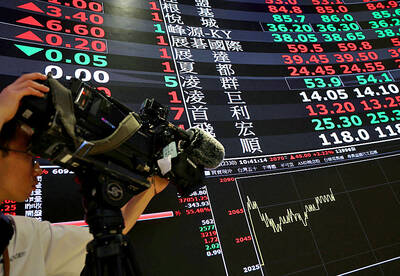
After several years flying high as Asia’s best Nvidia Corp proxy, Taiwan Semiconductor Manufacturing Co (TSMC, 台積電) is increasingly vying with other artificial intelligence (AI) stocks for investor attention. Stock traders are chasing a wider array of beneficiaries as mainstream usage of AI creates demand for hardware beyond the most-advanced chips TSMC makes for Nvidia. Subthemes from the deepening memory crunch to advances in robotics are also luring bids. At the same time, investment caps on single stocks are pushing funds to diversify, while retail investors long familiar with TSMC through its US depositary receipts are being offered a broader set of

UNDER MICROSCOPE: Taiwan detained three people who allegedly conspired to buy servers in Taiwan and export them using fraudulent documentation, prosecutors said Nvidia Corp chief executive officer Jensen Huang (黃仁勳) on Saturday urged Super Micro Computer Inc to tighten up on compliance after Taiwan detained three people this week for allegedly making fraudulent declarations about artificial intelligence (AI) servers made by its US partner. The development marked the nation’s first crackdown on semiconductor smuggling, which grew after the US slapped restrictions on exports of high-end chips such as Nvidia AI accelerators to China. Nvidia is “rigorous” in explaining regulations to all of its partners, Huang told reporters after arriving in Taipei. “Ultimately Super Micro has to run their own company,” he said in response to
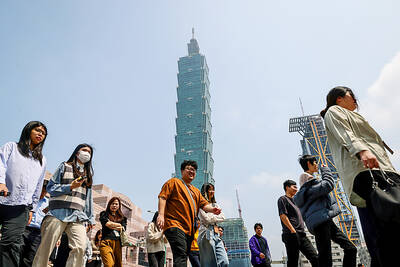
TECH RELIANCE: Growth is increasingly reflecting an unequal K-shaped distribution, where technology sectors outperform and other industries struggle, an expert said Standard Chartered Bank has significantly raised its forecast for Taiwan’s economic growth to 9.5 percent this year, up from 7.6 percent previously, citing surging artificial intelligence (AI) demand driving exports, semiconductor production and investment. The upgrade reflects a sustained AI supercycle that continues to fuel demand for advanced chips and technology infrastructure, which form the backbone of Taiwan’s exports, the bank said in a report this week. “We raise our 2026 growth forecast to reflect a much stronger-than-expected first-quarter GDP figure,” Standard Chartered senior economist for greater China and Asia Tommy Wu (胡東安) said in the report. Driven largely by a 35.3 percent
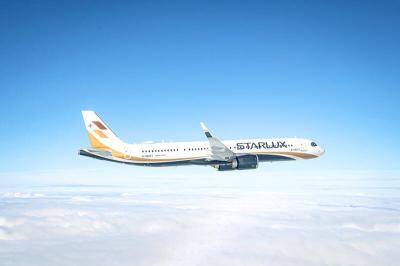
Two of Taiwan’s international carriers, Starlux Airlines Co (星宇航空) and EVA Airways Corp (長榮航空), have retained the five-star airline rating awarded by international airline review organization Skytrax. Starlux was awarded the distinction for a second consecutive year, while EVA Air received it for the 11th straight year, Skytrax said in statements released yesterday and on Thursday last week, respectively. The five-star rating is considered one of the airline industry's highest honors and is awarded following professional audits of airline product and frontline service standards, Skytrax said. The ratings are based on in-depth assessments using unified global quality standards rather than customer review scores


 RSS
RSS