


Taiwan Semiconductor Manufacturing Co (TSMC, 台積電) chairman Mark Liu (劉德音) yesterday said that he is optimistic about the semiconductor industry’s future growth, as Moore’s Law is alive and well, and should continue to drive industry growth.
Data from international trade group SEMI showed that over the past six decades, global semiconductor revenue has grown to US$480 billion, following the path of Moore’s Law, former Intel Corp CEO Golden Moore’s observation that the number of transistors on a microchip doubles every two years, while the cost per transistor is halved.
Debates have been going on whether a slowing of that ratio would hamper the industry’s growth.
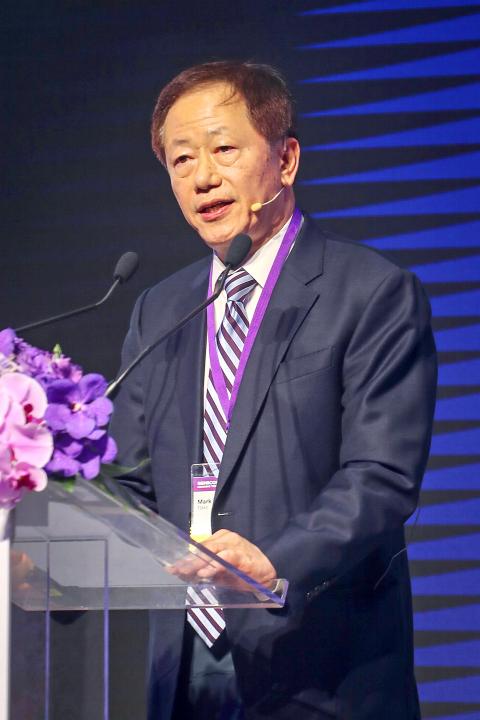
Photo: CNA
“People have asked: Will semiconductors evolve for another 60 years? I’m optimistic about this,” Liu said in a speech to a think tank summit organized by SEMI in Taipei as part of the three-day SEMICON Taiwan show at the Taipei Nangang Exhibition Center, which opened yesterday.
“To TSMC, Moore’s Law is alive and well,” Liu said.
TSMC’s 7-nanometer process technology entered its second year of mass production this year and its 5-nanometer technology is to begin mass production next year, Liu said.
“Next year, we will see rapid expansion for our 5-nanometer technology. Now we are concentrating our research and development efforts on 3-nanometer,” he said.
“We are also making encouraging progress in developing 2-nanometer technology every week. We are entering the ‘pathfinding’ mode [early research and development stage],” he added
“Someday, if everyone has a quantum computing device in his or her pocket, I believe TSMC will not be absent [from that technology]. I believe the development of semiconductors will continue to unfold,” Liu said.
However, a shortage of qualified engineers and other professionals could hamper the industry’s development more than technological barriers, he said.
To create a larger talent pool in Taiwan, Liu called on the government to increase its national technology research budget to encourage university professors and students to engage in semiconductor research.
“Technological leadership is the only way for Taiwan’s semiconductor industry to survive,” Liu said.
Meanwhile, Minister of Economic Affairs Shen Jong-chin (沈榮津) told the summit that the government has approved TSMC’s environmental impact assessment for a new 2-nanometer fab in Hsinchu.
In a separate forum organized by SEMI, TSMC vice president of corporate research Philip Wong (黃漢森) said that with the evolution of Moore’s Law, the company might offer 2-nanometer and even 1-nanometer technology.
However, the technological evolution might not be defined by the technology node, or by the transistor’s geometry, but rather by chip density, Wong said.
Higher chip density helps drive costs lower, while elevating chip performance, he said.

KEEPING UP: The acquisition of a cleanroom in Taiwan would enable Micron to increase production in a market where demand continues to outpace supply, a Micron official said Micron Technology Inc has signed a letter of intent to buy a fabrication site in Taiwan from Powerchip Semiconductor Manufacturing Corp (力積電) for US$1.8 billion to expand its production of memory chips. Micron would take control of the P5 site in Miaoli County’s Tongluo Township (銅鑼) and plans to ramp up DRAM production in phases after the transaction closes in the second quarter, the company said in a statement on Saturday. The acquisition includes an existing 12 inch fab cleanroom of 27,871m2 and would further position Micron to address growing global demand for memory solutions, the company said. Micron expects the transaction to

Vincent Wei led fellow Singaporean farmers around an empty Malaysian plot, laying out plans for a greenhouse and rows of leafy vegetables. What he pitched was not just space for crops, but a lifeline for growers struggling to make ends meet in a city-state with high prices and little vacant land. The future agriculture hub is part of a joint special economic zone launched last year by the two neighbors, expected to cost US$123 million and produce 10,000 tonnes of fresh produce annually. It is attracting Singaporean farmers with promises of cheaper land, labor and energy just over the border.

US actor Matthew McConaughey has filed recordings of his image and voice with US patent authorities to protect them from unauthorized usage by artificial intelligence (AI) platforms, a representative said earlier this week. Several video clips and audio recordings were registered by the commercial arm of the Just Keep Livin’ Foundation, a non-profit created by the Oscar-winning actor and his wife, Camila, according to the US Patent and Trademark Office database. Many artists are increasingly concerned about the uncontrolled use of their image via generative AI since the rollout of ChatGPT and other AI-powered tools. Several US states have adopted

A proposed billionaires’ tax in California has ignited a political uproar in Silicon Valley, with tech titans threatening to leave the state while California Governor Gavin Newsom of the Democratic Party maneuvers to defeat a levy that he fears would lead to an exodus of wealth. A technology mecca, California has more billionaires than any other US state — a few hundred, by some estimates. About half its personal income tax revenue, a financial backbone in the nearly US$350 billion budget, comes from the top 1 percent of earners. A large healthcare union is attempting to place a proposal before


 RSS
RSS