


The profitability of Taiwan’s major technology firms would take a serious blow this year and beyond if Washington hikes tariffs on consumer electronics made in China, where the firms have heavy exposure to supply chains, S&P Global Ratings said yesterday.
“The top 50 local technology firms would see their earnings before interest, tax, depreciation and amortization tumble 30 percent if the US imposes a 25 percent tariff on Chinese electronics,” Taiwan Ratings (中華信評) analyst Raymond Hsu (許智清) said in a report.
Taiwan Ratings is a local arm of the international agency.
US President Donald Trump has announced a 15 percent duty on Chinese goods, including smartwatches and smart speakers, effective this month. The tariff is to extend to smartphones and notebook computers on Dec. 15.
China has responded with tariff hikes on certain US goods.
As the two sides might take further steps in their trade dispute, which is unlikely to be resolved in the foreseeable future, demand for consumer electronics, vehicles and semiconductors could dwindle and suppress margins, Hsu said, adding that sales of high-end smartphones, especially Apple Inc’s iPhones, have weakened.
S&P forecast that iPhone sales would shrink 20 percent this year, boding ill for Taiwanese companies in Apple’s supply chain, Hsu said.
While the introduction of next-generation iPhones might spur replacement demand among Apple fans, they might not create as big a splash as their predecessors did, due to a lack of breakthrough features, he said.
Taiwanese firms have deep participation in iPhone’s production, but have limited exposure to Chinese and South Korean brands that enjoy a competitive edge in the use of organic LED display and 5G technologies, Hsu said.
Companies that supply memory chips, consumer electronics and electronics components, as well as technology brands such as Acer Inc (宏碁) and Asustek Computer Inc (華碩), would experience the steepest margin declines, he said.
Regional capacity increases in some segments, such as thin-film transistor-LCD panels and commodity chemicals, would put additional margin pressures on local suppliers, Hsu added.
Taiwan Ratings expects increased capital spending by tech companies to diversify their production bases away from China.
However, relocation is expensive and takes years, it said.
In other high-tech sectors, local telecoms would increase spending on 5G mobile communication bandwidth and infrastructure in the next three years, despite thin margin outlook for such a deployment, Hsu said.
A ban on burning high-sulfur fuels could soften profitability for shipping companies affected by the trade dispute, he said.
The trade row aside, excessive supply and increasing competition are likely to have a negative effect on local companies, Taiwan Ratings said.
S&P maintains its GDP growth forecast of 2 percent for this year, Hsu said.
Separately, earnings of Taiwanese technology companies are forecast to decline 7 percent annually this year, with a 13 percent fall in the hardware sector and a 8 percent drop in the semiconductor sector, owing to the sluggish sales of smartphones and uncertainty amid the trade dispute, Credit Suisse Hong Kong Ltd managing director Manish Nigam told a news conference in Taipei yesterday.
However, local firms are expected to see business rebound next year, with an annual gain of 14 percent in earnings, as major suppliers of mobile telecom components would benefit from 5G network services launched in China, Canada, France, Hong Kong and Japan, said Randy Abrams, the head of Taiwan research in the equity research department.
Additional reporting by Kao Shih-ching

Cairo’s new monorail slices across the city skyline, running above the familiar chaos of blaring horns and aging buses’ exhaust fumes that mark rush hour below. The US$4.5 billion monorail, opened this month, is among Egypt’s most prominent new transport projects, part of a debt-funded infrastructure drive criticized for sapping state finances while bringing limited benefits to most of the country’s 109 million people. “It feels like you’re in a different country,” said Ramy Sayed, a restaurant manager, aboard a driverless Innovia 300 train. “No noise, no traffic, we’re not used to this.” The eastern line runs 56km from the bustling middle-class
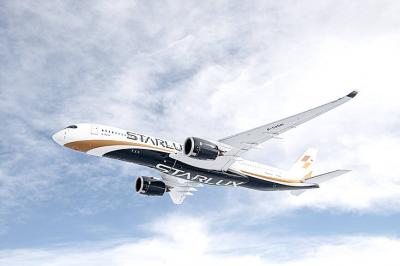
Starlux Airlines Co (星宇航空) today unveiled a long-haul network expansion plan at a shareholders’ meeting in Taipei, including direct flights to Barcelona, Spain, and Zurich, Switzerland, as well as a service connecting Taipei, Sydney and New Zealand. Starlux is to become the first Taiwanese carrier to offer non-stop services to the two European cities, while the inaugural oceanic route is expected to expand transit opportunities within the Australia-New Zealand market, Starlux said. Flight services to Chicago, Dallas, Washington and New York are under evaluation, the airline added. Prior to the shareholders’ meeting, the airline earlier this year announced that it would be

Taiwanese firms have increased investment in the Philippines in recent years as Manila’s ties with Washington deepen and global supply chains continue to shift away from China, an expert at the Chung-Hua Institution for Economic Research (CIER, 中華經濟研究院) said yesterday. The Philippines had not been among Taiwanese investors’ top choices in Southeast Asia, CIER Taiwan ASEAN Studies Center director Kristy Hsu (徐遵慈) said at a seminar in Taipei. However, Taiwan’s investment in the country has grown significantly since the COVID-19 pandemic, reaching US $257 million last year, a high in recent years, she said. Although Taiwan’s total investment in the Philippines still lags

Intel Corp regards Taiwan Semiconductor Manufacturing Co (TSMC, 台積電) as a longstanding partner, as the US chipmaker would continue outsourcing production of advanced chips to TSMC, Intel chief executive officer Lip-Bu Tan (陳立武) said yesterday. “I don’t look at people as competitors. I look at the collaboration... Nvidia is also, you know, a good friend,” Tan told a news conference following his keynote speech at the Computex trade show in Taipei. “It’s a very trusted partnership for us... We are a big, top customer for them, and we’re going to continue doing that,” he said, referring to TSMC, the world’s largest foundry


 RSS
RSS