


US-based clinical research organization Veristat Inc yesterday announced that it would be hiring more local talent at its Taipei unit to support an increase in demand from clients.
The company owns 100 percent of the unit, which it set up at the end of last year. It held a reopening ceremony yesterday to mark its expansion efforts.
Veristat plans to hire 10 Statistical Analysis System (SAS) programmers and two data managers to add to its team of six employees, Philip Ho (何昇峰), director of Taipei operations, told a news conference.
While the Taipei unit has participated in 20 global projects organized by its parent company, it aims to expand its client base in Taiwan and reach out to other projects in Asia, Ho said.
“More projects are expected as more small and medium-sized biotech or biopharmaceutical companies have begun outsourcing their clinical research to companies like us,” Ho said.
“Time is money. It would be a great advantage for companies that want to get ahead and win marketing approval before other companies that are researching similar therapies... Our service could help them speed up,” he said.
“Usually, it takes two SAS programmers to complete the statistical work for phase I clinical trials, but the number of programmers required mainly depends on the complexity of the tests,” Taipei unit manager Henry Ou (歐恒佑) said.
Veristat offers clinical monitoring, clinical project management, data management, biostatistics, medical writing, regulatory submissions and strategic consulting services.
The local subsidiary would initially concentrate on biometrics and programming, and then expand its operations, Ho said.
The Taipei unit is Veristat’s first in Asia, but it has other units in the UK and Canada.
“We favor Taiwan, as there is a lot of talent in the nation. While Taiwan is a business, financial and technology hub, it also has an active pharmaceutical industry, with stable research funding,” Veristat executive vice president of operations Alecia Barbee told the Taipei Times.
The company, which has cooperated with clients focusing on oncology, and the treatment of rare diseases and cardiovascular diseases, is seeking new business partners in the nation, she added.


Taiwan’s foreign exchange reserves fell below the US$600 billion mark at the end of last month, with the central bank reporting a total of US$596.89 billion — a decline of US$8.6 billion from February — ending a three-month streak of increases. The central bank attributed the drop to a combination of factors such as outflows by foreign institutional investors, currency fluctuations and its own market interventions. “The large-scale outflows disrupted the balance of supply and demand in the foreign exchange market, prompting the central bank to intervene repeatedly by selling US dollars to stabilize the local currency,” Department of Foreign

Intel Corp is joining Elon Musk’s long-shot effort to develop semiconductors for Tesla Inc, Space Exploration Technologies Corp and xAI, marking a surprising twist in the chipmaker’s comeback bid. Intel would help the Terafab project “refactor” the technology in a chip factory, the company said on Tuesday in a post on X, Musk’s social media platform. That is a stage in the development process that typically helps make chips more powerful or reliable. The chipmaker’s shares jumped 4.2 percent to US$52.91 in New York trading on Tuesday. The Terafab project is a grand plan by Musk to eventually manufacture his own chips for
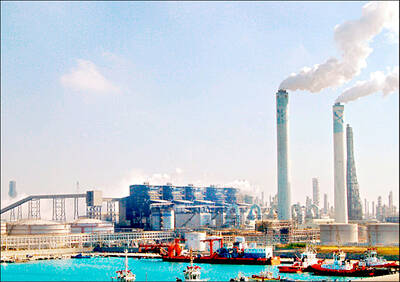
Taiwan Power Co (Taipower, 台電) yesterday said it plans to resume operations at two coal-fired power generators for three months to boost security of electricity supply as liquefied natural gas (LNG) supply risks are running high due to the Middle East conflict. The two coal-fired power generators are at Mailiao Power Plant in Yunlin County’s Mailiao Township (麥寮). The plant, operated by Formosa Plastics Group (台塑集團), supplied electricity to Taipower’s power grid until the end of last year. Taipower’s decision came about one month after Minister of Economic Affairs Kung Ming-hsin (龔明鑫) on March 10 said that the nation had no imminent

Some robotaxi passengers were left stranded in the middle of fast-moving traffic in a major Chinese city after their driverless vehicles stopped running, according to police and media reports on Wednesday. A preliminary investigation indicates more than 100 robotaxis came to a halt because of a “system malfunction,” police in the city of Wuhan said in a statement, without elaborating. No injuries were reported. One passenger told Chinese media that their robotaxi stopped after turning a corner. An instruction on a screen read: “Driving system malfunction. Staff are expected to arrive in 5 minutes.” After no one showed up, the passenger pushed


 RSS
RSS