


Last month’s manufacturing purchasing managers’ index (PMI) increased slightly to 48.2 from July’s 48, as technology firms benefited from upcoming releases of new-generation devices, but other sectors floundered amid a global slowdown, the Chung-Hua Institution for Economic Research (CIER, 中華經濟研究院) said yesterday.
“Although the US and China exchanged tariff hikes last month, local firms are more prepared as they have moved production lines out of China and adjusted procurement strategies,” CIER president Chen Shi-kuan (陳思寬) said.
Taiwan is home to the world’s largest makers of chips, camera lenses, and components used in smartphones, laptops and other consumer electronics.
The PMI has hovered at about 48 in the past few months, suggesting that operating conditions have stalled for major sectors, Chen said.
The PMI aims to gauge the health of the manufacturing industry, with scores greater than 50 indicating expansion and scores below signaling contraction.
The US-China trade dispute has lasted more than a year, and with no end in sight, firms have factored in potential risks, she said.
Firms “are now less shocked by unfavorable twists,” Chen said.
The sub-index for new business orders increased marginally from 48.2 to 48.9, while the industrial production reading rose from 50.3 to 51.7, the Taipei-based think tank’s monthly survey found.
The sub-index on new export orders climbed from 46.8 to 47.4, while the customers’ inventory sub-index increased from 44.6 to 46.7, the survey showed.
Apple Inc, Huawei Technologies Co (華為) and Samsung Electronics Co are to launch new smartphones and notebook computers later this month to spur replacement demand, increasing business opportunities for local firms in their supply chains.
A 15 percent US tariff hike went into effect this month on Apple earphones, smart speakers and wrist watches imported from China, Chen said, adding that it would take a little time to see the effect on sales.
The tariffs are to be extended to smartphones and laptops in December.
That probably explains why the six-month outlook for business prospects weakened from 49.3 to 44.5, she said.
Sentiment is bleakest among firms selling machinery equipment and raw materials, the survey showed.
Supply Management Institute in Taiwan (中華採購與供應管理協會) executive director Steve Lai (賴樹鑫) said that pessimism would spread to downstream firms.
The non-manufacturing index registered 53.1, comfortably in the expansion range, despite a slight decline from July, the survey showed.
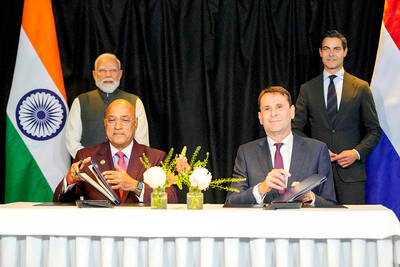
NEW MARKET: The partnership opens up India to the Dutch company, which already has a strong hold in the semiconductor market of South Korea, Taiwan and China ASML Holding NV entered into a partnership agreement with Tata Electronics Pvt Ltd aimed at ramping up India’s goal to develop domestic chip-manufacturing capabilities. The Dutch company’s technology would help power Tata Electronics’ planned 300 millimeter (mm) semiconductor foundry in Gujarat, according to a joint statement from the two companies on Saturday. The signing of a memorandum of understanding coincides with a visit by Indian Prime Minister Narendra Modi to the Netherlands, which is looking to deepen bilateral relations with New Delhi. ASML, whose top customers include Taiwan Semiconductor Manufacturing Co (台積電) and Samsung Electronics Co, makes lithography machines that can print
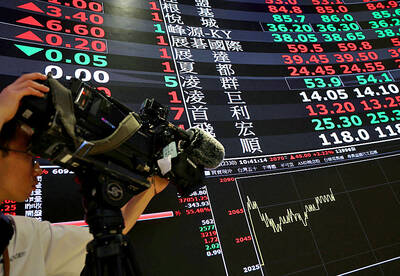
After several years flying high as Asia’s best Nvidia Corp proxy, Taiwan Semiconductor Manufacturing Co (TSMC, 台積電) is increasingly vying with other artificial intelligence (AI) stocks for investor attention. Stock traders are chasing a wider array of beneficiaries as mainstream usage of AI creates demand for hardware beyond the most-advanced chips TSMC makes for Nvidia. Subthemes from the deepening memory crunch to advances in robotics are also luring bids. At the same time, investment caps on single stocks are pushing funds to diversify, while retail investors long familiar with TSMC through its US depositary receipts are being offered a broader set of
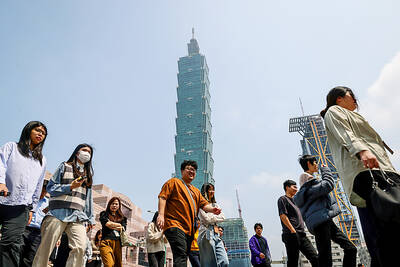
TECH RELIANCE: Growth is increasingly reflecting an unequal K-shaped distribution, where technology sectors outperform and other industries struggle, an expert said Standard Chartered Bank has significantly raised its forecast for Taiwan’s economic growth to 9.5 percent this year, up from 7.6 percent previously, citing surging artificial intelligence (AI) demand driving exports, semiconductor production and investment. The upgrade reflects a sustained AI supercycle that continues to fuel demand for advanced chips and technology infrastructure, which form the backbone of Taiwan’s exports, the bank said in a report this week. “We raise our 2026 growth forecast to reflect a much stronger-than-expected first-quarter GDP figure,” Standard Chartered senior economist for greater China and Asia Tommy Wu (胡東安) said in the report. Driven largely by a 35.3 percent
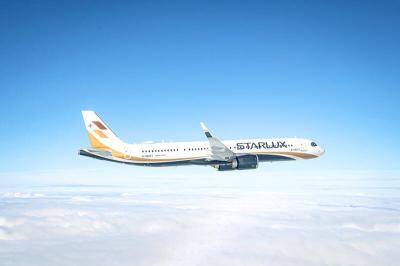
Two of Taiwan’s international carriers, Starlux Airlines Co (星宇航空) and EVA Airways Corp (長榮航空), have retained the five-star airline rating awarded by international airline review organization Skytrax. Starlux was awarded the distinction for a second consecutive year, while EVA Air received it for the 11th straight year, Skytrax said in statements released yesterday and on Thursday last week, respectively. The five-star rating is considered one of the airline industry's highest honors and is awarded following professional audits of airline product and frontline service standards, Skytrax said. The ratings are based on in-depth assessments using unified global quality standards rather than customer review scores


 RSS
RSS