


Bolstered by robust sales of electronics, optical products and integrated circuits, industrial production increased 3.03 percent annually last month, ahead of the high season for technology products, the Ministry of Economic Affairs said yesterday.
Electronics and optical components reported record sales last month, surging 34.82 percent from a year earlier, the ministry said, adding that sales expanded for a 10th consecutive month.
“Industrial production was better than expected, thanks to demand for electronics from the US and 5G development, which boosted shipments of servers, switches, routers and wireless communication devices,” Department of Statistics Deputy Director-General Wang Shu-chuan (王淑娟) told a news conference.
Shipments of camera lenses also swelled, as new-generation smartphones are about to enter the market, she said.
The electronics industry saw the fastest growth in nine months, up 4.83 percent year-on-year, with the integrated circuit sector reporting a 12.39 percent increase annually as 5G applications gained momentum and demand for high-end semiconductors used in consumer electronics remained robust, Wang said.
However, sales of LCD panels and related components dropped 14.6 percent annually due to intensifying competition from China, she said.
Sales of machinery equipment declined 13.98 percent year-on-year, as the US-China trade dispute slowed companies’ expansion, the ministry said.
As demand and prices for raw materials remained soft, the base metal and chemical material sectors saw production weakening 8.84 percent and 1.47 percent respectively, the ministry said.
A separate ministry report showed that the wholesale sector’s revenue edged up 1 percent from a year earlier to NT$905.4 billion (US$28.83 billion) last month due to better demand for machinery and automobiles.
Machinery sales increased 3.7 percent year-on-year on the back of higher shipments of new mobile phones and related electronics, while the automotive sector rose 10.7 percent annually, aided by sales of new vehicle models and marketing promotions ahead of the Ghost Festival, the ministry said.
However, building materials and chemicals sales declined 5.7 percent and 7.2 percent respectively last month due to weak demand, it said.
The retail sector saw faster growth of 6.7 percent year-on-year to NT$326.8 billion last month, thanks to robust sales of cars and motorbikes, which soared 18.8 percent annually ahead of Ghost Month, the ministry said, adding that increasing e-commerce and catalogue sales of cosmetic products and drugs also lent support.
The opening of new shopping centers and holilday shopping boosted revenue from general merchandise by 6.1 percent year-on-year, it said.
Sales from the food and beverage sector grew 5 percent annually to NT$69.7 billion, boosted by higher sales from restaurants, expansion of tea shops and growing sales of beverages due to the hot weather, it said.
“Although Chinese tourist numbers might drop going forward, the blow would be less serious compared with 2016, as local companies and restaurants have adjusted their response strategies such as providing discounts for domestic customers and targeting tourists from other countries,” Wang said.


The domestic unit of the Chinese-owned, Dutch-headquartered chipmaker Nexperia BV will soon be able to produce semiconductors locally within China, according to two company sources. Nexperia is at the center of a global tug-of-war over critical semiconductor technology, with a Dutch court in February ordering a probe into alleged mismanagement at the company. The geopolitical tussle has disrupted supply chains, with some carmakers reportedly forced to cut production due to chip shortages. Local production would allow Nexperia’s domestic arm, Nexperia Semiconductors (China) Ltd (安世半導體中國), to bypass restrictions in place since October on the supply of silicon wafers — etched with tiny components to
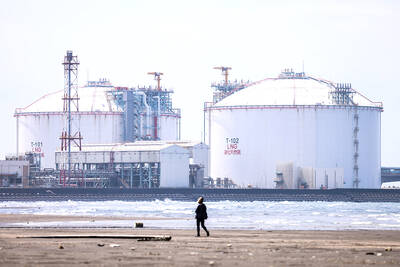
Taiwan is open to joining a global liquefied natural gas (LNG) program if one is created, but on the condition that countries provide delivery even in a scenario where there is a conflict with China, an energy department official said yesterday. While Taiwan’s priority is to have enough LNG at home, the nation is open to exploring potential strategic reserves in other countries such as Japan or South Korea, Energy Administration Deputy Director-General Chen Chung-hsien (陳崇憲) said. While the LNG market does not have a global reserve for emergencies like that of oil, the concept has been raised a few times —
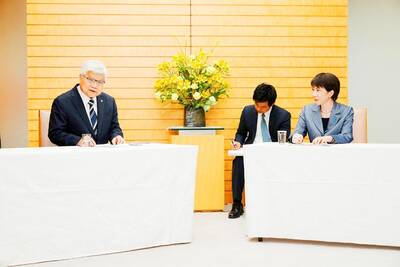
Taiwan Semiconductor Manufacturing Co (TSMC, 台積電) yesterday received government approval to deploy its advanced 3-nanometer (3nm) process at its second fab currently under construction in Japan, the Ministry of Economic Affairs said in a news release. The ministry green-lit the plan for the facility in Kumamoto, which is scheduled to start installing equipment and come online in 2028 with a monthly production capacity of 15,000 12-inch wafers, the ministry said. The Department of Investment Review in June 2024 authorized a US$5.26 billion investment for the facility, slated to manufacture 6- to 12nm chips, significantly less advanced than 3nm process. At a meeting with
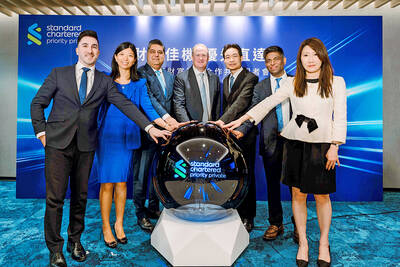
Standard Chartered Taiwan on March 26 announced that it has partnered with international fintech firm FinIQ to build an “Automated Structured Products Pricing Platform.” The bank is also introducing products from global issuers including Goldman Sachs Group Inc, Barclays PLC and BNP Paribas SA. The new platform enables an end-to-end process whereby it finds the most competitive pricing across multiple issuers in a matter of minutes, followed by automated documentation and transaction execution, which significantly shortens time-to-market and delivers a superior wealth management experience. Standard Chartered Bank Taiwan CEO Anthony Yu (游天立) said: “Standard Chartered is increasingly leveraging its wealth management


 RSS
RSS