


Memorychip maker Winbond Electronics Corp (華邦電) yesterday was optimistic about the company’s growth in the coming months, after posting net profits of NT$462 million (US$14.86 million) last quarter, an 11.33 percent increase from NT$415 million in the first quarter.
However, gross margin decreased to 26 percent from 32 percent in the first quarter, the chipmaker said.
“We have cut production to sync with demand and avoid large inventories,” Winbond president Chan Tung-yi (詹東益) told an investors’ conference in Taipei.
Prices dropped due to volatility caused by trade tensions between the US and China, Chan said.
Price declines in the first half of this year reduced revenue by about NT$500 million, Winbond chief financial officer Jessica Huang (黃求己) said.
The chipmaker posted revenue of NT$22.9 billion in the first two quarters of the year, down from NT$25.64 billion a year earlier, a company financial report showed.
“The market was overly saturated in past few months … but we are seeing improvements,” Chan said.
“We have resumed full production this month,” he said, adding that the worst is over and the market is recovering with demand inching up.
Asked whether the trade dispute between South Korea and Japan would affect the company, Chan said it would have a positive effect on Winbond.
“I believe we are looking at new opportunities here,” he said.
As Winbond has gained a larger market share, the company is focusing on ramping up production of its 25-nanometer (nm) chips, Chan said, adding that it has already increased to 2 percent of overall DRAM production from 1 percent in the first quarter.
“The demand for 46nm chips remains very stable,” he said, adding that the chips made up 69 percent of DRAM production last quarter.
Winbond has budgeted capital expenditure of NT$18.5 billion this year, as it is continuing to invest in its 12-inch fab in Kaohsiung, which is expected to begin shipments in three years, Chan said, adding that the company has secured a NT$42 billion seven-year syndicated loan for the fab.
He said that Winbond has set its sights on the automotive and industrial segment, where “there is a lot of potential.”
The automotive and industrial segment contributed 20 percent of overall revenue in the first half of this year, an increase from 16 percent over the same period last year.
In the first half, Winbond made 30 percent of its revenue from the consumer segment, 29 percent from the communication segment and 21 percent from the computer segment.
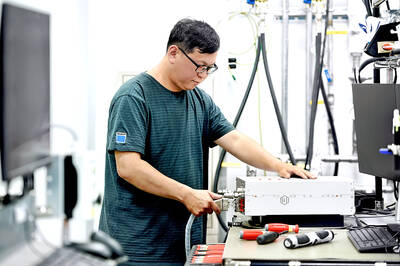
SEMICONDUCTORS: The German laser and plasma generator company will expand its local services as its specialized offerings support Taiwan’s semiconductor industries Trumpf SE + Co KG, a global leader in supplying laser technology and plasma generators used in chip production, is expanding its investments in Taiwan in an effort to deeply integrate into the global semiconductor supply chain in the pursuit of growth. The company, headquartered in Ditzingen, Germany, has invested significantly in a newly inaugurated regional technical center for plasma generators in Taoyuan, its latest expansion in Taiwan after being engaged in various industries for more than 25 years. The center, the first of its kind Trumpf built outside Germany, aims to serve customers from Taiwan, Japan, Southeast Asia and South Korea,

Gasoline and diesel prices at domestic fuel stations are to fall NT$0.2 per liter this week, down for a second consecutive week, CPC Corp, Taiwan (台灣中油) and Formosa Petrochemical Corp (台塑石化) announced yesterday. Effective today, gasoline prices at CPC and Formosa stations are to drop to NT$26.4, NT$27.9 and NT$29.9 per liter for 92, 95 and 98-octane unleaded gasoline respectively, the companies said in separate statements. The price of premium diesel is to fall to NT$24.8 per liter at CPC stations and NT$24.6 at Formosa pumps, they said. The price adjustments came even as international crude oil prices rose last week, as traders
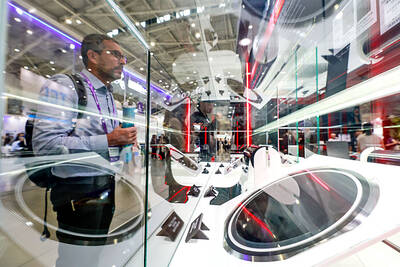
SIZE MATTERS: TSMC started phasing out 8-inch wafer production last year, while Samsung is more aggressively retiring 8-inch capacity, TrendForce said Chipmakers are expected to raise prices of 8-inch wafers by up to 20 percent this year on concern over supply constraints as major contract chipmakers Taiwan Semiconductor Manufacturing Co (TSMC, 台積電) and Samsung Electronics Co gradually retire less advanced wafer capacity, TrendForce Corp (集邦科技) said yesterday. It is the first significant across-the-board price hike since a global semiconductor correction in 2023, the Taipei-based market researcher said in a report. Global 8-inch wafer capacity slid 0.3 percent year-on-year last year, although 8-inch wafer prices still hovered at relatively stable levels throughout the year, TrendForce said. The downward trend is expected to continue this year,
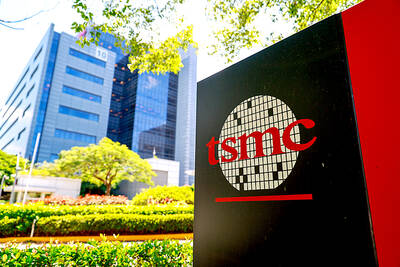
Taiwan Semiconductor Manufacturing Co (TSMC, 台積電), which supplies advanced chips to Nvidia Corp and Apple Inc, yesterday reported NT$1.046 trillion (US$33.1 billion) in revenue for last quarter, driven by constantly strong demand for artificial intelligence (AI) chips, falling in the upper end of its forecast. Based on TSMC’s financial guidance, revenue would expand about 22 percent sequentially to the range from US$32.2 billion to US$33.4 billion during the final quarter of 2024, it told investors in October last year. Last year in total, revenue jumped 31.61 percent to NT$3.81 trillion, compared with NT$2.89 trillion generated in the year before, according to


 RSS
RSS