


Local shares on Friday finished higher after getting a boost from rising hopes that the US Federal Reserve would cut interest rates in the near future, dealers said.
Buying focused on the bellwether electronics sector, led by contract chipmaker Taiwan Semiconductor Manufacturing Co (TSMC, 台積電), which gave a better-than-expected sales forecast for the third quarter, while old economy and financial stocks appeared mixed, they said.
The TAIEX on Friday ended up 73.91 points, or 0.68 percent, at 10,873.19, after moving between 10,861.99 and 10,919.96, on turnover of NT$122.57 billion (US$3.95 billion). That was a 0.5 percent increase from a close of 10,824.35 on July 12.
The market opened up 0.58 percent as investors rushed to buy large-cap electronics stocks in reaction to a strong recovery overnight on the Dow Jones Industrial Average, which ended up 3.12 points after rebounding from an earlier 151.06-point decline, dealers said.
The Dow bounced back after New York Federal Reserve President John Williams said that the Fed should “act quickly” at a time when the economy was slowing, a clear appeal to lower interest rates.
He pointed to studies suggesting that when there are few stimulus options available, officials should “move more quickly than you otherwise might” rather than waiting “for disaster to unfold.”
TSMC, the most heavily weighted stock in Taiwan, led the early gains and even pushed the weighted index above 10,900 points, before some investors pulled back, limiting the day’s gains, dealers said.
“Since Williams is one of the voting members on the Federal Open Market Committee, his comments have strengthened market hopes that the Fed will lower its key interest rates at the end of this month, say, by 0.5 percentage points,” Hua Nan Securities Co (華南永昌證券) analyst Kevin Su (蘇俊宏) said.
The Fed has scheduled a policymaking meeting for July 30-31.
“Once the Fed lowers interest rates to send the US dollar lower, funds are expected to exit the US market, but enter regional markets, and markets including Taiwan could enjoy ample liquidity,” Su said.
Combined with the rate cut hopes, an upbeat sales forecast for the third quarter given by TSMC a day earlier led investors to pick up large-cap tech stocks, in particular in the semiconductor sector, he said.
TSMC rose 1.97 percent to close at NT$259, with 59.64 million shares changing hands, after the chipmaker said that it could post US$9.1 billion to US$9.2 billion in consolidated sales for the third quarter, which would be up 18 percent from the second quarter.
TSMC’s gains alone contributed to an increase of about 50 points to the TAIEX, and boosted the semiconductor subindex by 1.87 percent and the electronics sector by 1.16 percent.
Buying also spread to other IC stocks, with IC packaging and testing services provider ASE Technology Holding Co (日月光投資控股) up 4.14 percent to close at NT$70.40 and DRAM chipmaker Nanya Technology Corp (南亞科技) up 1.5 percent to end at NT$67.70.
Bucking the uptrend, Largan Precision Co (大立光), a supplier of smartphone camera lenses to Apple Inc, fell 0.24 percent to close at NT$4,140, off a high of NT$4,250, on profit-taking.
“As today’s market attention was largely drawn by TSMC and the semiconductor sector, many non-tech stocks seemed to fall off the radar,” Su said.
In the old economy sector, textile maker Far Eastern New Century Corp (遠東新世紀) fell 1.87 percent to close at NT$31.55, Formosa Plastics Corp (台灣塑膠) lost 0.49 percent to end at NT$101 and Formosa Chemicals & Fibre Corp (台灣化纖) dropped 0.31 percent to close at NT$96.50.
However, U-Ming Marine Transport Corp (裕民航運) gained 4.42 percent to end at NT$36.65 in the wake of an increase in freight fees.
Among the mixed financial stocks, Fubon Financial Holding Co (富邦金控) rose 0.12 percent to close at NT$43.50, while CTBC Financial Holding Co (中信金控) fell 0.49 percent to end at NT$20.50 and Cathay Financial Holding Co (國泰金控) lost 0.12 percent to close at NT$41.05.
“Judging from today’s TAIEX movement, technical resistance ahead of the 10,900-point mark remained stiff, so the main board saw some profit-taking and failed to end above that level,” Su said.
“Investors should pay close attention to the corporate earnings season taking place right now at home and in the US,” Su said. “And do not forget the lingering trade friction between Washington and Beijing.”
Foreign institutional investors on Friday bought a net NT$8.16 billion of shares, Taiwan Stock Exchange data showed.
Elsewhere in Asia on Friday, markets rallied as Williams’ comments were pounced on by investors as indicating that the central bank would unveil a deep interest rate cut at the end of the month.
While a spokesman later clarified that Williams was not outlining Fed policy and was not flagging a half-point cut, analysts said that the remarks provided an insight into how officials were thinking.
Markets wavered this week over how big the bank’s expected reduction would be, with 25 basis points priced in, but traders hoping for 50.
“Williams’ remarks put probabilities of multiple rate cuts higher after strong economic indicators had put doubts on the number of rate reductions this year and how deep the cut will be,” Oanda Corp senior market analyst Alfonso Esparza said.
Asia finished the week on a strong note, despite concerns about the global outlook and a lack of progress in China-US trade talks.
Tokyo’s Nikkei 225 on Friday rose 420.75 points, or 2 percent, to 21,466.99, but fell 1 percent from a close of 21,685.90 on July 12.
Hong Kong’s Hang Seng on Friday gained 303.74 points, or 1.1 percent, to 28,765.40, a 1 percent increase from 28,471.62 a week earlier.
The Shanghai Composite on Friday climbed 23.02 points, or 0.8 percent, to 2,924.20, but slid 0.2 percent from a close of 2,930.55 on July 12.
Seoul’s KOSPI on Friday rose 27.81 points, or 1.4 percent, to 2,094.36, gaining 0.4 percent from 2,086.66 a week earlier.
Singapore gained 0.4 percent and Sydney put on 0.8 percent. Wellington, Manila and Jakarta were also well up, but Mumbai fell more than 1 percent due to disappointment with government plans for a super-rich tax.
Charles Schwab & Co chief global investment strategist Jeffrey Kleintop warned that weakness in the world economy would eventually drag on markets.
“I don’t think a few rates cuts is going to make the difference, whether it’s 25 or 50 basis points at the end of this month,” Kleintop told Bloomberg TV. “While the bond market is pricing in a realistic probability of the slowdown, stocks have gone the other direction this year and may be in for a surprise.”
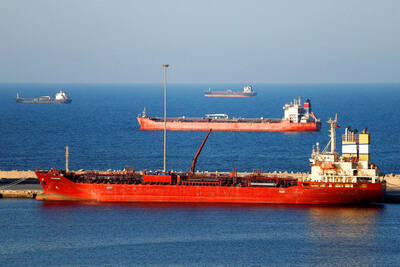
HORMUZ ISSUE: The US president said he expected crude prices to drop at the end of the war, which he called a ‘minor excursion’ that could continue ‘for a little while’ The United Arab Emirates (UAE) and Kuwait started reducing oil production, as the near-closure of the crucial Strait of Hormuz ripples through energy markets and affects global supply. Abu Dhabi National Oil Co (ADNOC) is “managing offshore production levels to address storage requirements,” the company said in a statement, without giving details. Kuwait Petroleum Corp said it was lowering production at its oil fields and refineries after “Iranian threats against safe passage of ships through the Strait of Hormuz.” The war in the Middle East has all but closed Hormuz, the narrow waterway linking the Persian Gulf to the open seas,

Nanya Technology Corp (南亞科技) yesterday said the DRAM supply crunch could extend through 2028, as the artificial intelligence (AI) boom has led the world’s major memory makers to dramatically reduce production of standard DRAM and allocate a significant portion of their capacity for high-bandwidth memory (HBM) chips. The most severe supply constraints would stretch to the first half of next year due to “very limited” increases in new DRAM capacity worldwide, Nanya Technology president Lee Pei-ing (李培瑛) told a news briefing. The company plans to increase monthly 12-inch wafer capacity to 20,000 in the first half of 2028 after a
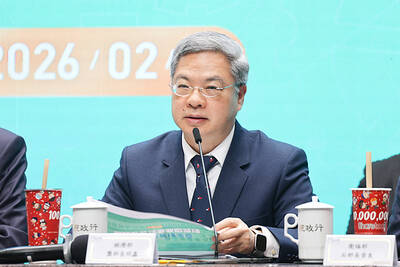
Taiwan has enough crude oil reserves for more than 100 days and sufficient natural gas reserves for more than 11 days, both above the regulatory safety requirement, Minister of Economic Affairs Kung Ming-hsin (龔明鑫) said yesterday, adding that the government would prioritize domestic price stability as conflicts in the Middle East continue. Overall, energy supply for this month is secure, and the government is continuing efforts to ensure sufficient supply for next month, Kung told reporters after meeting with representatives from business groups at the ministry in Taipei. The ministry has been holding daily cross-ministry meetings at the Executive Yuan to ensure
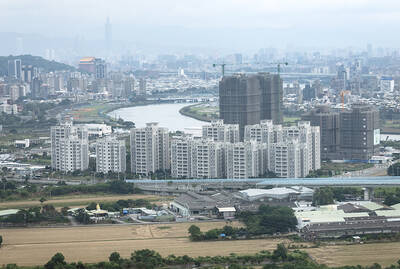
Property transactions in the nation’s six special municipalities plunged last month, as a lengthy Lunar New Year holiday combined with ongoing credit tightening dampened housing market activity, data compiled by local land administration offices released on Monday showed. The six cities recorded a total of 10,480 property transfers last month, down 42.5 percent from January and marking the second-lowest monthly level on record, the data showed. “The sharp drop largely reflected seasonal factors and tighter credit conditions,” Evertrust Rehouse Co (永慶房屋) deputy research manager Chen Chin-ping (陳金萍) said. The nine-day Lunar New Year holiday fell in February this year, reducing


 RSS
RSS