


CSBC Corp, Taiwan (CSBC, 台灣國際造船) yesterday launched the CSBC No. 15, the first locally made accommodation barge for offshore wind farms.
The nation’s largest local shipbuilder plans to use the barge to support the offshore wind projects of developers it has partnered with: projects by Copenhagen Infrastructure Partners K/S (CIP), and the project codeveloped by Yushan Energy Pte Ltd (玉山能源) and Northland Power Inc (北陸, NPI), CSBC president Tseng Kuo-cheng (曾國正) said.
Its subsidiary CSBC-DEME Wind Engineering Co Ltd (台船環海) last year signed a letter of intent with Yushan and NPI, and would undertake all marine construction for the Hai Long projects, including Hai Long 2A with a power capacity of 300 megawatts (MW), Hai Long 2B with a capacity of 232MW and Hai Long 3 with a capacity of 512MW, Tseng said.
CSBC-DEME in May inked a priority contractor deal with CIP for transporting and installing 62 wind turbine generators for CIP’s Chang Fang (彰芳) and Xidao (西島) projects, Tseng said.
The barge is likely to support CIP first, as the government requires construction of its wind farms to be completed from 2021 to 2024, while the wind farms developed by Yushan and NPI are to be completed from 2024 to 2025, he said.
CSBC is negotiating with other developers who plan to deploy the barge next year, Tseng said, declining to name potential partners.
“The barge will be in full service next year as there is so far no other locally made barge of its size,” Tseng said. “Despite developers being able to use foreign barges, we have advantages, as we know the domestic regulations better and we are closer.”
The new barge, which yesterday left the Port of Keelung on its maiden voyage transporting 15 hull units and erection blocks, is expected to arrive in the Port of Kaohsiung on Thursday, the company said.
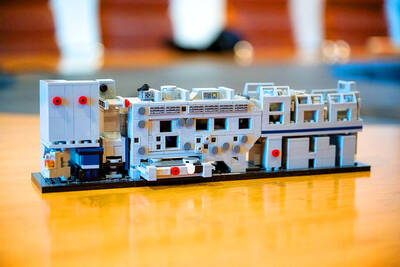
The CSBC No. 15 has a load capacity of up to 23,000 tonnes, is 140m long and 41m wide and has deck space capable of accommodating extra-large and heavy cargoes, the company said.
The barge could, in one run, carry a complete offshore substation: a 3,500 tonne foundation, a 3,400 tonne topside and four 300 tonne pin piles, it added.
The barge could transport three jackets: 30m long, 30m wide, 80m tall and weighing up to 1,200 tonnes each, it said.
CSBC has spent NT$700 million (US$22.54 million) building the barge and said that it expects to charge potential renters a freight fee of less than NT$1 million per day.

Taiwan Semiconductor Manufacturing Co (TSMC, 台積電) last week recorded an increase in the number of shareholders to the highest in almost eight months, despite its share price falling 3.38 percent from the previous week, Taiwan Stock Exchange data released on Saturday showed. As of Friday, TSMC had 1.88 million shareholders, the most since the week of April 25 and an increase of 31,870 from the previous week, the data showed. The number of shareholders jumped despite a drop of NT$50 (US$1.59), or 3.38 percent, in TSMC’s share price from a week earlier to NT$1,430, as investors took profits from their earlier gains
In a high-security Shenzhen laboratory, Chinese scientists have built what Washington has spent years trying to prevent: a prototype of a machine capable of producing the cutting-edge semiconductor chips that power artificial intelligence (AI), smartphones and weapons central to Western military dominance, Reuters has learned. Completed early this year and undergoing testing, the prototype fills nearly an entire factory floor. It was built by a team of former engineers from Dutch semiconductor giant ASML who reverse-engineered the company’s extreme ultraviolet lithography (EUV) machines, according to two people with knowledge of the project. EUV machines sit at the heart of a technological Cold

AI TALENT: No financial details were released about the deal, in which top Groq executives, including its CEO, would join Nvidia to help advance the technology Nvidia Corp has agreed to a licensing deal with artificial intelligence (AI) start-up Groq, furthering its investments in companies connected to the AI boom and gaining the right to add a new type of technology to its products. The world’s largest publicly traded company has paid for the right to use Groq’s technology and is to integrate its chip design into future products. Some of the start-up’s executives are leaving to join Nvidia to help with that effort, the companies said. Groq would continue as an independent company with a new chief executive, it said on Wednesday in a post on its Web

CHINA RIVAL: The chips are positioned to compete with Nvidia’s Hopper and Blackwell products and would enable clusters connecting more than 100,000 chips Moore Threads Technology Co (摩爾線程) introduced a new generation of chips aimed at reducing artificial intelligence (AI) developers’ dependence on Nvidia Corp’s hardware, just weeks after pulling off one of the most successful Chinese initial public offerings (IPOs) in years. “These products will significantly enhance world-class computing speed and capabilities that all developers aspire to,” Moore Threads CEO Zhang Jianzhong (張建中), a former Nvidia executive, said on Saturday at a company event in Beijing. “We hope they can meet the needs of more developers in China so that you no longer need to wait for advanced foreign products.” Chinese chipmakers are in


 RSS
RSS