


The combined revenue of listed companies rose 1.49 percent year-on-year to NT$15.18 trillion (US$488.4 billion) in the first six months of this year, statistics released last week by the Taiwan Stock Exchange (TWSE) showed.
Of the 932 firms listed on the main bourse, 428 posted revenue growth for the January-to-June period, while 504 saw revenue decline, the TWSE said in statement on Thursday.
The information service sector again reported the fastest revenue growth among all industries, with a 17.15 percent increase to NT$32.1 billion, ahead of the shipping sector’s 9.38 percent gain to NT$458.1 billion, it said.
Taipei-based IT solution provider Zero One Technology Co Ltd (零壹科技) saw its revenue rise 33.6 percent, while online game company X-Legend Entertainment Co Ltd (傳奇網路) achieved a 308 percent increase to NT$1.73 billion, the data showed.
At the other end of the spectrum, the electrical cable sector posted a 20.37 percent decline to NT$117.3 billion, while the glass sector fell 13.53 percent to NT$26 billion, making them the worst performers, the data showed.
“Given the slowdown in the local economy and US-China trade tensions, it is good to see a mild rise in the first two quarters, although some big companies posted revenue declines,” TWSE spokeswoman Rebecca Chen (陳麗卿) told the Taipei Times by telephone on Friday.
In the six-month period, Hon Hai Precision Industry Co (鴻海精密) remained the nation’s largest listed firm in terms of revenue, with NT$2.21 trillion, up 5.14 percent from a year earlier.
Pegatron Corp (和碩聯合科技) was second, generating NT$593 billion in revenue, up 7.47 percent, ahead of Quanta Computer Inc (廣達電腦), whose revenue jumped 8.84 percent to NT$467 billion, the data showed.
Fourth was Compal Electronics Inc (仁寶電腦), with its cumulative revenue growing 6.69 percent to NT$462.9 billion, ahead of Taiwan Semiconductor Manufacturing Co (TSMC, 台積電) and Wistron Corp (緯創資通). TSMC, the world’s biggest contract chipmaker, saw its revenue fall 4.5 percent to NT$459 billion, while Wistron’s cumulative revenue gained 1.32 percent to reach NT$411 billion, the data showed.
Seventh to 10th were Formosa Petrochemical Corp (台塑石化) with revenue of NT$335 billion, Cathay Financial Holding Co (國泰金控, NT$243 billion), Inventec Corp (英業達, NT$242 billion) and WPG Holdings Co (大聯大, NT$241 billion).
Fubon Financial Holding Co (富邦金控) lost its place in the top 10 after posting revenue of NT$194 billion, down 6.62 percent from a year earlier, the data showed.


Taiwan’s foreign exchange reserves fell below the US$600 billion mark at the end of last month, with the central bank reporting a total of US$596.89 billion — a decline of US$8.6 billion from February — ending a three-month streak of increases. The central bank attributed the drop to a combination of factors such as outflows by foreign institutional investors, currency fluctuations and its own market interventions. “The large-scale outflows disrupted the balance of supply and demand in the foreign exchange market, prompting the central bank to intervene repeatedly by selling US dollars to stabilize the local currency,” Department of Foreign

Intel Corp is joining Elon Musk’s long-shot effort to develop semiconductors for Tesla Inc, Space Exploration Technologies Corp and xAI, marking a surprising twist in the chipmaker’s comeback bid. Intel would help the Terafab project “refactor” the technology in a chip factory, the company said on Tuesday in a post on X, Musk’s social media platform. That is a stage in the development process that typically helps make chips more powerful or reliable. The chipmaker’s shares jumped 4.2 percent to US$52.91 in New York trading on Tuesday. The Terafab project is a grand plan by Musk to eventually manufacture his own chips for
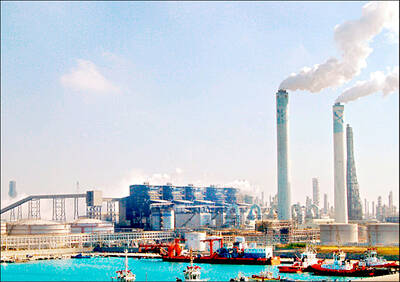
Taiwan Power Co (Taipower, 台電) yesterday said it plans to resume operations at two coal-fired power generators for three months to boost security of electricity supply as liquefied natural gas (LNG) supply risks are running high due to the Middle East conflict. The two coal-fired power generators are at Mailiao Power Plant in Yunlin County’s Mailiao Township (麥寮). The plant, operated by Formosa Plastics Group (台塑集團), supplied electricity to Taipower’s power grid until the end of last year. Taipower’s decision came about one month after Minister of Economic Affairs Kung Ming-hsin (龔明鑫) on March 10 said that the nation had no imminent

Some robotaxi passengers were left stranded in the middle of fast-moving traffic in a major Chinese city after their driverless vehicles stopped running, according to police and media reports on Wednesday. A preliminary investigation indicates more than 100 robotaxis came to a halt because of a “system malfunction,” police in the city of Wuhan said in a statement, without elaborating. No injuries were reported. One passenger told Chinese media that their robotaxi stopped after turning a corner. An instruction on a screen read: “Driving system malfunction. Staff are expected to arrive in 5 minutes.” After no one showed up, the passenger pushed


 RSS
RSS