


LCD panel makers Innolux Corp (群創) and AU Optronics Corp (AUO, 友達光電) yesterday called for more support from the government, including a share of the government’s technology fund, to help the industry overcome challenges.
The government has not come up with industry-specific policies or funds to facilitate the LCD sector’s development, while Chinese rivals rose to global leadership in terms of shipments on the back of heavy government subsidies, the companies said.
AUO hopes the government will provide more financial support to the LCD industry and remove barriers to facilitate industry integration, AUO chairman Paul Peng (彭双浪) told a conference held by the Executive Yuan’s Board of Science and Technology at the Taipei International Convention Center.

Photo: Chen Mei-ying, Taipei Times
As flat-panel displays are an important interface for smart living, the government should earmark a budget over the next four to five years and push for technological upgrade of new displays used in smart living and new applications, Peng said.
The government should also ease restrictions to encourage integration between different sectors to seize emerging business opportunities in smart mobility, smart entertainment, smart retailing and smart healthcare, he said.
Innolux president James Yang (楊柱祥) said that “the LCD panel industry deserves more government funding, as it contributes 8 percent of the nation’s GDP each year, making [it] the [economy’s] second-largest pillar.”
“An 8 percent share of the government’s [technology] budget would help facilitate industry development,” Yang said.
The local LCD panel industry’s production value last year reached NT$1.5 trillion (US$48.11 billion), with about 150,000 people working in the industry’s supply chain, government statistics showed.
The government should inject more resources to facilitate technology integration and upgrades, as Taiwan risks its global market share further degrading to about 20 percent in the next five to 10 years, Yang said.
Taiwan, with 35 percent global market share, has seen its ranking fall to No. 2 in terms of production value, trailing China, Yang said.
Separately, AUO said revenue last month contracted 2 percent year-on-year to NT$24.34 billion due to falling shipments.
Second-quarter revenue fell 6.6 percent to NT$70.07 billion from a year earlier, but it was up 5 percent from the previous quarter, AUO said.
Shipments of PC and TV panels rose 5 percent quarterly to 27.17 million units, AUO said.
Innolux said that revenue last month fell 13.9 percent annually to NT$21.3 billion, with second-quarter revenue sliding 4.9 percent to NT$63.2 billion from a year earlier.
On a quarterly basis, revenue rose 5.4 percent.
Innoux said shipments of PC and TV panels increased 8.4 percent quarterly to 30.92 million units.
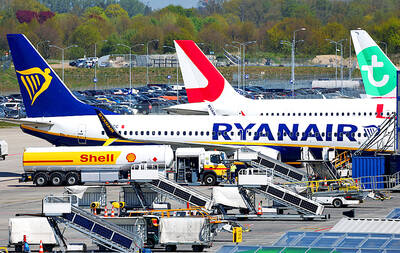
Ryanair, Transavia, Volotea and other low-cost airlines are feeling the financial pain from high jet fuel prices as a result of the Middle East war and are cutting flights. The closure of the Strait of Hormuz has taken a huge chunk of oil supplies off the market, sending the price of jet fuel soaring and triggering fears of shortages that could force airlines to cancel flights. Airlines are not waiting for a lack of supplies to react. “Travel alert: Airlines are cutting thousands of flights right now,” Travel Therapy host Karen Schaler said in an Instagram reel this past weekend.
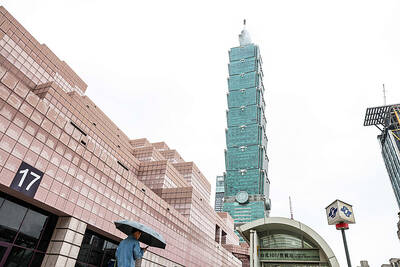
MANAGING RISKS: Taiwan has secured LNG sufficient to cover 95 percent of electricity demand for next month, UBS said, describing the government’s approach as proactive UBS Group AG has raised its forecast for Taiwan’s economic growth this year to 8 percent, up from 6.9 percent previously, and said expansion could reach as high as 8.6 percent if external energy shocks are avoided. The upgrade reflects a stronger-than-expected first-quarter performance and sustained momentum in artificial intelligence (AI)-driven exports, which UBS said are providing a firm foundation for growth despite geopolitical and energy risks. Taiwan’s GDP expanded 13.69 percent year-on-year in the first quarter, the fastest growth since the second quarter of 1987, the Directorate-General of Budget, Accounting and Statistics (DGBAS) reported on Thursday. On a seasonally
The Fair Trade Commission’s (FTC) ongoing review of Grab Holdings Ltd’s US$600 million acquisition of Foodpanda Taiwan’s operations, announced on March 23, has taken on fresh urgency as industry experts warn that the transaction could embed significant Chinese cybersecurity vulnerabilities into Taiwan’s digital infrastructure through Grab’s deep ties to autonomous-driving firm WeRide (文遠知行). Less than 16 months after the FTC blocked Uber Eats’ direct attempt to acquire Foodpanda Taiwan — citing potential combined market shares of 80 to 90 percent — the emergence of Grab as the buyer has prompted questions about whether the same competitive harm is simply being rerouted
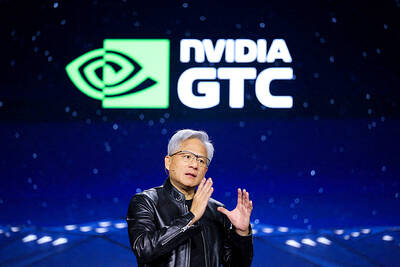
The list of Asian stocks that benefit from business partnership with Nvidia Corp is getting longer, as the region further integrates into the artificial intelligence (AI) chip giant’s business ecosystem. Just in the past week, South Korea’s LG Electronics Inc, Taiwan’s Nanya Technology Corp (南亞科技), as well as China’s Huizhou Desay SV Automotive Co (德賽西威) and Pateo Connect Technology Shanghai Corp (博泰車聯) have become the latest to rally on news of tie-ups, supply-chain participation or product collaboration with the US chip designer. Asian suppliers account for about 90 percent of Nvidia’s production costs, up from about 65 percent last year, data compiled


 RSS
RSS