


Industrial production fell back into negative growth last month, dropping 3.05 percent year-on-year, after growth of 1.04 percent in April, the Ministry of Economic Affairs said yesterday.
Although all sectors saw declines of more than 2 percent, the main cause was the 3.01 percent drop in the manufacturing sector, it said.
Last month’s performance was even greater than DBS Bank Ltd’s (星展銀行) estimate of a 1.7 percent contraction.
Despite the decline across the manufacturing sector, the output of the computer, electronic goods and optical components industry stood out with a year-on-year increase of 23.3 percent, a double-digit growth for an eighth month in a row, the ministry said.
The increase was largely the result of companies expanding production capacity of servers, routers and networking switches, as well as wireless communication equipment in Taiwan.
“We expect companies to continue moving production sites back to Taiwan amid the unresolved [trade] conflict between the US and China,” Department of Statistics Deputy Director-General Wang Shu-chuan (王淑娟) told a news conference in Taipei.
The electronic components industry’s production dropped 5.5 percent due to withering demand for integrated circuits amid the lingering inventory adjustments and an oversaturated DRAM market, the ministry said.
A decrease in the output of LCDs and related components also contributed to the industry’s decline as China continues to increase production, it said.
Production in traditional industries such as base metal and machinery equipment dropped 9.57 and 16.86 percent respectively as global demand slowed due to the US-China trade war, the ministry said.
The chemical materials industry’s output contracted by 3 percent, reflecting falling crude oil prices, while the production of styrene and aromatic hydrocarbons declined due to routine plant maintenance, it said.
Automobile and auto parts production shrank by 6.01 percent, which the ministry attributed to a high comparison base last year and rising demand for imported vehicles.
For the first five months of the year, total industrial production declined 2.98 percent, of which the manufacturing sector declined 3.12 percent from the same period last year, it added.
The latest industrial production data came on the heels of recent economic gauges pointing to challenges ahead for the economy, while a ministry survey of industries in the manufacturing sector showed that companies expect production to remain on a downward trend this month.
However, the ministry said it expects a general amelioration of industrial production in the third and fourth quarters.
“The main factor remains the US-China trade dispute,” Wang said, adding that overall production would improve following Taiwanese companies’ relocating production back home.


Taiwan’s foreign exchange reserves fell below the US$600 billion mark at the end of last month, with the central bank reporting a total of US$596.89 billion — a decline of US$8.6 billion from February — ending a three-month streak of increases. The central bank attributed the drop to a combination of factors such as outflows by foreign institutional investors, currency fluctuations and its own market interventions. “The large-scale outflows disrupted the balance of supply and demand in the foreign exchange market, prompting the central bank to intervene repeatedly by selling US dollars to stabilize the local currency,” Department of Foreign

Intel Corp is joining Elon Musk’s long-shot effort to develop semiconductors for Tesla Inc, Space Exploration Technologies Corp and xAI, marking a surprising twist in the chipmaker’s comeback bid. Intel would help the Terafab project “refactor” the technology in a chip factory, the company said on Tuesday in a post on X, Musk’s social media platform. That is a stage in the development process that typically helps make chips more powerful or reliable. The chipmaker’s shares jumped 4.2 percent to US$52.91 in New York trading on Tuesday. The Terafab project is a grand plan by Musk to eventually manufacture his own chips for
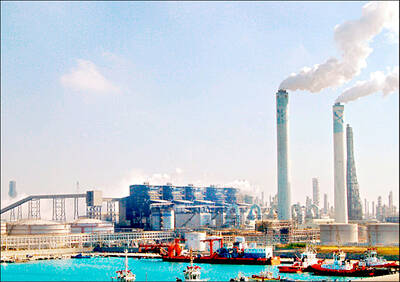
Taiwan Power Co (Taipower, 台電) yesterday said it plans to resume operations at two coal-fired power generators for three months to boost security of electricity supply as liquefied natural gas (LNG) supply risks are running high due to the Middle East conflict. The two coal-fired power generators are at Mailiao Power Plant in Yunlin County’s Mailiao Township (麥寮). The plant, operated by Formosa Plastics Group (台塑集團), supplied electricity to Taipower’s power grid until the end of last year. Taipower’s decision came about one month after Minister of Economic Affairs Kung Ming-hsin (龔明鑫) on March 10 said that the nation had no imminent

UNCERTAINTIES: Sales in the current quarter are expected to grow, but the impact of the volatile global political and economic situation should be monitored, Hon Hai said Hon Hai Precision Industry Co (鴻海精密) yesterday reported a 29.68 percent year-on-year rise in quarterly sales, a sign of sustained artificial intelligence (AI) demand during the first weeks of war in the Middle East. Revenue for the first quarter grew to NT$2.13 trillion (US$66.6 billion), while analysts on average were looking for NT$2.14 trillion. On a quarterly basis, revenue fell 18.18 percent, said Hon Hai, known internationally as Foxconn Technology Group (富士康科技集團). Concerns about a rush to build power-guzzling data centers are growing in the face of escalating conflict in the Middle East, which is putting pressure on global shipping


 RSS
RSS