


The Bank of Japan (BOJ) can deliver more big monetary stimulus if necessary, but needs to take care with its side effects on the financial system, Governor Haruhiko Kuroda said.
The BOJ would ease further if momentum toward its 2 percent inflation target is lost, Kuroda said in an interview with Bloomberg TV’s Kathleen Hays in Fukuoka, Japan, where central bankers and finance chiefs from G20 nations met over the weekend.
The governor said the BOJ does not need to act now, citing the health of the Japanese economy.
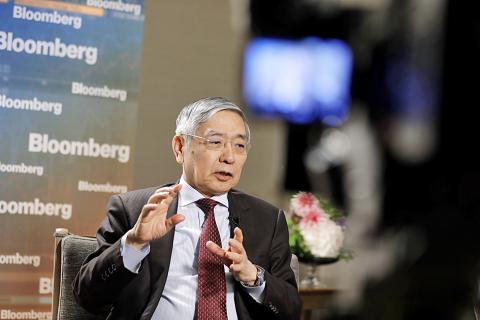
Photo: Bloomberg
Kuroda’s comments come after US Federal Reserve Chairman Jerome Powell signaled a willingness to act if the US economy needs it, while European Central Bank President Mario Draghi vowed to support growth and People’s Bank of China Governor Yi Gang (易綱) told Bloomberg in a separate interview that he has “tremendous” policy options to stoke demand.
“Like Mario Draghi, I think we can do these things if necessary,” Kuroda said.
While economic growth data released yesterday provides some support to Kuroda, inflation is still less than halfway to his goal and investors question whether the BOJ’s ultra-aggressive stimulus program is sustainable.
The BOJ’s program compromised the bond market’s function for pricing risk and low yields are squashing profits at commercial banks.
Asked if the BOJ still has the capacity to do “something big,” Kuroda said: “I think so.”
He cited four policy options: cutting the minus-0.1 percent rate further, lowering the target for 10-year yields, increasing the monetary base or boosting asset purchases.
“If the momentum to our 2 percent inflation target is lost, then of course, the Bank of Japan will swiftly respond by changing our policy,” Kuroda said.
The yen weakened immediately after publication of the governor’s remarks, falling to as low as ¥108.68 per US dollar.
Kuroda said the BOJ’s policy options would depend “particularly’’ on what is happening in financial markets.
The Fed is increasingly expected to cut rates this year, a move that would likely strengthen the yen. This has prompted more BOJ watchers to see additional easing as the central bank’s next move, given that a weak yen helps Japan’s efforts to spur inflation.
JPMorgan Chase & Co last week said that it now expects the BOJ to lower its negative interest rate to minus-0.3 percent in September.
In the interview, Kuroda said that he sees two areas of “potential risks” when it comes to side effects of BOJ monetary policy: The first is low yields pushing commercial banks into risky areas to find returns and the second is compromising their role as financial intermediaries.
“We may combine various monetary tools” to reduce harm, he said.
The BOJ is watching the employment market closely because it can have a big influence on inflation, Kuroda said, adding that the plan to raise the sales tax in October is understandable and the government has prepared measures to offset any negative effects.

Contract chipmaker United Microelectronics Corp (UMC, 聯電) yesterday said it has signed a memorandum of understanding (MOU) with Polar Semiconductor LLC to collaborate on the production of 8-inch wafers in the US. The collaboration aims to strengthen 8-inch wafer manufacturing in the US amid Washington’s efforts to increase onshore manufacturing of semiconductors, contribute to supply chain resilience against shifting geopolitical dynamics, and ensure a secure domestic supply of power semiconductors critical to automotive, electric grids, robotic manufacturing and data centers, the companies said in a joint statement. Under the MOU, Polar and UMC will identify devices for Polar to manufacture at

TECH TITANS: Amazon’s latest chip joins Google in competing for the 90 percent market share held by Nvidia, which claims it is ‘a generation ahead of the industry’ Amazon Web Services (AWS) on Tuesday launched its in-house-built Trainium3 artificial intelligence (AI) chip, marking a significant push to compete with Nvidia Corp in the lucrative market for AI computing power. The move intensifies competition in the AI chip market, where Nvidia dominates with an estimated 80 to 90 percent market share for products used in training large language models that power the likes of ChatGPT. Google last week caused tremors in the industry when it was reported that Facebook-parent Meta Platforms Inc would employ Google AI chips in data centers, signaling new competition for Nvidia. This followed the release last month of

INSULATED: The company said it is less exposed to global complications, as it has built a strong footprint worldwide, and has multiple sources of rare earths and raw minerals Merck Group yesterday said it would ramp up production next year at its new flagship facility in Kaohsiung’s Lujhu District (路竹) to satisfy growing demand for advanced semiconductor materials and specialty gases, and to address supply resilience issues amid mounting geopolitical risks. Merck made the remarks during a news conference before the inauguration of its 500 million euros (US$582.1 million) facility, which is also to supply other markets in the Asia-Pacific region, it said. Merck executive board deputy chair and electronics CEO Kai Beckmann told reporters the company adopted a “local-for-local” strategy about seven years ago to address the cycle time of

Two companies wholly owned by the daughter of the founder of Hon Hai Precision Industry Co (鴻海精密) on Monday reported to the Taiwan Stock Exchange that they would dispose of all of the Hon Hai shares they hold. In filings with the exchange, Hong Wei Investment Co (鋐維) said it would sell the 2.771 million Hon Hai shares it holds and Frontier Investment Corp (承鋒投資) said it would sell its 2.409 million Hon Hai shares from tomorrow until Jan. 3 next year. The two companies are wholly owned and chaired by Shirley Gou (郭曉玲), the eldest daughter of Hon Hai founder Terry


 RSS
RSS