


Mobile phone chip supplier MediaTek Inc (聯發科) yesterday said it was maintaining its financial forecast for this quarter, downplaying speculation that Qualcomm Inc no longer supplying components to Huawei Technologies Co (華為) would be a boon for the Taiwanese firm.
“We are not revising our guidance for the second quarter,” MediaTek executive vice president David Ku (顧大為) told reporters on the sidelines of an event at Computex Taipeito unveil the chipmaker’s latest 5G chips .
“Everything meets our original expectations. The full-year guidance is also maintained,” Ku said. “We cannot comment on any single client. Clients’ orders are trade secrets.”
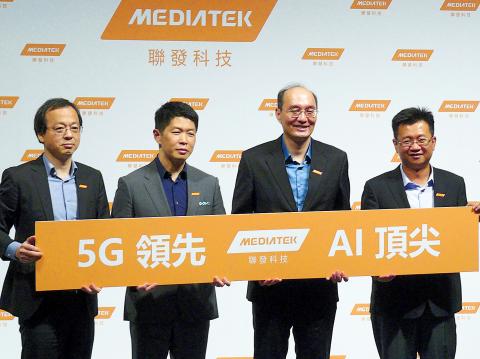
Photo: CNA
Last month, MediaTek projected that revenue this quarter would grow at a quarterly pace of 13 to 21 percent to between NT$53.8 billion and NT$59.6 billion (US$1.7 billion US$1.89 billion).
The company also said that annual revenue would grow mildly this year.
An official from Qualcomm Technology Inc, a wholly owned subsidiary of Qualcomm, on Monday said that the US company has stopped supplying chips to Huawei in compliance with the US government’s trade sanctions.
Huawei, the world’s No. 2 mobile phone vendor, sourced chips from Qualcomm and MediaTek for its mid and entry-level smartphones, while using chips from its semiconductor subsidiary HiSilicon Technologies Co (海思半導體) for its premium products.
Ku declined to comment on whether MediaTek would benefit from Huawei being blacklisted by the US.
The company would focus on creating roadmaps for new technologies and products to satisfy customers’ demands, rather than dwell on external developments, he said.
MediaTek said it has made progress in tapping into the 5G market, with its first 5G single chips for high-end Chinese smartphones likely to hit the market in the first quarter of next year.
Most of its customers have worked with it to roll out 5G smartphones next year, when shipments of 5G devices are expected to reach 50 million units, MediaTek said.
MediaTek counts major Chinese smartphone makers, including Oppo Mobile Telecommunications Corp (歐珀), Vivo Communication Technology Co (維沃) and Xiaomi Corp (小米), among its clients.
The company’s first 5G single chip would be produced using Taiwan Semiconductor Manufacturing Co’s (台積電) advanced 7-nanometer technology.
The chip is based on ARM Ltd’s Coretex A77 processor and Mali G77 graphics architecture.
MediaTek shares yesterday ended unchanged at NT$280.50 in Taipei trading, off a low of NT4275, while the TAIEX ended down 10.53 points, or 0.10 percent, at 10,301.78, on turnover of NT$93.38 billion.
Additional reporting by staff writer

GROWING OWINGS: While Luxembourg and China swapped the top three spots, the US continued to be the largest exposure for Taiwan for the 41st consecutive quarter The US remained the largest debtor nation to Taiwan’s banking sector for the 41st consecutive quarter at the end of September, after local banks’ exposure to the US market rose more than 2 percent from three months earlier, the central bank said. Exposure to the US increased to US$198.896 billion, up US$4.026 billion, or 2.07 percent, from US$194.87 billion in the previous quarter, data released by the central bank showed on Friday. Of the increase, about US$1.4 billion came from banks’ investments in securitized products and interbank loans in the US, while another US$2.6 billion stemmed from trust assets, including mutual funds,
Micron Memory Taiwan Co (台灣美光), a subsidiary of US memorychip maker Micron Technology Inc, has been granted a NT$4.7 billion (US$149.5 million) subsidy under the Ministry of Economic Affairs A+ Corporate Innovation and R&D Enhancement program, the ministry said yesterday. The US memorychip maker’s program aims to back the development of high-performance and high-bandwidth memory chips with a total budget of NT$11.75 billion, the ministry said. Aside from the government funding, Micron is to inject the remaining investment of NT$7.06 billion as the company applied to participate the government’s Global Innovation Partnership Program to deepen technology cooperation, a ministry official told the
Taiwan Semiconductor Manufacturing Co (TSMC, 台積電), the world’s leading advanced chipmaker, officially began volume production of its 2-nanometer chips in the fourth quarter of this year, according to a recent update on the company’s Web site. The low-key announcement confirms that TSMC, the go-to chipmaker for artificial intelligence (AI) hardware providers Nvidia Corp and iPhone maker Apple Inc, met its original roadmap for the next-generation technology. Production is currently centered at Fab 22 in Kaohsiung, utilizing the company’s first-generation nanosheet transistor technology. The new architecture achieves “full-node strides in performance and power consumption,” TSMC said. The company described the 2nm process as

Even as the US is embarked on a bitter rivalry with China over the deployment of artificial intelligence (AI), Chinese technology is quietly making inroads into the US market. Despite considerable geopolitical tensions, Chinese open-source AI models are winning over a growing number of programmers and companies in the US. These are different from the closed generative AI models that have become household names — ChatGPT-maker OpenAI or Google’s Gemini — whose inner workings are fiercely protected. In contrast, “open” models offered by many Chinese rivals, from Alibaba (阿里巴巴) to DeepSeek (深度求索), allow programmers to customize parts of the software to suit their


 RSS
RSS