


Local shares on Friday staged a mild technical rebound after plunging in the previous session as the bellwether electronics sector led the broader market higher throughout the session, dealers said.
However, turnover remained moderate to cap the upturn, as market sentiment remained roiled by rising trade tensions between the US and China, as well as uncertainty over Chinese telecom equipment maker Huawei Technologies Co Ltd (華為) after a business ban imposed by Washington, they said.
The TAIEX on Friday closed up 19.91 points, or 0.19 percent, at 10,328.28, after moving between 10,308.59 and 10,370.97, on turnover of NT$101.47 billion (US$3.22 billion). That was a slide of 0.5 percent from a close of 10,384.11 on May 17.
The market opened up 4.78 points and rose to the day’s high at about 9:30am as contract chipmaker Taiwan Semiconductor Manufacturing Co (TSMC, 台積電) bounced back from Thursday’s 3.36 percent slump to boost the weighted index, dealers said.
As the main board moved closer to the nearest technical resistance ahead of the five-day moving average of 10,392 points, some investors shifted to the sell side, which prompted the TAIEX to give up part of its earlier gains by the end of the session, dealers added.
“Despite today’s gains, the local main board remained in consolidation mode after shares suffered a dive yesterday, making the market technically fragile,” Hua Nan Securities Co (華南永昌證券) analyst Kevin Su (蘇俊宏) said.
On Thursday, the TAIEX fell 1.42 percent on the weakness of tech stocks.
“The tech sector as a whole rebounded, but the strength was limited, as there are no signs that Washington and Beijing will resolve their trade disputes anytime soon, in particular after the business ban faced by Huawei,” Su said on Friday.
“As many tech firms in Taiwan, including TSMC, are in Huawei’s supply chain, worries over their future shipments prevented investors from chasing prices for the moment,” he said.
TSMC, the most heavily weighted stock on the local market, rose 1.3 percent to close at NT$233 after an early high of NT$234, with 35.95 million shares changing hands. TSMC’s gains contributed about 30 points to the weighted index and boosted the electronics sector by 0.44 percent.
TSMC said that it would continue to supply chips to Huawei, as, after a preliminary review, the business is in line with the company’s rules governing compliance management and due diligence for shipments.
Also in the tech sector, IC packaging and testing services provider ASE Technology Holding Co (日月光投資控股), a Huawei supplier, rose 0.51 percent to close at NT$58.60 after hitting a high of NT$59.10.
Bucking the upturn of the electronics sector, shares in iPhone assembler Hon Hai Precision Industry Co (鴻海精密) fell 0.14 percent to end at NT$71.40, off a high of NT$72.20, and smartphone camera lens supplier Largan Precision Co (大立光) lost 0.66 percent to close at NT$3,775 after hitting a high of NT$3,935.
“Select old economy and financial stocks moved higher to help the broader market stay at the previous closing level,” Su said. “I think some investors were willing to park their funds in non-tech stocks as a safe haven amid the current trade friction.”
In the property sector, which rose 0.75 percent, shares in Cathay Real Estate Development Co (國泰建設) rose 3.87 percent to close at NT$25.50, Kindom Construction Co (冠德建設) gained 3.77 percent to end at NT$24.75 and Huaku Development Co (華固建設) added 2.4 percent to close at NT$81 on hopes that returning Taiwanese companies would boost demand for property.
Among gaining financial stocks, Shanghai Commercial & Savings Bank (上海商業儲蓄銀行) rose 5.28 percent to close at NT$57.80 and SinoPac Financial Holding Co (永豐金控) rose 1.67 percent to end at NT$12.20.
“Foreign institutional selling is expected to continue amid global uncertainty, so it is possible the local equity market will encounter more volatility down the road,” Su said.
Foreign institutional investors on Friday sold a net NT$8.52 billion of shares on the main board, after net sales of NT$11.02 billion on Thursday, Taiwan Stock Exchange data showed.
Elsewhere in Asia on Friday, the increasingly fractious US-China trade row was the main focus of investor angst, with most markets down to extend the previous day’s steep losses.
With little hope for a quick turnaround in the standoff, the economic superpowers appear to be digging in their heels as they exchange barbs, blaming each other for the breakdown in tariff negotiations while the Huawei crisis shows no sign of letting up.
On top of that, investors have been spooked by weak economic data in Europe and the US that reinforced concerns about a global slowdown, with the IMF warning the trade standoff will “jeopardize” this year’s growth.
“The trade war is going to cause growth to slow, both in the US and China, and therefore globally — there is no doubt about that,” Sri-Kumar Global Strategies founder Komal Sri-Kumar told Bloomberg TV. “The trade war is taking on new dimensions.”
Having taken a hammering on Thursday — with energy and tech firms among the worst hit — Asian markets continued to struggle on Friday.
Tokyo’s Nikkei 225 on Friday fell 33.92 points, or 0.2 percent, to 21,117.22, dropping 0.6 percent from a close of 21,250.09 on May 17.
Seoul’s KOSPI on Friday plunged 14.28 points, or 0.7 percent, to 2,045.31, a decrease of 0.5 percent from a week earlier.
Sydney lost 0.6 percent, while Wellington dipped 0.4 percent and Manila gave up 0.7 percent.
However, Hong Kong’s Hang Seng on Friday rose 86.80 points, or 0.3 percent, to 27,353.93, a fall of 2.1 percent from 27,946.46 on May 17.
The Shanghai Composite on Friday edged up 0.48 points to 2,852.99, but was still down 1 percent from a close of 2,882.30 a week earlier.
The tepid performance followed a sharp drop on Wall Street, where all three main indices lost more than 1 percent.
Investors were also spooked by an index of US manufacturing activity hitting a nine-year low this month and Germany posting weak factory figures.
There were also warnings about the outlook for equities as China and the US continue to hit out at each other.
“China’s stance on the talks has been clear — if the US wants to resume talks, they should show sincerity and correct their wrong practices,” Chinese Ministry of Commerce spokesman Gao Feng (高峰) said on Thursday.
Meanwhile, US Secretary of State Mike Pompeo rejected Huawei’s statements about its relationship with China’s government and said that any data touched by the company is “at risk” of falling into the wrong hands.
“To say that they don’t work with the Chinese government is a false statement,” he said.
Huawei “is deeply tied not only to China, but to the Chinese Communist Party,” he added.
Taiwan Semiconductor Manufacturing Co (TSMC, 台積電) last week recorded an increase in the number of shareholders to the highest in almost eight months, despite its share price falling 3.38 percent from the previous week, Taiwan Stock Exchange data released on Saturday showed. As of Friday, TSMC had 1.88 million shareholders, the most since the week of April 25 and an increase of 31,870 from the previous week, the data showed. The number of shareholders jumped despite a drop of NT$50 (US$1.59), or 3.38 percent, in TSMC’s share price from a week earlier to NT$1,430, as investors took profits from their earlier gains
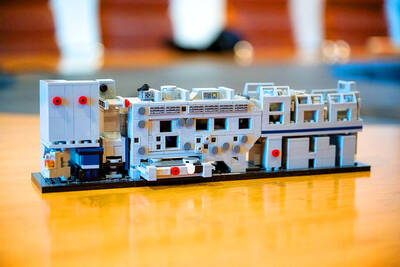
In a high-security Shenzhen laboratory, Chinese scientists have built what Washington has spent years trying to prevent: a prototype of a machine capable of producing the cutting-edge semiconductor chips that power artificial intelligence (AI), smartphones and weapons central to Western military dominance, Reuters has learned. Completed early this year and undergoing testing, the prototype fills nearly an entire factory floor. It was built by a team of former engineers from Dutch semiconductor giant ASML who reverse-engineered the company’s extreme ultraviolet lithography (EUV) machines, according to two people with knowledge of the project. EUV machines sit at the heart of a technological Cold
AI TALENT: No financial details were released about the deal, in which top Groq executives, including its CEO, would join Nvidia to help advance the technology Nvidia Corp has agreed to a licensing deal with artificial intelligence (AI) start-up Groq, furthering its investments in companies connected to the AI boom and gaining the right to add a new type of technology to its products. The world’s largest publicly traded company has paid for the right to use Groq’s technology and is to integrate its chip design into future products. Some of the start-up’s executives are leaving to join Nvidia to help with that effort, the companies said. Groq would continue as an independent company with a new chief executive, it said on Wednesday in a post on its Web

CHINA RIVAL: The chips are positioned to compete with Nvidia’s Hopper and Blackwell products and would enable clusters connecting more than 100,000 chips Moore Threads Technology Co (摩爾線程) introduced a new generation of chips aimed at reducing artificial intelligence (AI) developers’ dependence on Nvidia Corp’s hardware, just weeks after pulling off one of the most successful Chinese initial public offerings (IPOs) in years. “These products will significantly enhance world-class computing speed and capabilities that all developers aspire to,” Moore Threads CEO Zhang Jianzhong (張建中), a former Nvidia executive, said on Saturday at a company event in Beijing. “We hope they can meet the needs of more developers in China so that you no longer need to wait for advanced foreign products.” Chinese chipmakers are in


 RSS
RSS