


Taiflex Scientific Co (台虹科技), which manufactures flexible printed circuit boards for mobile phones, on Tuesday gave a conservative guidance for this quarter, with revenue likely to fall 7.78 percent to NT$2.2 billion (US$71.19 million).
The forecast would represent a nearly 60 percent pickup from the previous quarter.
Chinese clients are supplying the demand, general manager Yen Chih-ming (顏志明) said in an earnings call, adding that the company plans to end its solar energy business entirely at the end of this quarter.
While orders from US clients fell, orders from Huawei Technologies Co Ltd (華為), Oppo Mobile Telecommunications Corp (歐珀) and Vivo Communication Technology Co (維沃) have increased, Yen said.
Consequently, Chinese clients have gained importance, accounting for 55 percent of first-quarter revenue, compared with 30 percent a year earlier, company data showed.
US clients generated 35 percent last quarter, compared with 60 percent a year earlier, with automobile electronics manufacturers making up the remaining share.
Net losses reached NT$7.17 million, down from NT$180.85 million a quarter earlier and NT$96.94 million a year earlier.
Losses per share were NT$0.03, reversing from earnings per share of NT$0.86 a quarter earlier.
Gross margin fell to 11.43 percent, compared with 18.21 percent a quarter earlier and 19.71 percent a year earlier, the company said, blaming the poor showing on weak mobile phone sales and the exit from the solar energy business.
Revenue dropped 43.04 percent quarter-on-quarter, or 31.35 percent year-on-year, to NT$1.37 billion.
Sales of electronic materials dropped 20.7 percent year-on-year.
Sales of smartphones released last year disappointed and upstream component suppliers felt the pinch, Yen said.
The firm is to divest of NT$50 million in solar energy-related products this quarter and there would be no revenue contribution from the solar energy business from next quarter, he said.
“There are no bad debts among the accounts receivable in the solar energy business, so investors do not have to worry,” Yen said.
Taiflex’s new factory in Rudong County in China’s Jiangsu Province is expected to be completed next quarter and contribute to earnings next year, he said.
The company would adjust its product portfolio in the short term to maintain steady revenue, Yen said.
It is to focus on developing more high-frequency materials and white, brown or transparent cover layers to make products more competitive from next year, he said.
The company’s Modified PI used in mobile phone antennas is ready for shipment, Yen said, adding that liquid crystal polymer, another material for making antennas, would contribute to revenue next year.
Taiflex shares on Tuesday remained at NT$39.7 in Taipei trading.

Nvidia Corp chief executive officer Jensen Huang (黃仁勳) on Monday introduced the company’s latest supercomputer platform, featuring six new chips made by Taiwan Semiconductor Manufacturing Co (TSMC, 台積電), saying that it is now “in full production.” “If Vera Rubin is going to be in time for this year, it must be in production by now, and so, today I can tell you that Vera Rubin is in full production,” Huang said during his keynote speech at CES in Las Vegas. The rollout of six concurrent chips for Vera Rubin — the company’s next-generation artificial intelligence (AI) computing platform — marks a strategic
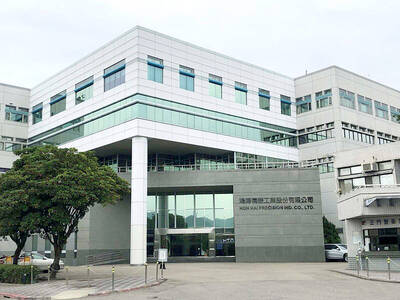
REVENUE PERFORMANCE: Cloud and network products, and electronic components saw strong increases, while smart consumer electronics and computing products fell Hon Hai Precision Industry Co (鴻海精密) yesterday posted 26.51 percent quarterly growth in revenue for last quarter to NT$2.6 trillion (US$82.44 billion), the strongest on record for the period and above expectations, but the company forecast a slight revenue dip this quarter due to seasonal factors. On an annual basis, revenue last quarter grew 22.07 percent, the company said. Analysts on average estimated about NT$2.4 trillion increase. Hon Hai, which assembles servers for Nvidia Corp and iPhones for Apple Inc, is expanding its capacity in the US, adding artificial intelligence (AI) server production in Wisconsin and Texas, where it operates established campuses. This
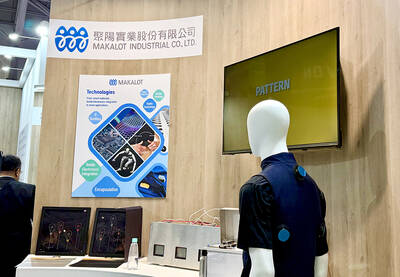
Garment maker Makalot Industrial Co (聚陽) yesterday reported lower-than-expected fourth-quarter revenue of NT$7.93 billion (US$251.44 million), down 9.48 percent from NT$8.76 billion a year earlier. On a quarterly basis, revenue fell 10.83 percent from NT$8.89 billion, company data showed. The figure was also lower than market expectations of NT$8.05 billion, according to data compiled by Yuanta Securities Investment and Consulting Co (元大投顧), which had projected NT$8.22 billion. Makalot’s revenue this quarter would likely increase by a mid-teens percentage as the industry is entering its high season, Yuanta said. Overall, Makalot’s revenue last year totaled NT$34.43 billion, down 3.08 percent from its record NT$35.52

PRECEDENTED TIMES: In news that surely does not shock, AI and tech exports drove a banner for exports last year as Taiwan’s economic growth experienced a flood tide Taiwan’s exports delivered a blockbuster finish to last year with last month’s shipments rising at the second-highest pace on record as demand for artificial intelligence (AI) hardware and advanced computing remained strong, the Ministry of Finance said yesterday. Exports surged 43.4 percent from a year earlier to US$62.48 billion last month, extending growth to 26 consecutive months. Imports climbed 14.9 percent to US$43.04 billion, the second-highest monthly level historically, resulting in a trade surplus of US$19.43 billion — more than double that of the year before. Department of Statistics Director-General Beatrice Tsai (蔡美娜) described the performance as “surprisingly outstanding,” forecasting export growth


 RSS
RSS