

Braving the cold and hostile Libyan desert, Milad Mohammed scratches the ground to extract what he calls “manna from heaven” — white truffles coveted as a delicacy at home and abroad.
The fungus known locally as terfas is the only thing, besides some wild grass, that grows under the desert sands, nurtured by the combined effect of rain and cold temperatures at night.
They have been consumed since Roman times for their delicate taste, as well as their nutritious and medical properties, and are sold to Persian Gulf countries as a luxury food item.
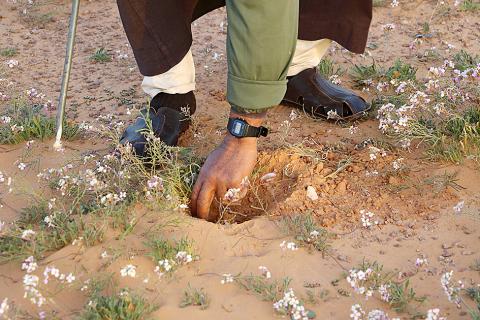
Photo: AFP
Mohammed harvests the white truffle as a hobby, and each year before springtime he treks through the desert region of al-Hamada al-Hamra, southwest of Tripoli, to look for them.
“I don’t earn my living from this. It’s a passion,” said Mohammed, a retired civil servant in his 60s from the western city of Zintan.
“It’s like a therapy, a way to purify myself from the chaos of the city,” he said as he took a drag from a cigarette outside a tent he pitched in the desert after a day’s work.
“It’s a beautiful place, and rough, and you feel so isolated here,” he added.
For hours he wanders across the desert by foot or in his pickup truck, covering dozens of kilometers and stopping at several spots to scratch the sand with his hands or a cane in search of white truffles.
Usually they are buried deep underground.
“There is nothing more satisfying than to use your bare hands to dig into the sand and extract these delicious truffles,” Mohammed said. “They’re manna from heaven.”
However, searching for this white gold in the oil-rich north African country that descended into chaos after the fall of Muammar Qaddafi in a 2011 NATO-backed uprising is no easy task.
Libya has been gripped by unrest since the revolt, with various groups vying for control of its oil wealth and cities, while the desert has become a hornet’s nest for extremists and criminal gangs.
Unlike hunters of black truffles, who use dogs or hogs to search for the prized mushroom, Mohammed only trusts his eyes to spot the place where they grow.
White truffles — scientifically known to provide a rich source of protein — have health benefits and their juice is used to treat eye diseases, he said.
However, truffles are also in great demand in Persian Gulf markets.
Over the past few years, the price per kilo of white truffles tripled to 130 Libyan dinars (US$93.86), one merchant said, as harvesting the fungus became more difficult due to Libya’s unrest and unfavorable weather conditions.
This year, the harvest was good thanks to abundant rain, but that meant that the cost per kilo dropped to 80 dinars.
Wholesale transactions often take place at a tent erected on a road near Zintan that leads to al-Hamada al-Hamra.
It is there that pickers like Mohammed and Khaled Abdelwahed go to sell the truffles they found in the desert.
“We endured very cold weather, but the merchant is offering us a fraction of the price,” Abdelwahed said as he tried to negotiate a good deal for the 8kg of truffles he collected after four nights in the desert.
“The merchant’s making a better profit than us, and all that time he keeps warm in his tent,” while truffle pickers do all the hard work, he said.
The buyer, Khalifa al-Sahraoui, a merchant from neighboring Algeria who travels to Libya each year for truffle season between November and March, disagreed.
“We buy the truffles and sell them to other merchants,” he said.
Abdallah Miloud, another truffle merchant, said that the harvest is sold to middlemen who in turn “sell them to clients abroad.”
The Libyan white truffle is of “excellent quality” and “prized in Gulf countries,” he added.
There are no official figures for the export of Libyan truffles, but Miloud said that revenues from sales have “rescued several families” from financial hardship.
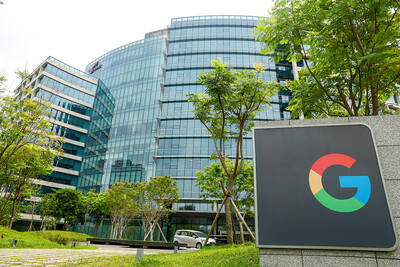
READJUSTMENT? Despite the rumors, a senior Google official said that the company plans to expand its AI research center in Taipei’s Shilin District Google Taiwan is reducing its workforce as the company continues to adjust operations to improve efficiency and focus resources on core goals, the Chinese-language Liberty Times (sister paper of the Taipei Times) reported yesterday. The Alphabet Inc unit said the organizational adjustments have begun and would continue, even though it did not put a figure on the number of potential job cuts or specify the affected departments in its Taiwan operations. The company’s response came after rumors circulated on social media about major job cuts at Google Taiwan. Some posts said the downsizing would target the company’s consumer electronics-related departments
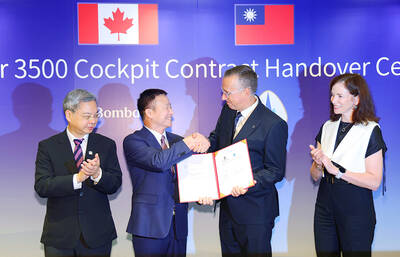
Taiwanese aircraft maker Aerospace Industrial Development Corp (AIDC, 漢翔航空) yesterday announced that it has secured a 20-year partnership agreement with Canada-based Bombardier Inc. The two companies held a ceremony in Taipei yesterday to exchange signed copies of the agreement, launching the 20-year partnership under which AIDC would supply cockpit and forward fuselage structural components for Bombardier’s super-midsize Challenger 3500 business jets, the Taiwanese company said. The agreement represents a new milestone in cooperation between the two companies, which dates back to 1999, with the Taiwanese supplier having provided rear fuselage structural components for more than 1,000 Challenger 3500 aircraft, it

Taiwan should avoid becoming overly dependent on semiconductors and preserve resources for other industries while expanding chip production with trusted overseas partners, a US academic said yesterday. Glenn D. Tiffert, distinguished research fellow and cochair of the Program on the US, China and the World at Stanford University’s Hoover Institution, made the remarks during a panel discussion on trusted supply chains at a forum hosted by the Research Institute for Democracy, Society and Emerging Technology (DSET) and SEMI in Taipei. “The semiconductor industry has been fabulous for Taiwan, but there is the danger that Taiwan devotes too much to being the one-trick
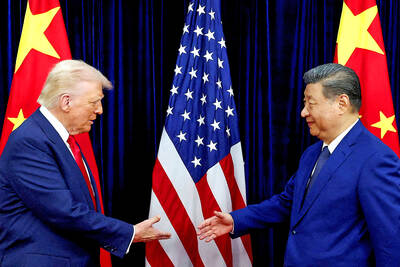
UNUSUAL INCLUSION: While Trump brought a herd of executives to the meeting in Beijing several month ago, Xinping has shown less inclination to bring CEOs along Chinese President Xi Jinping (習近平) is preparing a large business delegation to accompany him on his visit to Washington, two sources said, an unusual move given US skepticism toward Chinese investment and Beijing’s strained ties with private enterprise. Xi rarely travels abroad with corporate executives, many of whom fell from of favor after Beijing’s regulatory crackdowns on the technology, education and property sectors that began in 2020. “The White House is not tracking a Chinese CEO delegation,” an US official said. They did not explain what they meant by tracking. The business delegation for the Sept. 24 summit has not been reported before.


 RSS
RSS