

Taiwan Semiconductor Manufacturing Co (TSMC, 台積電) yesterday said that its board of directors has approved a proposal to distribute a cash dividend of NT$8 per common share based on last year’s earnings and NT$2 per share for this quarter’s earnings.
The world’s largest contract chipmaker said that it would distribute the former in July and the latter in the fourth quarter of this year after obtaining final approval from shareholders at a shareholders’ meeting to be held on June 5.
It would be the first time the three-decade-old company would pay two cash dividends in a calendar year, instead of the usual once per year.
The board yesterday also approved a new distribution scheme to pay cash dividends on a quarterly basis.
TSMC would be the nation’s first listed company to pay quarterly cash dividends after lawmakers passed amendments to the Company Act (公司法) last summer.
The changes aim to give greater flexibility to listed companies when arranging their cash dividend payments, instead of requiring them to pay dividends once per year.
The distribution of NT$8 per common share, same as last year, represents a payout ratio of 59 percent based on the company’s earnings per share of NT$13.54 last year.
“TSMC intends to continue its stable dividend policy and return about 70 percent of its free cash flow to shareholders every year,” the company said in a statement.
“As the company’s business continues to grow and generates greater amounts of free cash flow, it expects to maintain a sustainable quarterly cash dividend and to distribute the cash dividend each year at a level not lower than the year before,” it said.
The board approved a proposal to distribute a total bonus of NT$47.14 billion to the company’s employees in July, TSMC said.
The board agreed to appropriate about US$3.73 billion to install advanced technology capacity and convert logic capacity to specialty technology capacity, the company said.
A budget would be earmarked for research and development capital investments and sustaining capital expenditure next quarter, the company added.
The board approved capital appropriation of US$4.91 million to increase the budget for capitalized leased assets in the first half of this year, it said.
It also promoted Liaw Y.H. (廖永豪), a senior director at Fab 15 B, to vice president, TSMC said.

Bankers in Hong Kong skipped the summer break as an artificial intelligence (AI)-fueled rush for capital sent share sales to a record, defying a bruising selloff in the city’s stocks. Initial public offerings (IPOs), placements and block trades raised US$47.5 billion in July to last month, the biggest haul ever for the period, data compiled by Bloomberg showed. That pushed fundraising this year above US$92 billion and within reach of the US$112.5 billion record set in 2021. AI has been at the heart of Hong Kong’s deal revival, but this summer brought a new level of intensity. Chinese companies raised ever-larger sums
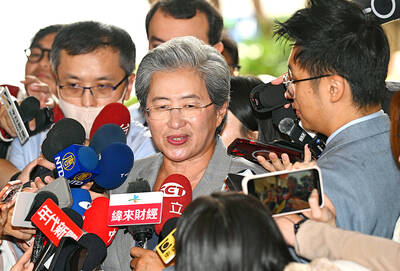
SILICON ISLAND: When asked about geopolitical tensions, Lisa Su said that ‘Taiwan is absolutely critical to the semiconductor supply chain, and very, very critical for AMD’ Advanced Micro Devices Inc (AMD) CEO Lisa Su (蘇姿丰) yesterday said the company plans to “substantially” increase manufacturing capacity next year through its Taiwanese supply chain, particularly with Taiwan Semiconductor Manufacturing Co (TSMC, 台積電), as surging demand for artificial intelligence (AI)-related processors continues to outstrip supply. “It is a very exciting time right now for all kinds of compute, and especially on the CPU [central processing unit] side,” Su said during a visit to Taiwan. “The overall market has increased a lot in 2026, and so we have also increased our own supply and capacity in 2026, but I can
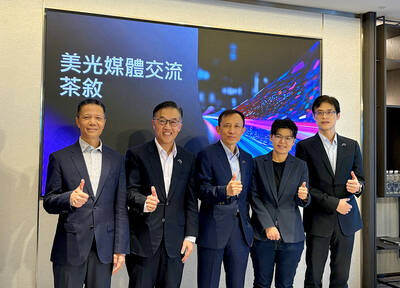
BOOMING BUSINESS: Memory supply constraints would be even more severe in 2027 and 2028, prompting customers to sign long-term supply agreements, Micron said Micron Memory Taiwan Co (台灣美光) yesterday said it is accelerating memorychip capacity expansion amid growing artificial intelligence (AI)-driven demand, with its accumulated investment in Taiwan reaching NT$1.6 trillion (US$50.2 billion) as of June. The company’s investment in Taiwan has surged over the past four years, with recent spending equaling the total invested over the past 25 years, Micron Taiwan chairman Donghui Lu (盧東暉) told a media briefing in Taipei. “The launch of ChatGPT and the outbreak of COVID triggered increasing demand for memory chips. Since then, demand has gathered pace rapidly, with only a brief pause in 2023 when a major downturn”
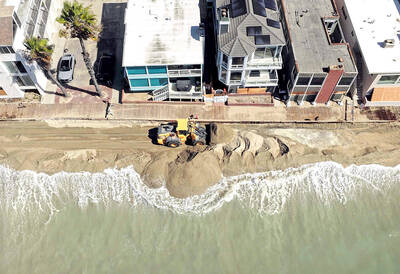
Sea levels in California are set to rise by as much as a foot (30cm) in the coming days as an enormous wave washes up the US West Coast. The huge surge of energy, known as a “coastal trapped wave” or a “Kelvin wave,” is part of El Nino, a months-long phenomenon in the Pacific Ocean that scientists say could generate powerful storms and floods in some parts of the world, while leaving others in drought. The Kelvin wave is not anything like a tsunami; nor does it crash on beaches. Rather it is a sustained bulge of excess water up to


 RSS
RSS