


The New Taiwan dollar on Friday fell against the US dollar, shedding NT$0.005 to close at NT$30.745.
However, that was a 0.3 percent gain from a close of NT$30.825 on Jan. 25.
The greenback opened at NT$30.750, moving between NT$30.725 and NT$30.775 before the close. Turnover totaled US$565 million during the trading session.
Elsewhere on Friday, the US dollar slipped after the US nonfarm payrolls report for last month showed very little wage inflation, affirming the US Federal Reserve’s patient stance on further interest rate increases.
The greenback did shoot higher after the release of strong job gains, but quickly got back to its levels before the data, with analysts citing the average hourly earnings figure, which rose just 0.1 percent, compared with expectations for a 0.3 percent increase.
Beyond the headline jobs gains, the US dollar has become more sensitive to wage inflation over the past year.
The report showed that the US economy last month created 304,000 new jobs, the highest in 11 months, superseding forecasts for 165,000 jobs.
However, the unemployment rate rose to a seven-month peak of 4 percent.
“We had a knee-jerk rise in the [US] dollar based on the strong gain in payrolls, as well as the overall solid report,” Credit Agricole Group foreign exchange strategist Eric Viloria said. “But the miss in wages probably reinforces this patient approach by the Fed and that has restrained the [US] dollar.”
Contracts tied to the Fed’s policy rate had priced out any chance of a rate hike this year, after Fed Chairman Jerome Powell on Wednesday said that the case for rate increases had weakened, and were pricing in an about one-in-three chance of a rate cut by the end of the year.
However, after the jobs data, traders reduced rate-cut bets, although they continue to bet against a rate hike.
In mid-morning trading, the US dollar index was down 0.1 percent at 95.508.
Meanwhile, the euro rose 0.2 percent against the greenback to US$1.1471, while the US dollar gained 0.2 percent against the yen to ¥109.02.
Broader risk sentiment remained somewhat robust after a top US negotiator on Thursday reported “substantial progress” in two days of high-level talks on trade with China.
The US dollar is widely expected to weaken this year as the Fed turns more cautious about rate increases.
“The outlook for US assets remains relatively uncompelling and investors should be shopping for value elsewhere,” Morgan Stanley global head of currency strategy Hans Redeker said in London. “A weak US equity market outlook should keep low-yielders such as the yen and the Swedish crown supported.”
Taiwan’s long-term economic competitiveness will hinge not only on national champions like Taiwan Semiconductor Manufacturing Co. (TSMC, 台積電) but also on the widespread adoption of artificial intelligence (AI) and other emerging technologies, a US-based scholar has said. At a lecture in Taipei on Tuesday, Jeffrey Ding, assistant professor of political science at the George Washington University and author of "Technology and the Rise of Great Powers," argued that historical experience shows that general-purpose technologies (GPTs) — such as electricity, computers and now AI — shape long-term economic advantages through their diffusion across the broader economy. "What really matters is not who pioneers

In a high-security Shenzhen laboratory, Chinese scientists have built what Washington has spent years trying to prevent: a prototype of a machine capable of producing the cutting-edge semiconductor chips that power artificial intelligence (AI), smartphones and weapons central to Western military dominance, Reuters has learned. Completed early this year and undergoing testing, the prototype fills nearly an entire factory floor. It was built by a team of former engineers from Dutch semiconductor giant ASML who reverse-engineered the company’s extreme ultraviolet lithography (EUV) machines, according to two people with knowledge of the project. EUV machines sit at the heart of a technological Cold
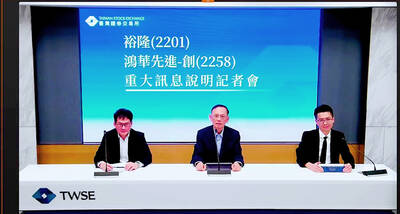
TAIWAN VALUE CHAIN: Foxtron is to fully own Luxgen following the transaction and it plans to launch a new electric model, the Foxtron Bria, in Taiwan next year Yulon Motor Co (裕隆汽車) yesterday said that its board of directors approved the disposal of its electric vehicle (EV) unit, Luxgen Motor Co (納智捷汽車), to Foxtron Vehicle Technologies Co (鴻華先進) for NT$787.6 million (US$24.98 million). Foxtron, a half-half joint venture between Yulon affiliate Hua-Chuang Automobile Information Technical Center Co (華創車電) and Hon Hai Precision Industry Co (鴻海精密), expects to wrap up the deal in the first quarter of next year. Foxtron would fully own Luxgen following the transaction, including five car distributing companies, outlets and all employees. The deal is subject to the approval of the Fair Trade Commission, Foxtron said. “Foxtron will be

INFLATION CONSIDERATION: The BOJ governor said that it would ‘keep making appropriate decisions’ and would adjust depending on the economy and prices The Bank of Japan (BOJ) yesterday raised its benchmark interest rate to the highest in 30 years and said more increases are in the pipeline if conditions allow, in a sign of growing conviction that it can attain the stable inflation target it has pursued for more than a decade. Bank of Japan Governor Kazuo Ueda’s policy board increased the rate by 0.2 percentage points to 0.75 percent, in a unanimous decision, the bank said in a statement. The central bank cited the rising likelihood of its economic outlook being realized. The rate change was expected by all 50 economists surveyed by Bloomberg. The


 RSS
RSS