


The 128 people in Asia with enough money to make the 500-member Bloomberg Billionaires Index lost a combined US$137 billion this year, the first time wealth in the region has dropped since the ranking started in 2012.
Global trade tensions and concerns that stock valuations are too frothy hammered some of the area’s biggest fortunes.
China’s tech sector was hit particularly hard, while India and South Korea were not spared. The declines occurred even as banks and money managers aggressively stepped up efforts to cater to Asia’s richest people.
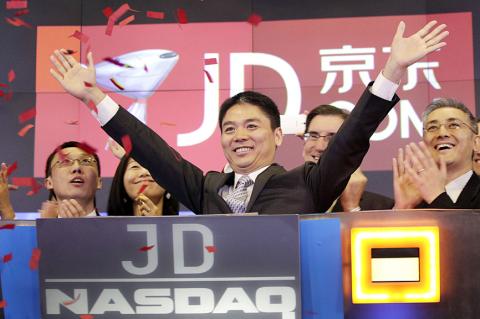
Photo: AP
“Difficult stock market conditions this year and the uncertainty of the trade tensions likely have been a challenge to many businesses,” said Philip Wyatt, a Hong Kong-based economist for UBS Group AG, who does not see the downdraft continuing through next year or significantly reducing the ranks of billionaires.
Conditions are actually ripe for the region to create more of the mega rich as new technologies attract private capital and government support, he said.
However, for now, fear in the market is trampling fortunes. More than two-thirds of the 40 Chinese on the Bloomberg ranking saw their wealth dwindle.
Wanda Group’s (萬達集團) Wang Jianlin (王健林), whose property conglomerate is selling assets to cut debt, lost US$10.8 billion, the most of anyone in Asia.
JD.com (京東) founder Richard Liu (劉強東), who was arrested in the US in August for less than 24 hours on suspicion of rape before being released, took the heaviest losses in percentage terms, with his wealth cut almost in half to US$4.8 billion.
India’s 23 richest people saw a combined US$21 billion vanish.
Lakshmi Mittal, who controls the world’s largest steelmaker, led the way, losing US$5.6 billion, or 29 percent of his net worth, followed by Dilip Shanghvi, the founder of Sun Pharmaceutical Industries Ltd, the world’s fourth-largest generic drugmaker, whose wealth declined US$4.6 billion.
South Korea’s tycoons did not escape either. The market rout lopped US$17.2 billion from the fortunes of the country’s seven richest people. The father and son who control Samsung Electronics Co, Lee Kun-hee and son Jay Y. Lee, account for more than one-third of that decline.
In Hong Kong, titans of real estate took a hit. Li Ka-shing (李嘉誠), who retired as chairman of CK Hutchison Holdings Ltd (長和集團) and CK Asset Holdings Ltd (長江實業) in March, lost US$6 billion this year, while Lee Shau-kee (李兆基), the territory’s second-richest person, ends the year about US$3.3 billion poorer.
Among Taiwanese on the list, Want Want Group (旺旺集團) chairman Tsai Eng-meng (蔡衍明) had lost US$673 million as of yesterday. He remained No. 1 among Taiwanese, ranked at 271 overall. The biggest loss to date this year was by Hon Hai Precision Industry Co (鴻海精密) chairman Terry Gou (郭台銘), down US$1.65 billion, while Ruentex Group (潤泰集團) chairman Samuel Yin (尹衍樑) had gained US$460 million to be the biggest winner.
There were plenty of other winners elsewhere to emerge this year.
Lei Jun (雷軍), chairman of Chinese smartphone maker Xiaomi Corp (小米), added US$8.7 billion, with a July initial public offering catapulting him into the Top 100 of the Bloomberg index after he started the year outside the rankings. The IPO also turned three of his cofounders into billionaires.
Japan’s richest person, Tadashi Yanai, added US$6.3 billion to his fortune as shares of Fast Retailing Co, the world’s largest apparel retailer, surged 30 percent. India’s Mukesh Ambani added US$4 billion to his fortune and eclipsed Alibaba Group Holding Ltd’s (阿里巴巴) Jack Ma (馬雲) as Asia’s richest person, thanks in part to the performance of Reliance Industries Ltd.
Among the winners, the Bloomberg Billionaires Index added new members in technology, consumer, biotech and pharmaceuticals. E-commerce platform Pinduoduo Inc’s (拼多多) Colin Huang (黃崢) was the second-largest winner in the region, adding US$6.6 billion to his net worth.
While most of the newcomers to Asia’s ranks of billionaires are from China, there are five from South Korea and four from Japan. Two new billionaires were identified in Southeast Asia. The household “must-have” fish sauce condiment saw Nguyen Dang Quang, chairman of Vietnam’s consumer giant Masan Group, join the ultra-rich club. Indonesian real-estate mogul Donald Sihombing, who works 20 hours a day, also joined the list.
At least six Asian billionaires died, leaving behind a total of US$29 billion.
Walter Kwok (郭炳湘), former chairman of Hong Kong’s biggest real-estate developer, Sun Hung Kai Properties Ltd (新鴻基地產), who was worth US$9.1 billion, died in October at the age of 68. His two sons inherited a US$3 billion stake from the company. Vichai Srivaddhanaprabha, founder of Thailand’s duty-free giant King Power Group, was killed in a helicopter crash in October. He owned English Premier League team Leicester City.
Additional reporting by staff writer
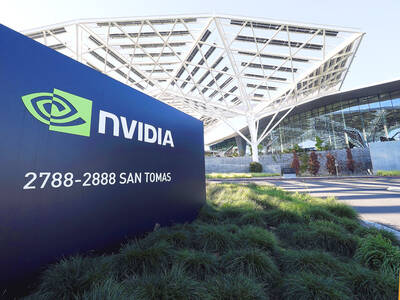
CHIP RACE: Three years of overbroad export controls drove foreign competitors to pursue their own AI chips, and ‘cost US taxpayers billions of dollars,’ Nvidia said China has figured out the US strategy for allowing it to buy Nvidia Corp’s H200s and is rejecting the artificial intelligence (AI) chip in favor of domestically developed semiconductors, White House AI adviser David Sacks said, citing news reports. US President Donald Trump on Monday said that he would allow shipments of Nvidia’s H200 chips to China, part of an administration effort backed by Sacks to challenge Chinese tech champions such as Huawei Technologies Co (華為) by bringing US competition to their home market. On Friday, Sacks signaled that he was uncertain about whether that approach would work. “They’re rejecting our chips,” Sacks
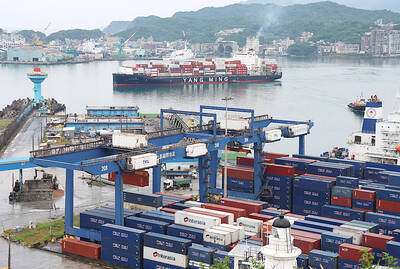
Taiwan’s exports soared 56 percent year-on-year to an all-time high of US$64.05 billion last month, propelled by surging global demand for artificial intelligence (AI), high-performance computing and cloud service infrastructure, the Ministry of Finance said yesterday. Department of Statistics Director-General Beatrice Tsai (蔡美娜) called the figure an unexpected upside surprise, citing a wave of technology orders from overseas customers alongside the usual year-end shopping season for technology products. Growth is likely to remain strong this month, she said, projecting a 40 percent to 45 percent expansion on an annual basis. The outperformance could prompt the Directorate-General of Budget, Accounting and
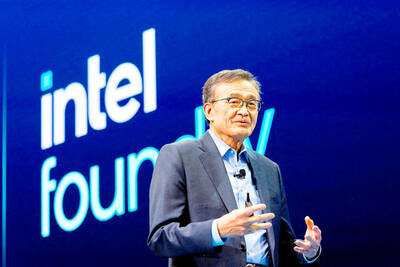
NATIONAL SECURITY: Intel’s testing of ACM tools despite US government control ‘highlights egregious gaps in US technology protection policies,’ a former official said Chipmaker Intel Corp has tested chipmaking tools this year from a toolmaker with deep roots in China and two overseas units that were targeted by US sanctions, according to two sources with direct knowledge of the matter. Intel, which fended off calls for its CEO’s resignation from US President Donald Trump in August over his alleged ties to China, got the tools from ACM Research Inc, a Fremont, California-based producer of chipmaking equipment. Two of ACM’s units, based in Shanghai and South Korea, were among a number of firms barred last year from receiving US technology over claims they have
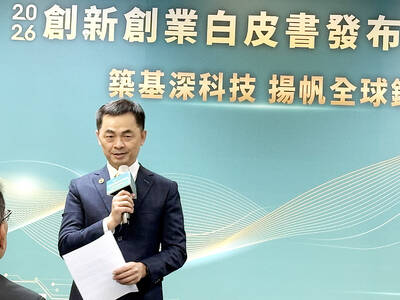
BARRIERS: Gudeng’s chairman said it was unlikely that the US could replicate Taiwan’s science parks in Arizona, given its strict immigration policies and cultural differences Gudeng Precision Industrial Co (家登), which supplies wafer pods to the world’s major semiconductor firms, yesterday said it is in no rush to set up production in the US due to high costs. The company supplies its customers through a warehouse in Arizona jointly operated by TSS Holdings Ltd (德鑫控股), a joint holding of Gudeng and 17 Taiwanese firms in the semiconductor supply chain, including specialty plastic compounds producer Nytex Composites Co (耐特) and automated material handling system supplier Symtek Automation Asia Co (迅得). While the company has long been exploring the feasibility of setting up production in the US to address


 RSS
RSS