


Shares of Hon Hai Precision Industry Co (鴻海), a key assembler of Apple Inc’s iPhones, yesterday remained strong following media reports that chairman Terry Gou (郭台銘) bought about NT$2 billion (US$64.8 million) shares last month, dealers said.
However, the gains could be short-lived as global demand for the latest iPhones is slower than expected and trade tensions between the US and China continues, they said.
The stock closed 4.1 percent higher at NT$71.20 on turnover of 52.2 million shares, Taiwan Stock Exchange (TWSE) data showed.
The stock attracted strong buying soon after the market opened and its momentum continued, dealers said.
“It seems that market confidence in Hon Hai shares was reinforced by Gou’s move to spend a lot of money to increase his stake in the company,” Ta Ching Securities (大慶證券) analyst Jerry Chen said.
Hon Hai’s market capitalization rose from NT$948 billion on Tuesday to NT$984 billion yesterday.
In a posting to the TWSE on Tuesday, Hon Hai said Gou bought a total of 27 million company shares last month, raising his holding to 1.32 billion.
After the purchase, Gou’s stake in Hon Hai rose from 9.36 percent in October to 9.55 percent at the end of last month.
Based on Hon Hai’s average closing price of NT$71.75 last month, Gou is estimated to have spent about NT$2 billion to raise his stake in the company.
Commenting on Gou’s share purchases, Hon Hai said it was an issue of personal wealth management.
On Tuesday, Hon Hai shares rose 1.03 percent to NT$68.40 after the company reported better-than-expected sales for last month.
Consolidated sales rose 1.99 percent from a month earlier to NT$601.44 billion last month, the highest level ever for the month and the second-highest month for the company.
On an annual basis, sales rose 5.59 percent.
“After the gains on Tuesday and Wednesday, Hon Hai shares have turned technically healthier, but I am afraid that such a strong showing will be short-lived, since market sentiment has been affected by slow iPhone sales,” Chen said.
“Moreover, the Washington-Beijing trade dispute has prompted foreign institutional investors to cut their holdings in Hon Hai, which has a broad production base in China,” Chen said.

The EU and US are nearing an agreement to coordinate on producing and securing critical minerals, part of a push to break reliance on Chinese supplies. The potential deal would create incentives, such as minimum prices, that could advantage non-Chinese suppliers, according to a draft of an “action plan” seen by Bloomberg. The EU and US would also cooperate on standards, investments and joint projects, as well as coordinate on any supply disruptions by countries like China. The two sides are additionally seeking other “like-minded partners” to join a multicountry accord to help create these new critical mineral supply chains, which feed into

For weeks now, the global tech industry has been waiting for a major artificial intelligence (AI) launch from DeepSeek (深度求索), seen as a benchmark for China’s progress in the fast-moving field. More than a year has passed since the start-up put Chinese AI on the map in early last year with a low-cost chatbot that performed at a similar level to US rivals. However, despite reports and rumors about its imminent release, DeepSeek’s next-generation “V4” model is nowhere in sight. Speculation is also swirling over the geopolitical implications of which computer chips were chosen to train and power the new

Elon Musk’s lieutenants have reached out to chip industry suppliers, including Applied Materials Inc, Tokyo Electron Ltd and Lam Research Corp, for his envisioned Terafab, early steps in an audacious and likely arduous attempt to break into the production of cutting-edge chips. Staff working for the joint venture between Tesla Inc and Space Exploration Technologies Corp (SpaceX) have sought price quotes and delivery times for an array of chipmaking gear, people familiar with the matter said. In past weeks, they’ve contacted makers of photomasks, substrates, etchers, depositors, cleaning devices, testers and other tools, according to the people, who asked not to
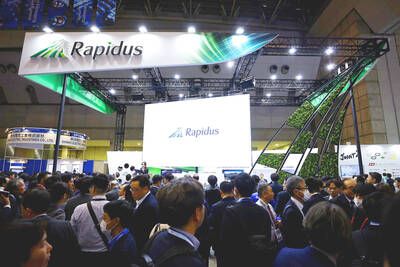
Japan approved ¥631.5 billion (US$3.97 billion) in additional subsidies to hasten Rapidus Corp’s entry into the high-stakes artificial intelligence (AI) chipmaking arena, ramping up support for a project widely regarded as a long shot. The capital is intended to bankroll Rapidus’ work for information technology firm Fujitsu Ltd, one of the initial customers that Tokyo hopes would get the signature endeavor off the ground. The new money raises the fees and investments that the government is injecting into the start-up to ¥2.6 trillion by the end of the current fiscal year to March next year, the Japanese Ministry of Economy, Trade and


 RSS
RSS