


Far EasTone Telecommunications Co (遠傳電信), the nation’s No. 3 telecom operator, yesterday launched an alliance to offer cellular-based 5G field trials for manufacturers in the autonomous vehicle supply chain in the first half of next year at the earliest.
The formation of the alliance is part of the telecom’s broader efforts to create a 5G ecosystem to accelerate uptake of the new technology after its commercialization, the company said.
Far EasTone is the nation’s first and sole telecom participating in the 5G Automotive Association (5GAA), giving it an advantage to share and offer the latest automotive applications, it said.
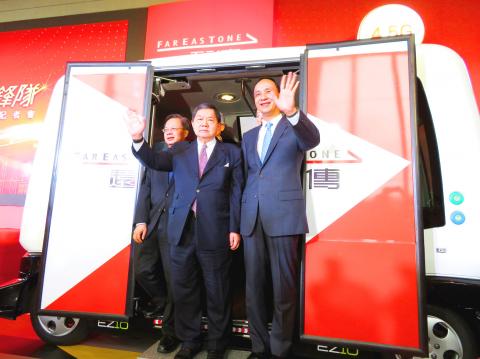
Photo: He Yu-hua, Taipei Times
The company plans to offer field trials at select sites, including Shalun (沙崙) in Tainan, Linkuo (林口) in New Taipei City and Hutou Mountain Park (虎頭山園區) in Taoyuan.
“The first field tests will be available in Shalun,” company president Yvonne Li (李彬) told reporters. “We are also considering adding [New Taipei City’s] Banciao (板橋) and Tamsui (淡水) to the field trial sites.”
About 26 companies have joined the alliance, including telecom equipment supplier Sercomm Corp (中磊), Alpha Networks Inc (明泰科技) and Gemtek Technology Co (正文科技).
Far EasTone is also developing applications related to smart city projects and medical care, Li said.
As the National Communications Commission has not finalized the timeframe for its 5G license auction, only saying that it would be held in 2020, Far EasTone expects to launch its 5G commercial services in the second half of 2020 at the earliest, Li said.
Far EasTone said it would prioritize populous cities when deploying its 5G network.
Fixed-wireless access might be among the first batch of 5G services offered, as global peer Verizon Inc has done, it said.
The availability of handsets remains crucial to the uptake of 5G services, given limited selections and high price tags, Li said.
The first 5G mobile phones are likely to become available in the first half of next year, but they would be pricey, she said.
As for pricing, Li said the company is not thinking of offering flat rates.

The EU and US are nearing an agreement to coordinate on producing and securing critical minerals, part of a push to break reliance on Chinese supplies. The potential deal would create incentives, such as minimum prices, that could advantage non-Chinese suppliers, according to a draft of an “action plan” seen by Bloomberg. The EU and US would also cooperate on standards, investments and joint projects, as well as coordinate on any supply disruptions by countries like China. The two sides are additionally seeking other “like-minded partners” to join a multicountry accord to help create these new critical mineral supply chains, which feed into

For weeks now, the global tech industry has been waiting for a major artificial intelligence (AI) launch from DeepSeek (深度求索), seen as a benchmark for China’s progress in the fast-moving field. More than a year has passed since the start-up put Chinese AI on the map in early last year with a low-cost chatbot that performed at a similar level to US rivals. However, despite reports and rumors about its imminent release, DeepSeek’s next-generation “V4” model is nowhere in sight. Speculation is also swirling over the geopolitical implications of which computer chips were chosen to train and power the new

Elon Musk’s lieutenants have reached out to chip industry suppliers, including Applied Materials Inc, Tokyo Electron Ltd and Lam Research Corp, for his envisioned Terafab, early steps in an audacious and likely arduous attempt to break into the production of cutting-edge chips. Staff working for the joint venture between Tesla Inc and Space Exploration Technologies Corp (SpaceX) have sought price quotes and delivery times for an array of chipmaking gear, people familiar with the matter said. In past weeks, they’ve contacted makers of photomasks, substrates, etchers, depositors, cleaning devices, testers and other tools, according to the people, who asked not to
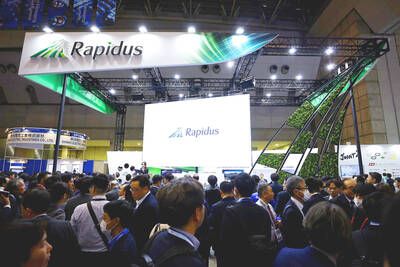
Japan approved ¥631.5 billion (US$3.97 billion) in additional subsidies to hasten Rapidus Corp’s entry into the high-stakes artificial intelligence (AI) chipmaking arena, ramping up support for a project widely regarded as a long shot. The capital is intended to bankroll Rapidus’ work for information technology firm Fujitsu Ltd, one of the initial customers that Tokyo hopes would get the signature endeavor off the ground. The new money raises the fees and investments that the government is injecting into the start-up to ¥2.6 trillion by the end of the current fiscal year to March next year, the Japanese Ministry of Economy, Trade and


 RSS
RSS